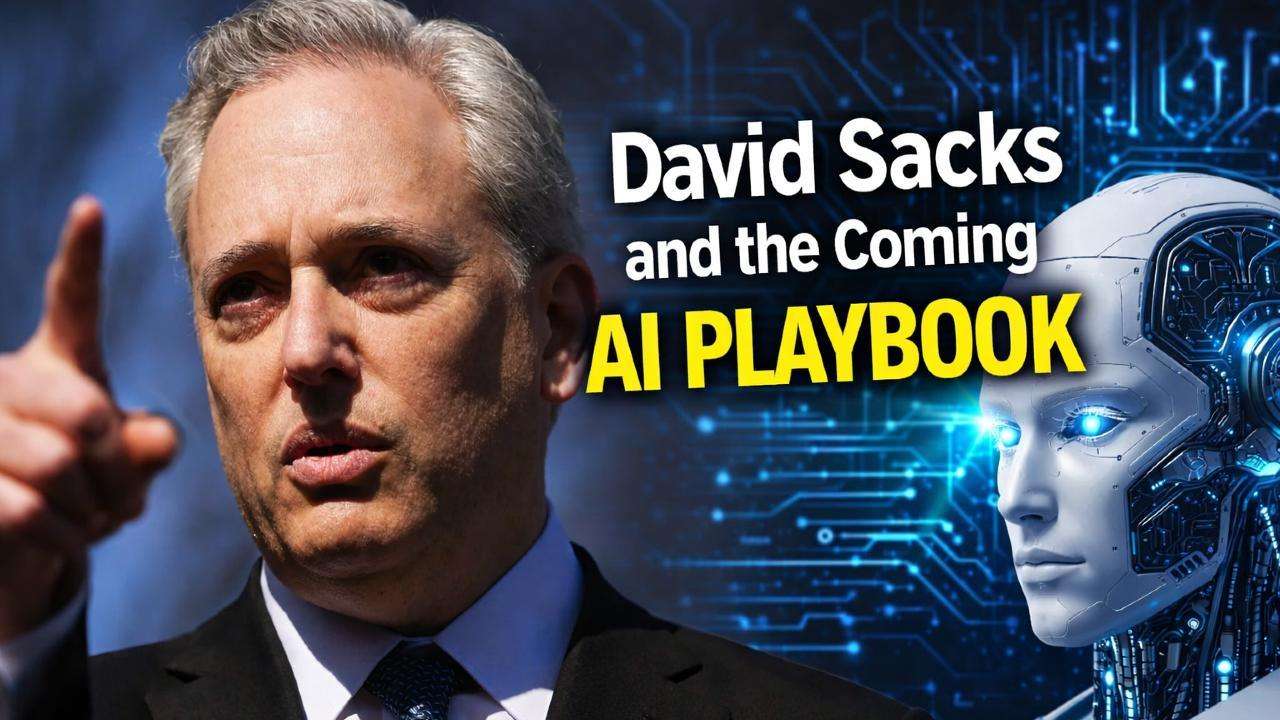
- David Sacks has officially ended his 130-day tenure as President Trump’s AI and crypto czar, a limit imposed by federal law on special government employees, and is transitioning to co-chair the President’s Council of Advisors on Science and Technology (PCAST).
- The White House confirmed it will not appoint a replacement AI czar, and Sacks will continue advising President Trump on artificial intelligence and technology policy from his new PCAST role.
- PCAST’s inaugural 13-member lineup reads like a Silicon Valley power summit, including NVIDIA’s Jensen Huang, Meta’s Mark Zuckerberg, Google co-founder Sergey Brin, Oracle’s Larry Ellison, AMD’s Lisa Su, Marc Andreessen, and early Coinbase backer Fred Ehrsam.
- During his czar tenure, Sacks advanced the stablecoin-focused GENIUS Act, supported a strategic bitcoin reserve, contributed to the Digital Assets Working Group report, and helped craft the Trump administration’s newly released national AI legislative framework.
- Sacks’ move raises legitimate structural questions, as PCAST is now composed almost entirely of CEOs from companies that stand to benefit directly from the federal AI and semiconductor policies the council will help shape.
- Earlier this month, Sacks publicly urged the Trump administration to pursue an exit from the U.S.-backed war with Iran on his “All In” podcast — comments he later distanced himself from — raising unanswered questions about whether the timing of his transition was entirely routine.
- In today’s episode of Economic Collapse Report, JD breaks down how Sacks and his team could be the difference makers in the current AI war.
David Sacks walked into the Trump White House last January as America’s first-ever AI and crypto czar, armed with a Silicon Valley network, a free-market philosophy, and a mandate to drag federal technology policy into the 21st century. Thirteen months later, he’s walking out of that specific role — not because he stumbled, not because he was pushed, but because federal law says 130 days is the limit for a special government employee, and he used every one of them. What he’s walking into is something arguably more consequential: co-chair of the President’s Council of Advisors on Science and Technology, a body that now reads less like a government committee and more like a who’s-who of the companies that are actively building the future.
Sacks confirmed the transition in an interview with Bloomberg Television on Thursday, March 26, stating plainly, “In the first year of the Trump administration, I had a role as a special government employee. I had 130 days. We’ve now used up that time.” He framed the move to PCAST not as a step back but as an expansion of scope. “I think moving forward as co-chair of PCAST, I can now make recommendations on not just AI but an expanded range of technology topics,” he said. “So yes, this is how I’ll be involved moving forward.”
Those words matter. The White House confirmed separately that it has no plans to appoint a new AI czar. Sacks will continue advising President Trump on artificial intelligence from his new perch. The title changes; the influence, according to those close to the matter, does not.
The roster Sacks is now co-chairing deserves more attention than it has received. President Trump announced the council’s initial 13 members just days before Sacks’ formal transition. The list includes NVIDIA CEO Jensen Huang, Meta founder Mark Zuckerberg, Google co-founder Sergey Brin, Oracle’s Larry Ellison and his executive vice chair Safra Catz, Dell founder Michael Dell, AMD CEO Lisa Su, Andreessen Horowitz co-founder Marc Andreessen, early Coinbase backer Fred Ehrsam, and UC Santa Barbara physicist John Martinis.
Sacks himself boasted to Bloomberg that PCAST has “the most star power of any group like this” ever assembled. That is not hyperbole. This is not the Biden administration’s council of Nobel laureates and MacArthur Fellows. It is the executive suite of the companies currently deciding what AI, semiconductors, and digital assets will look like for the next generation of Americans.
Sacks will co-chair the council alongside Michael Kratsios, the White House Office of Science and Technology Policy director who also served in Trump’s first term. PCAST was formally reestablished by executive order in January 2025 at the opening of Trump’s second term, with Sacks and Kratsios named co-chairs from the outset.
In his own announcement post on X, Sacks wrote: “PCAST is the principal body of external advisors tasked with shaping science, technology, and innovation policy for the President and the White House. Thirteen of the world’s most accomplished leaders in science and technology will join us as this PCAST’s initial members.”
He added that the council will focus on ensuring “America leads — and wins — in artificial intelligence and other cutting-edge technologies.”
During his 130-day stint as czar, Sacks logged a real policy record. He shepherded the administration’s early digital assets agenda, advanced the stablecoin-focused GENIUS Act through Congress, helped coordinate the administration’s position on the crypto market structure bill, contributed to the Digital Assets Working Group report, and backed the creation of a strategic bitcoin reserve.
Just last week, the Trump administration released its national AI legislative framework — a document Sacks helped shape — designed to establish uniform federal standards and replace what he described as “50 different states regulating this in 50 different ways,” a regulatory patchwork he argued makes compliance unreasonably burdensome for American innovators.
For observers wondering whether moving from czar to PCAST co-chair represents a genuine demotion, the historical record offers a nuanced answer. Advisory councils have varied wildly in their practical influence depending on the administration. Obama’s PCAST produced 36 reports over eight years, two of which led to concrete regulatory changes. Trump’s first-term version took nearly three years just to finalize its membership and left little lasting mark. Biden’s council skewed heavily academic.
But the current iteration is structurally unlike any of its predecessors. Previous councils typically featured a mix of university researchers and industry leaders; this one is built almost entirely from the CEO tier of the companies actively building and deploying the technologies the council is supposed to advise on. That composition is either a strength or a conflict of interest, depending on your perspective — and it is a question worth asking.
That question is not theoretical. During his time as czar, Sacks drew sustained criticism over the ethics waivers he obtained that allowed him to maintain financial stakes in AI and crypto companies while simultaneously shaping federal policy governing those same sectors. A White House memo disclosed in early 2025 that Sacks had sold more than $200 million in digital asset-related investments prior to his appointment. Critics argued the divestment was incomplete; supporters said it exceeded what was legally required.
Those tensions do not disappear when Sacks moves from czar to council co-chair. If anything, with PCAST populated by the CEOs of companies that stand to benefit enormously from favorable federal AI and semiconductor policy, the structural conflict is wider than it was before — even if the legal exposure is narrower.
There is also the matter of what was left unsaid during Thursday’s Bloomberg interview. Earlier this month, on the popular “All In” podcast that Sacks co-hosts, he publicly urged the Trump administration to pursue an exit from the U.S.-backed war with Iran, walking through a series of escalating scenarios involving oil infrastructure attacks, the destruction of desalination plants, and the possibility of nuclear deployment by Israel. President Trump responded by telling reporters that Sacks had not spoken to him personally about the conflict.
Asked about the episode on Thursday by Bloomberg, Sacks stepped back: “I’m not on the foreign policy team or the national security team,” he said, describing his podcast comments as a personal view rather than an official one. Whether those comments contributed to the timing of his transition out of the czar role is an open question the White House has not addressed.
The policy agenda Sacks is carrying into PCAST is substantive. He told Bloomberg the council will tackle advanced semiconductors, quantum computing, nuclear power, and AI infrastructure — and will direct near-term attention toward advancing the national AI framework released just last week. The framework’s core objective is federally preempting the web of state-level AI regulations that have proliferated over the past several years. That effort will require Congress to act, and it will require the kind of industry alignment that only a council of this particular membership could provide. Whether PCAST can deliver that, or whether it becomes another well-appointed advisory panel that produces reports and little else, remains to be seen.
What is clear is that David Sacks is not going home. The czar title is gone, but the mission — keeping the United States ahead of China in artificial intelligence, building out the infrastructure that makes American technological leadership durable, and ensuring the federal regulatory framework enables rather than strangles innovation — remains exactly what it was on day one. The president wants to keep the pedal down. Sacks intends to keep his foot on it. The only thing that changed on Thursday is the letterhead.