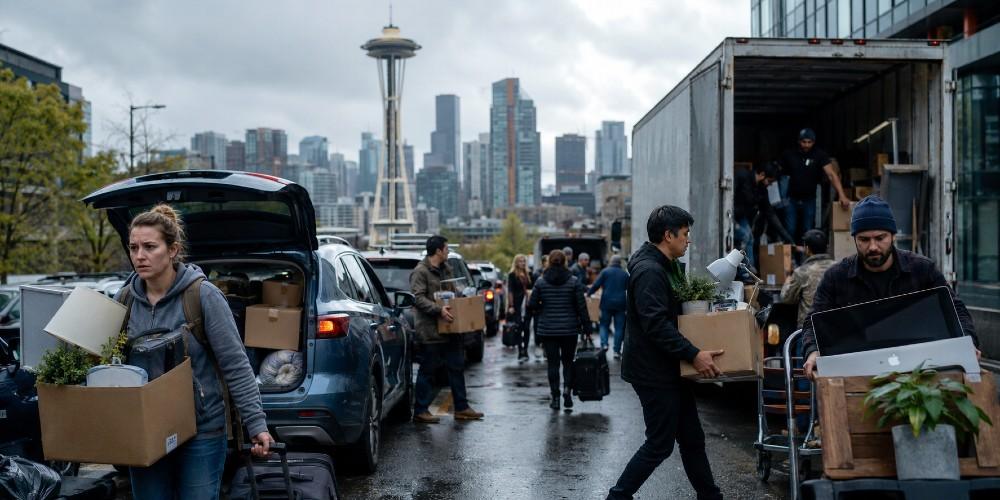
Seattle is becoming a case study in what happens when a city decides that wealth is something to be punished rather than cultivated. The for-sale signs are multiplying. Office towers sit half-empty. Iconic homegrown employers are quietly relocating jobs to states that still treat employers as something other than the enemy. And the political class running the city seems to think the cure for an exodus is more of whatever caused it.
The Northwest Multiple Listing Service reported active Washington listings surged 29.3 percent year over year in March, climbing to more than 15,000 homes, while closed sales rose just 0.2 percent. Median prices slipped 1.5 percent to $640,000, and the upper end of the market is bleeding far worse. Snohomish County inventory jumped 51.8 percent. San Juan County, where the median sale price hovers above $1 million, is now stacked with listings the wealthy buyers who used to absorb them are no longer interested in buying.
The much-publicized outflow of businesses and residents from Los Angeles and New York City is high, but Seattle’s numbers are worse. That gap between supply and demand is not a temporary blip caused by mortgage rates. It is a structural problem with a political signature, and the politicians responsible are still bragging about their handiwork.
The Tax Architecture That Built the Exit Ramp
Washington spent decades selling itself as a no-income-tax haven for builders, coders, and entrepreneurs. That pitch is gone. The state passed a 7 percent capital gains tax in 2021. Olympia layered a 9.9 percent income tax on earnings above $1 million on top of it this year. Lawmakers spent 2025 cranking the estate tax to the highest in the country at 35 percent before being forced to roll it back to 20 percent in 2026 because the wealthy were already heading for the door.
Seattle, not content with what the legislature had done, piled on its JumpStart payroll tax and a new 5 percent levy on salaries above $1 million paid by larger employers. The Tax Foundation ranked Washington 45th in its 2026 State Business Tax Climate Index before the income tax was bolted on. Florida, Texas, and Tennessee, all without state income taxes, are now actively recruiting the people Olympia keeps squeezing.
An Iconic Brand Picks Nashville
Starbucks is the company most closely associated with Seattle’s self-image as a creative, progressive, world-class metropolis. In April, it announced a $100 million corporate expansion in Nashville that will bring 2,000 jobs to Tennessee instead of Washington. Fox 13 reported the move could cost Seattle up to $750 million in tax revenue over the coming years.
Howard Schultz, the former Starbucks CEO who built the brand into a global juggernaut from a Pike Place storefront, announced his relocation to Miami the same day Washington Democrats approved the millionaires tax. Jeff Bezos left for Florida back in 2023 after the capital gains tax took effect. Boeing pulled up stakes years ago. Amazon has been quietly shifting thousands of jobs to Bellevue and other King County suburbs to escape the city’s payroll tax.
Nick Hanauer, the venture capitalist who personally funded much of Washington’s progressive tax framework, told GeekWire bluntly, Virtually every wealthy friend I have has either left or is planning to. It’s a catastrophe.
When the man who paid for the policy admits the policy is a disaster, that is not partisan spin. That is a confession.
The Mayor Waves Goodbye
Faced with this evidence, Seattle’s socialist mayor Katie Wilson decided the appropriate response was to mock the people leaving. At a Seattle University event in April, when a student asked whether she worried about wealth flight, Wilson laughed.
I think the claims that millionaires are going to leave our state are, like, super overblown. And the ones that leave, like, bye.
The crowd applauded. Within weeks, the Washington Post editorial board, hardly a conservative outfit, called Wilson’s posture arrogant and warned that her rhetoric was actively damaging the city. Even former Democratic state senator Reuven Carlyle pushed back, telling the Seattle Times, The language matters. Rhetoric matters. You’re going to wave goodbye to your hometown entrepreneurs? We can’t pretend that that rhetoric doesn’t have a serious impact.
Wilson’s first official act after winning the mayoralty last November was joining a picket line outside Starbucks and calling for a boycott of the company. Her opening message to Seattle’s most recognizable employer was that she did not want them around. They listened. Now she is exploring expanding the JumpStart payroll tax and creating a local capital gains tax on top of the state version, even as she admits she does not want to give companies an incentive to go over to Bellevue.
The Numbers Behind the Empty Storefronts
The collapse is no longer theoretical. Downtown Seattle’s office vacancy rate cleared 30 percent at the end of 2025, a record, and has continued climbing past 33 percent. The downtown core lost 13,000 jobs last year alone. More than 20,000 regional tech jobs have evaporated through layoffs at Microsoft, Amazon, Meta, and Oracle.
The Association of Washington Business’s winter 2026 employer survey found 24 percent of businesses are considering leaving the state, up from 17 percent the previous quarter. Fifty-five percent of surveyed business owners said they are considering moving their personal residence to another state. In Spokane County, that figure hits 67 percent. Two-thirds of business owners in a single Washington county actively planning their personal exit is not an outlier datapoint. That is a referendum.
Steven Bourassa, director of the Washington Center for Real Estate Research, summarized the housing dynamic with rare candor in the NWMLS report: Sellers have decided that they need to get on with their lives in spite of the fact that many would be giving up low-interest-rate mortgages. However, potential purchasers cannot afford to buy.
The Pattern That Progressives Cannot See
What is unfolding in Seattle is the same pattern that emptied parts of San Francisco, hollowed out portions of Chicago, and pushed Manhattan’s population to suburban Florida. Tax the productive, criminalize success, demonize employers, and insist with a smile that none of it will have consequences. Then act surprised when the consequences arrive on schedule.
The peculiar tell of progressive governance is its refusal to learn. Confronted with the predictable result of its policies, the political class reaches first for denial, then for mockery, then for more taxes. State Sen. Jamie Pedersen, the architect of the millionaires tax, told Fox 13 he sees no significant exodus
coming, even as Starbucks ships 2,000 jobs to Nashville and his own party rolled back the estate tax because the rich were leaving. The data does not match the narrative, so the narrative is restated more loudly.
There is something biblical in watching a city this committed to its own undoing. The wicked flee when no man pursueth, but the righteous are bold as a lion
goes the warning in the twenty-eighth chapter of Proverbs’ companion theme — and Galatians 6:7 puts it more sharply still. Be not deceived; God is not mocked, for whatsoever a man soweth, that shall he also reap.
Seattle has been sowing hostility toward the people who build, hire, and invest. It is now reaping a market in which homes will not sell, towers will not fill, and businesses will not stay.
What Happens to Cities That Stop Wanting Builders
The deeper question is not whether Seattle’s housing market recovers in 2027. It is whether a major American city can survive ideological capture by people who treat the productive class as an enemy to be punished rather than a community to be welcomed.
Cities are not abstractions. They are accumulated decisions by individuals about where to raise children, build companies, employ neighbors, and root themselves. When those individuals are told their success is a moral failing and their departure is a punchline, they do what reasonable people have always done. They go somewhere they are wanted. Nashville wants them. Miami wants them. Austin wants them. Seattle, evidently, does not.
The for-sale signs piling up across King and Snohomish counties are not a market quirk. They are a verdict. And the mayor laughing on the stage at Seattle University will not be the one paying the bill.