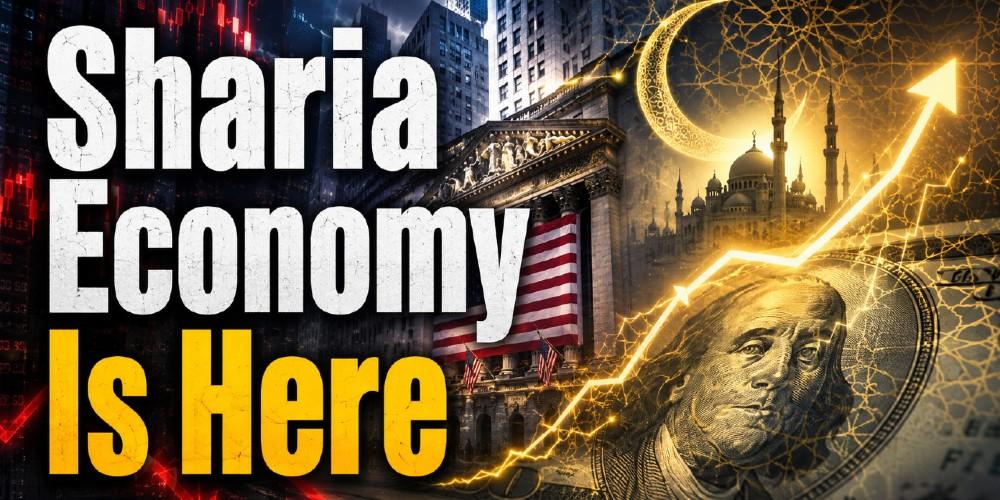
When the bond market opens each morning in lower Manhattan, no one ringing the bell is thinking about the seventh-century Arabian peninsula. Yet a small army of clerics, lobbyists, and shariah advisory boards has spent the better part of two decades quietly bending portions of America’s financial machinery to conform to Islamic religious law — and they are succeeding with the active cooperation of the largest names on Wall Street and the federal agencies that regulate them.
A new investigation by veteran reporter Paul Sperry at RealClearInvestigations lays out the architecture of what critics have long described as a parallel financial system operating inside the United States. The story is not that observant Muslims wish to invest according to their conscience. The story is that some of America’s most powerful banks, two government-sponsored enterprises holding trillions of dollars in mortgage paper, and federal regulators at Treasury and the SEC have all agreed to play along — without the public ever being asked whether religious law from abroad should be reshaping how American capital moves.
The implications run far deeper than a niche product line aimed at a particular faith community. They touch on national security, on the integrity of the country’s mortgage system, and on a question the political class would rather not address: when does religious accommodation stop being accommodation and start becoming the slow installation of a competing legal order?
- Major U.S. banks including JPMorgan Chase, Goldman Sachs, Morgan Stanley, Wells Fargo, Bank of America, Citicorp, and Merrill Lynch now offer shariah-compliant financial products structured around Islamic religious rulings.
- The Fiqh Council of North America issues fatwas dictating which American companies Muslim investors may hold, blacklisting U.S. aerospace and defense firms, conventional banks, entertainment companies, and any business with ties to Israel.
- Fannie Mae and Freddie Mac, under the Federal Housing Finance Agency, have been purchasing Islamic mortgages since the early 2000s and now serve as the primary investors backing the U.S. halal home-finance market.
- Amana Mutual Funds Trust, with $6.4 billion under management and large stakes in Google, Apple, NVIDIA, and Microsoft, was established by groups the Justice Department has identified as connected to the Muslim Brotherhood.
- The Center for Security Policy and the Thomas More Law Center argue that shariah-compliant finance can route capital, through mandatory religious tithing, to charities tied to terror-supporting organizations.
- Global Islamic finance is now nearly a $6 trillion industry, with the projected North American market valued at more than $1 trillion.
- National security analysts warn that activist Islamic investors could use accumulated equity stakes to pressure American companies into boycotts of Israel and other policy concessions.
- Britain, which began accommodating shariah finance earlier and more aggressively, recently dropped interest charges on government student loans for Muslim students and has issued sovereign sukuk bonds.
What Shariah-Compliant Finance Actually Means
The basic premise sounds harmless enough. Observant Muslims regard the charging or earning of interest, called riba, as forbidden. So a parallel set of financial instruments has been engineered to mimic the function of conventional loans, mortgages, and investment vehicles without technically involving interest.
A bank buys the house and sells it back to the buyer at a marked-up price paid over time. A fund holds equities, but only those that pass a religious screen. Bonds become sukuk, structured as asset-backed certificates rather than debt instruments.
The screening, however, is not a private matter between believer and conscience. It is administered by clerical bodies. In North America, the Fiqh Council of North America issues binding rulings that determine which companies are halal (permissible) and which are haram (forbidden). Per the Council’s published guidance,
Muslims are barred from investing in firms whose interest-bearing debt exceeds 30 percent of market capitalization. They are barred from holding stock in the U.S. aerospace and defense industry — meaning the very companies that build the weapons defending the country housing them. They are barred from conventional banking, entertainment, alcohol, pork, gambling — and from any company that does business with Israel.
That last item is not a footnote. It is the point at which a religious investment philosophy quietly converts into a geopolitical instrument.
The Fannie and Freddie Problem
Beginning in 2001 and 2003, Freddie Mac and Fannie Mae started purchasing Islamic mortgage products on the secondary market. Under the conservatorship of the Federal Housing Finance Agency, the two enterprises — which exist because the American taxpayer ultimately stands behind them — have grown into the principal buyers of halal mortgages in the country.
That arrangement carries a quiet philosophical concession. Fannie and Freddie were chartered to support the American homeownership system, an interest-based credit market governed by federal banking law and consumer protection statutes such as the Truth in Lending Act and the Real Estate Settlement Procedures Act. To make halal mortgages “fit,” regulators ruled that murabaha and ijara contracts function as the equivalent of secured real estate lending. The legal fiction works. But it works by quietly conceding that an alternative religious framework deserves federal accommodation alongside the country’s general law of contract.
No equivalent accommodation exists, of course, for any other religious community. There is no government-backed Mennonite mortgage product, no Hasidic alternative purchased in bulk by Freddie Mac, no Amish liquidity facility. Only one faith has been granted the privilege of having America’s mortgage infrastructure restructured around its doctrinal preferences.
The Muslim Brotherhood Mutual Fund
The most striking detail in Sperry’s investigation involves Amana Mutual Funds Trust. With $6.4 billion in assets, Amana holds significant positions in Google, Apple, NVIDIA, and Microsoft — companies whose decisions shape the digital lives of every American. The fund was established, as Sperry notes citing federal records, by groups the Department of Justice has identified as part of the Muslim Brotherhood network in North America.
That is not a fringe claim. The Justice Department’s Holy Land Foundation prosecution, the largest terrorism-financing case in U.S. history, produced a federal exhibit list naming a series of North American Islamic organizations as Brotherhood-affiliated. The Brotherhood itself, in an internal document obtained during that investigation, described its long-term work in the United States as “a kind of grand jihad in eliminating and destroying the Western civilization from within.”
After the most recent Israeli-Gaza war, Amana’s investors began pressuring Microsoft and Google to stop providing technical services to the Israeli military. This is what corporate activism looks like when religious doctrine and political objective become indistinguishable: shareholders demanding that American technology companies cut off an American ally engaged in a war against U.S.-designated terrorists.
“Economic Jihad” or Just Another ESG?
Defenders of shariah-compliant finance frequently make a clever comparison. If progressives can engineer “Environmental, Social, and Governance” funds that exclude oil, firearms, and tobacco, why can’t Muslims build investment vehicles that exclude pork, alcohol, and conventional banking? Are not both simply expressions of value-driven capital?
The comparison is glib, and it falls apart on inspection. ESG funds, whatever their merits or excesses, do not require religious tithing to charitable bodies under doctrinal supervision. They do not blacklist defense contractors as a matter of theological law. They do not categorically forbid investment in an allied nation. And they are not certified by clerical boards whose rulings double as instructions on what counts as religious obligation.
The Center for Security Policy, which has been sounding warnings about shariah-compliant finance for nearly two decades, describes the system more bluntly. Its analysts argue the entire enterprise functions as a Trojan horse — a mechanism for legitimating shariah law inside Western jurisdictions by embedding it first in the seemingly neutral plumbing of finance. Once a bank accepts shariah boards as legitimate advisors, the principle that religious law from abroad should govern segments of American commerce has been quietly conceded.
Patrick Sookhdeo, the London-based scholar Sperry quotes, calls it “economic jihad — a key and integrated part of the larger civilizational jihad.” That phrasing will be dismissed in respectable quarters as alarmist. But the British example is not theoretical. The United Kingdom now hosts a $9 billion Islamic finance market, has issued sovereign sukuk bonds, and recently abolished interest on government-issued student loans for Muslim students. London is showing what the destination looks like when accommodation runs unchecked for a generation.
The Tithing Problem
The most concrete national-security objection involves the obligation of zakat. Shariah requires that investment proceeds be “purified” by donating a portion to approved Islamic charities. The trouble is that several prominent American Islamic charities have, over the past two decades, been shut down, prosecuted, or named in court documents for funneling money to Hamas and other designated terrorist organizations. The Holy Land Foundation case alone resulted in convictions for funding $12 million to Hamas. Other organizations have faced similar federal scrutiny.
The Thomas More Law Center has sued federal regulators over precisely this issue, arguing that by permitting financial giants to promote shariah-compliant finance, the government is enabling a religiously laundered channel through which capital can flow to organizations hostile to the United States. The Center for Security Policy frames the same problem in starker terms — that the system “amounts to a way to dress up substantial opportunities for illegal material support for terror as a protected religious practice of tithing.”
Reasonable observers can argue about how often that risk materializes in practice. But “rarely” is not the same as “never,” and a financial system that creates structural pathways for terror financing is not a system whose design choices should be made in the back offices of Goldman Sachs.
The Question No One Is Asking
The growth projections are sobering. Global Islamic finance approaches $6 trillion. The North American market is valued above $1 trillion in potential. The Muslim population in the United States is projected by the Federal Reserve to grow at roughly twice the rate of the non-Muslim population through 2030. Wall Street sees market share. Federal regulators see compliant accommodation. National-security analysts see leverage being accumulated by activist investors who answer to clerics rather than to fiduciary duty as ordinarily understood.
And the American public, by and large, has never been told any of this is happening. There has been no congressional debate, no public hearing of consequence, no national conversation about whether the financial infrastructure undergirding mortgages, retirement accounts, and corporate equity should accommodate a religious legal system whose stated objective is its own universalization.
Scripture is candid about the danger of letting wealth become the master rather than the servant. “For the love of money is the root of all evil, which while some coveted after, they have erred from the faith, and pierced themselves through with many sorrows” (1 Timothy 6:10). Wall Street’s love of the next trillion-dollar market is, in this case, opening doors that may prove very hard to close. The banks are not motivated by ideology. They are motivated by fees. But the doctrine arrives anyway, riding shotgun with the capital, certified by clerical boards, and stamped with the quiet approval of federal regulators who have decided not to look too closely.
What Accommodation Costs
America’s tradition of religious liberty has always been generous, and rightly so. The Constitution’s free exercise clause protects the right of Muslims, like every other religious community, to live according to conscience. But there is a meaningful difference between protecting individual practice and conscripting public infrastructure — federally backed mortgage giants, SEC-regulated investment vehicles, and the largest banks in the country — into the service of a particular religious code.
That difference is the one Britain failed to recognize early enough. It is the one America’s regulators, lobbied by Muslim advocacy groups and lubricated by Wall Street’s appetite for new clients, are now in the process of failing to recognize as well. The Federalist Papers warned about gradual encroachments. So did the prophets. “Woe unto them that call evil good, and good evil; that put darkness for light, and light for darkness” (Isaiah 5:20). What is being sold as inclusion is, on inspection, something more structural — a slow rewriting of the rules of commerce to suit a worldview that does not share America’s foundational assumptions about liberty, equal treatment under one law, or the proper limits of religion in public finance.
The honest question is not whether Muslims may invest. They may, and they should be free to do so according to their conscience. The honest question is whether the United States government, the conservators of Fannie and Freddie, the SEC, the Treasury, and the boardrooms of America’s largest banks have any business restructuring the country’s financial architecture to make that conscience the operative governing principle for trillions of dollars in American capital. The answer, once stated plainly, ought to be obvious.
It is the failure to state it plainly that has allowed the question to go this long unasked.