The weapons seized Sunday during the raid that killed Nemesio “El Mencho” Oseguera Cervantes were not the tools of street-level drug dealers. They were rocket launchers — the kind capable of downing aircraft and punching through armored plating. That distinction matters, and it should alarm every American paying attention to what is happening on the other side of a border that is, in many places, barely a fence.
Mexican Special Forces, supported by Air Force aircraft, National Guard rapid-reaction units, and complementary intelligence provided by U.S. authorities, descended on Tapalpa, in the state of Jalisco, on Sunday morning. The operation targeted Oseguera Cervantes, the founder and leader of the Cartel Jalisco Nueva Generación — better known by its Spanish acronym, CJNG. He was wounded in a firefight, evacuated, and died en route to Mexico City. Four others were killed at the scene. Two additional cartel members were taken into custody. Three Mexican soldiers were wounded.
What the raid left behind in seized equipment told its own story. Armored vehicles. And those rocket launchers — anti-aircraft capable, anti-armor capable — recovered from a criminal organization that is technically classified as a drug trafficking outfit but has, for years, operated more like a standing army.
Oseguera Cervantes was not some anonymous crime boss. He was one of the most wanted men in the Western Hemisphere. The U.S. government had placed a $15 million bounty on his head. He was a former police officer who, after the arrest of Sinaloa Cartel boss Joaquín “El Chapo” Guzmán left a power vacuum, moved aggressively to fill it. Over roughly fifteen years, CJNG grew from a regional criminal enterprise centered in Jalisco into a global fentanyl trafficking network with tentacles extending into communities across the United States. The fentanyl flowing across the southern border — the same fentanyl that killed over 70,000 Americans in a single recent year — ran in significant part through CJNG’s operation.
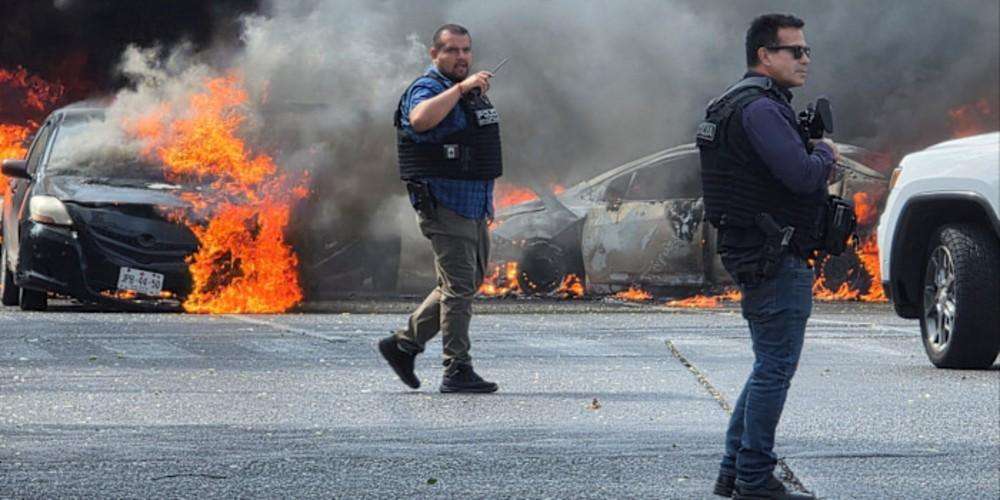
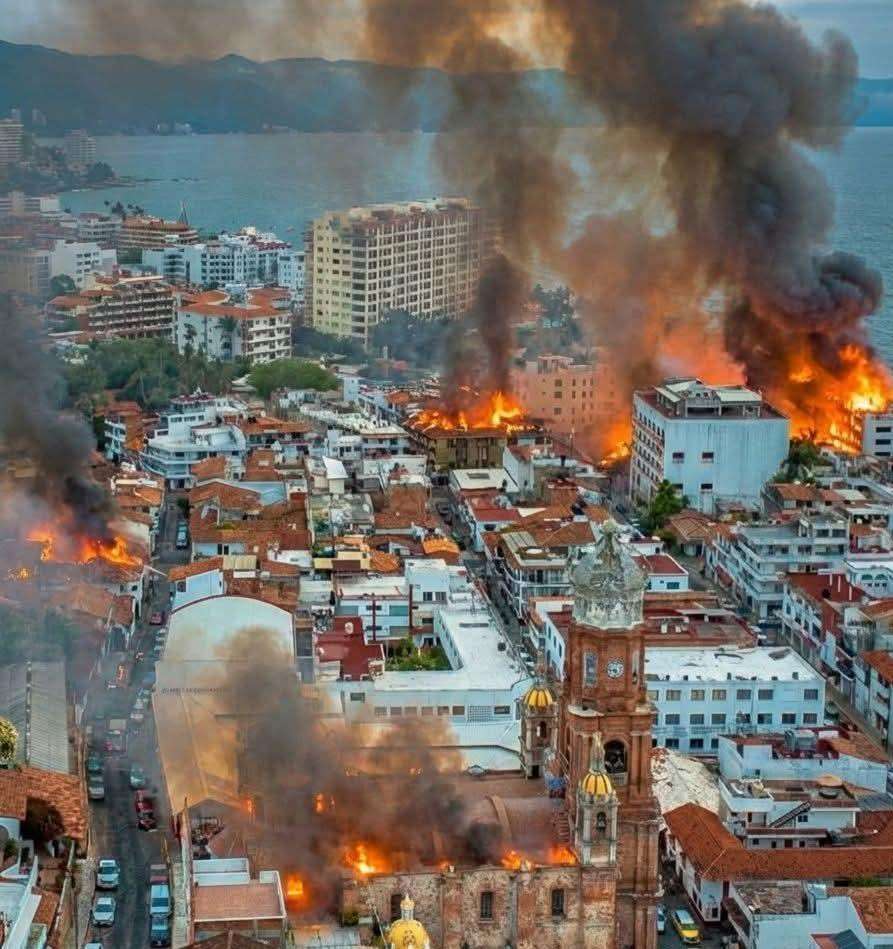
The response to his death was immediate and violent. Within hours of the announcement, CJNG loyalists began blocking highways across multiple Mexican states. Vehicles were set ablaze and used as barricades. At least 21 major roads were blocked, five of which authorities managed to reopen by Sunday evening. Roughly twenty branches of Banco del Bienestar, a state-run banking institution, were reportedly damaged during the wave of unrest. Smoke could be seen rising over Puerto Vallarta, a tourist destination on Mexico’s Pacific coast in Jalisco, visible from the city’s beaches. The U.S. Embassy issued shelter-in-place advisories covering Jalisco — including Guadalajara and Chapala — along with parts of Tamaulipas, Michoacán, Guerrero, and Nuevo León.
Jalisco Governor Pablo Lemus Navarro did not mince his public statements. “We remain in Code Red. We reiterate the recommendation to avoid leaving your homes. The clashes are occurring in several federal entities,” he said.
U.S. Deputy Secretary of State Christopher Landau weighed in on X, framing the moment as a victory in plain terms. “I’ve just been informed that Mexican security forces have killed ‘El Mencho,’ one of the bloodiest and most ruthless drug kingpins,” he wrote. “This is a great development for Mexico, the US, Latin America, and the world. The good guys are stronger than the bad guys.”
Hours later, as footage of burning buses and blocked highways spread across social media, Landau returned: “I’m watching the scenes of violence from Mexico with great sadness and concern. It’s not surprising that the bad guys are responding with terror. But we must never lose our nerve.”
The killing of El Mencho is a genuine achievement — the result of sustained U.S. pressure on Mexican President Claudia Sheinbaum’s government, bilateral intelligence cooperation, and a military operation that required aircraft, Special Forces, and significant firepower to execute. It is also a reminder of what CJNG actually is. This is a cartel that in 2015 used rocket-propelled grenades to shoot down a Mexican military helicopter in Jalisco. That was not a fluke or an aberration. It was a declaration. A criminal organization announcing to the Mexican government — and to the world — that it possessed the means and the willingness to engage the armed forces of a sovereign nation in direct combat.
The seizure of aircraft-capable rocket launchers during Sunday’s raid confirms that CJNG maintained and expanded that capability. These weapons did not appear from nowhere. They were procured, transported, and stockpiled. They were part of a deliberate arsenal.
Local police in most of Mexico’s affected states are not equipped, trained, or institutionally capable of confronting an organization armed at this level. The operation that killed Oseguera Cervantes required the Mexican military, Air Force, and National Guard working in coordination with American intelligence — and it still produced three wounded soldiers and triggered a national wave of cartel retaliation. That is the landscape. Not a crime problem. A war.
The question that follows — the one that tends to make diplomatic officials uncomfortable — is what happens next. The decapitation of a cartel leadership structure does not automatically dissolve the organization. The history of Mexican drug enforcement offers sobering precedent. El Chapo’s arrest and extradition to the United States contributed to the fragmentation of the Sinaloa Cartel and, arguably, to the subsequent explosion of violence as successor factions battled for territory.
CJNG, for its part, rose to prominence in the power vacuum left behind. What emerges from Sunday’s events remains to be seen. CJNG’s operational commanders, financial networks, weapons caches, and trafficking routes did not die with its founder. The cartel has lieutenants, it has infrastructure, and it has demonstrated within hours of El Mencho’s death that it retains the capacity to mobilize and cause chaos across multiple Mexican states simultaneously.
What is clear is that the weapons seized in Jalisco on Sunday represent a threshold that polite conversations about border security and drug enforcement consistently fail to acknowledge. The CJNG is not a law enforcement problem. It is a paramilitary force embedded inside a neighboring country, armed with anti-aircraft rockets, armored vehicles, and the organizational capacity to shut down highways and burn government-affiliated institutions in coordinated response to a single military operation.
The fentanyl it produced killed tens of thousands of Americans. The violence it generates has made entire regions of Mexico ungovernable. And it took the combined assets of two nations’ intelligence and military resources to reach the man who built it.
Killing El Mencho was necessary. Whether it proves sufficient — whether what comes next is a weakened cartel or a succession war that spreads chaos — will determine whether Sunday’s operation was a turning point or just an expensive afternoon in a conflict that has been grinding for decades.