There is a particular kind of political argument that does not need to be made in words, because it is already being made in moving vans. The great internal migration of the last decade — capital, companies, and citizens flowing out of New York, California, and Illinois into the states of the American Southeast — is not a trend. It is a verdict. And it is one that the governing class of the blue-state corridor has spent years refusing to read.
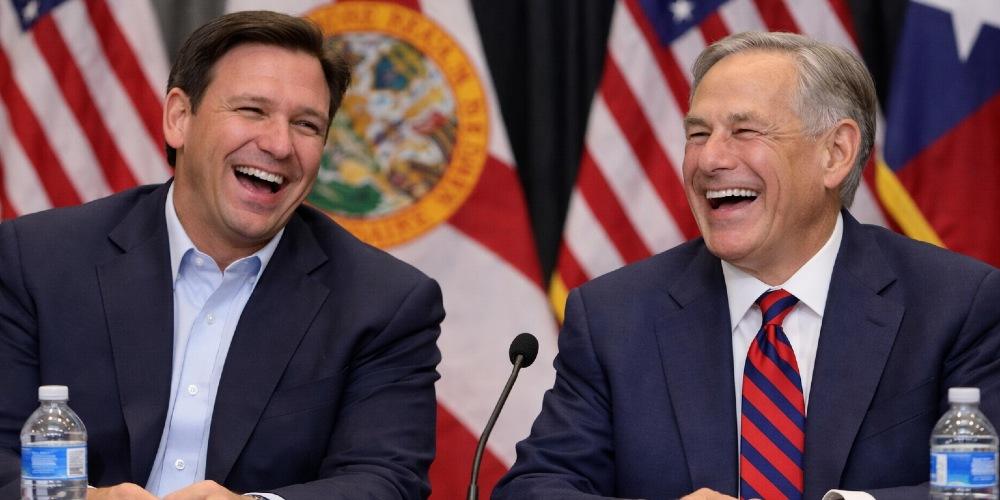
The occasion for revisiting this verdict came Tuesday in Miami, where Florida Gov. Ron DeSantis and Texas Gov. Greg Abbott convened a summit to celebrate what they are calling the “Boom Belt” — eleven southeastern states that together now generate $9 trillion in annual GDP. That figure, if the region were a nation, would make it the third-largest economy on earth, trailing only the United States as a whole and China. The 11-state grouping — Alabama, Arkansas, Florida, Georgia, Louisiana, Mississippi, North Carolina, Oklahoma, South Carolina, Tennessee, and Texas — has absorbed 70% of all U.S. population growth over the last five years. Seventy percent. That is not a trend line. That is a rout.
The instinct of progressive commentators will be to dismiss all of this as governor-speak, a political rally dressed in economic clothing. That interpretation would be wrong, and the reasons it is wrong go to the heart of what conservative governance actually means in practice.
DeSantis made the point plainly: “I often tell people, as Governor of Florida, my job is to closely follow California, Illinois, New York, so I can do precisely the opposite of what they do.” This is sometimes read as a partisan quip. It is better understood as a governing philosophy — one grounded in the observable consequences of policy rather than its stated intentions. The progressive coalition has had decades to prove that high taxation, expansive regulation, and hostility to private enterprise produce broadly shared prosperity. The migration data is their report card.
Abbott, for his part, offered something more durable than a campaign line. Texas, he noted, has made income taxes, wealth taxes, death taxes, and transactions taxes constitutionally prohibited — not merely legislatively discouraged, but structurally foreclosed from future legislatures who might be tempted by the sirens of redistribution. This is conservatism doing what it must do at its best: not merely winning elections, but locking in the conditions of freedom against the erosion of time and political fashion. Burke would have recognized the instinct. The constitution of liberty, as Hayek understood it, is most secure when it is insulated from the momentary will of temporary majorities.
The presence of SEC Chairman Paul Atkins at the Miami summit was worth noting for its own reasons. Atkins warned that the United States has lost half of its public companies over the last thirty years because federal policy made it “complicated, expensive and legally treacherous” to go public. This is a significant admission from a sitting federal regulator, and it is one the financial press has largely failed to reckon with. The decline of American public markets is not an accident of technology or global competition. It is the predictable consequence of a regulatory apparatus that treated every company as a potential defendant and every investor as a ward of the state. Private markets became, as TXSE CEO Jim Lee put it, “the only rational choice” — not because private markets were so attractive, but because public markets had been made so punishing. That is not capitalism working. That is capitalism working around its own government.
The deeper argument here is one about the nature of competition itself. Federalism was always designed to allow states to function as laboratories — testing different arrangements and allowing citizens to sort themselves accordingly. The founders did not envision this as chaos. They envisioned it as wisdom. When free people can move, and when their movement carries their tax base with it, the discipline of exit is brought to bear on the behavior of governments. California and New York have responded to this discipline by proposing new exit taxes and wealth levies designed to follow citizens who leave — a tacit confession that they cannot compete for residents on the merits, only retain them through coercion. DeSantis drew the connection directly to the founding: the fathers wanted a system of consent, a rule of law, and protections for private property that could not be subjected to the whims of the powerful. An exit tax is precisely such a whim.
Jim Esposito of Citadel Securities, whose firm relocated from Chicago to Miami, offered a formulation that should be taken seriously by anyone who thinks seriously about economic governance: “Across Florida, Texas and other high-growth states, government officials have created environments where businesses can operate, invest. And importantly, grow with confidence.” Confidence is the operative word. It is not a soft sentiment. It is the precondition of investment, and investment is the precondition of employment, and employment is the precondition of every social good that progressive governments claim to want and consistently fail to produce. The Boom Belt is not winning because its governors have better slogans. It is winning because businesses and families have concluded, rationally, that they can plan their futures there without fear that the rules will change beneath them.
The iron curtain the Fox Business headline invokes is meant as provocation, and it is one. But the metaphor contains a real insight. Behind the old Iron Curtain, people moved not because the East was attractive but because the West was free. What is happening across America’s internal geography is not identical, but it rhymes. People are not moving to Florida and Texas because those states are perfect. They are moving because the alternative — a regulatory, tax, and cultural environment that treats private success as a public problem — has become genuinely intolerable for anyone with the means to leave.
The question this raises for the governing class of the American left is the same one that any institution must eventually answer when it begins losing its people: not “how do we stop them from leaving?” but “why are they leaving?” The moving vans know the answer. The data knows the answer. Whether the governors of California and New York are capable of hearing it is the more uncertain question — and, given recent proposals, a question to which the early evidence is not encouraging.
For if a man will not be persuaded by reason, he may yet be persuaded by consequences. And the consequences of a generation of progressive governance are now large enough, and documented enough, to constitute proof. Proficiscere quo te vocat virtus — depart whither virtue calls. Americans are departing. Where they are going tells you everything.