There is a particular kind of audacity required to fund a fire, then sell buckets. That, in essence, is what a federal grand jury in Montgomery, Alabama, has accused the Southern Poverty Law Center of doing — and if the indictment holds, it may force a reckoning with one of the most consequential political narratives of the last decade.
On Tuesday, the Department of Justice charged the SPLC with eleven counts of wire fraud, bank fraud, and conspiracy to commit money laundering. The allegation at the center of it all: the organization secretly funneled more than $3 million in donor money — money given explicitly to fight white supremacy — to actual members of the Ku Klux Klan, the Aryan Nations, the National Socialist Party (NAZI), and others. But buried inside that indictment is a detail that dwarfs the financial crimes.
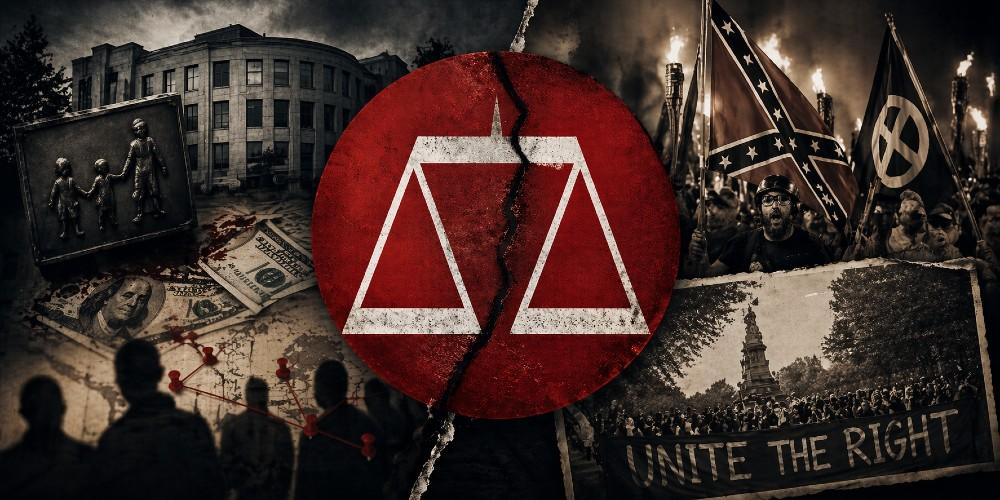
One SPLC-paid operative, known only as “Field Source 37,” was a member of the online leadership group that planned the 2017 “Unite the Right” rally in Charlottesville, Virginia. He attended the rally at the SPLC’s direction. He made racist postings under SPLC supervision. He helped coordinate transportation for attendees. For his services, he was paid $270,000 over eight years.
Let that sit for a moment. The rally that liberals spent years holding up as proof that American conservatism was indistinguishable from Nazism — the event that launched a presidency, restructured the media landscape, justified mass corporate censorship of the right, and provided the emotional core of Joe Biden’s entire 2020 campaign — had a paid operative of a left-wing nonprofit organizing it.
The prophet Isaiah understood this dynamic long before the age of nonprofit grift. “Woe unto them that call evil good, and good evil; that put darkness for light, and light for darkness.” The SPLC built an empire doing exactly that — and according to federal prosecutors, it was doing so with money it told donors would be used for the opposite purpose.
The Most Profitable Rally in American Political History
To understand what was really at stake in Charlottesville, you have to follow the money — not the $270,000 paid to FS-37, but the tidal wave that came back the other direction. According to the SPLC’s own tax filings, the organization collected roughly $50 million in donations in 2016. In the fiscal year ending October 2017 — the period bookended by the Charlottesville rally — that number exploded to $132 million.
Donations had never previously exceeded $50 million in a single year. They have not fallen below $97 million since. The organization, already sitting on a half-billion-dollar endowment, received an infusion of celebrity and corporate cash that reads like a who’s who of progressive America.
Apple CEO Tim Cook announced a $1 million gift, saying “hate is a cancer.” JP Morgan Chase pledged another $500,000. George and Amal Clooney wrote a check for $1 million, declaring that “what happened in Charlottesville demands our collective engagement.” None of these donors knew, apparently, that an SPLC-paid operative had helped make the event happen.
This is what Acting Attorney General Todd Blanche meant when he said the SPLC was “manufacturing the extremism it purports to oppose.” The indictment states that the SPLC’s paid informants “engaged in the active promotion of racist groups at the same time that the SPLC was denouncing the same groups on its website.”
The scheme required fictitious shell companies — Fox Photography, Rare Books Warehouse, Center Investigative Agency — through which prepaid debit cards were loaded and handed off to Klansmen and neo-Nazis. The deception was not incidental. It was structural.
The Narrative That Built a Presidency
The political returns on Charlottesville dwarfed even the financial ones. The rally became the single most weaponized event in modern American political history — and its utility to the left depended entirely on a lie. When President Trump said there were “very fine people on both sides,” he was explicitly referring to those on both sides of the Confederate statue debate, and he explicitly condemned the neo-Nazis.
The transcript has always been available. It has never been ambiguous. In 2024, even the left-leaning fact-checker Snopes was forced to concede the claim was false, ruling that Trump had not called neo-Nazis “very fine people.” Yet for years, that fabrication was treated as established fact by every major media institution in the country.
Joe Biden built his entire candidacy on it. The first word of his 2020 presidential campaign announcement video was “Charlottesville.” He looked into the camera and described “crazed faces illuminated by torches, veins bulging and bearing the fangs of racism,” then accused Trump of having assigned “a moral equivalence between those spreading hate and those with the courage to stand against it.”
He said that moment was when he knew “the threat to this nation was unlike any I had ever seen in my lifetime.” It propelled him to the White House. The SPLC’s hate map provided the media the academic scaffolding for years of related coverage — with one study finding that 20 to 25 percent of all major analytical pieces on the Unite the Right rally either cited SPLC data or quoted SPLC leadership directly. The New York Times. The Washington Post. USA Today. All of them laundering the SPLC’s moral authority onto their front pages while an SPLC-paid operative had helped bus people to the event.
A Machine With a Method
None of this happened in isolation. The SPLC’s hate map was never really about hate. It was about power — specifically, the power to define who was acceptable in American public life and who was not. The list of organizations the SPLC branded as hate groups reads like a directory of mainstream Christian and conservative America.
The Family Research Council. Focus on the Family. Alliance Defending Freedom. The Catholic Medical Association. The Ethics and Religious Liberty Commission. Franklin Graham. The Homeschool Legal Defense Association. PragerU. These were not fringe operations. They were — and are — respected institutions with millions of members. Placing them alongside the Klan was a deliberate act of political warfare dressed up as civic service.
The consequences were real and, in at least one case, deadly. In 2012, a gunman walked into the Family Research Council’s Washington headquarters and opened fire, wounding a security guard before being subdued. The shooter told investigators he had used the SPLC’s hate map to identify his target.
That case did not slow the SPLC down. Nor did it prompt the media organizations, corporations, and federal agencies that relied on SPLC designations to reconsider their partnership. Tech platforms used the hate map to justify deplatforming. Banks used it to justify defunding. The FBI used it for over a decade to identify “domestic extremists” — a category that expanded, under the Biden administration, to include traditional Catholics. A Senate investigation later found at least thirteen FBI documents that relied on SPLC data to designate Catholics as potential domestic threats, with one FBI agent acknowledging internally that the “overreliance on the SPLC for hate designation is… problematic.”
Charlie Kirk saw all of this clearly. When the SPLC placed Turning Point USA on its hate map in early 2025, Kirk went on television and warned explicitly that the designation would put his organization “in the crosshairs” — citing the 2012 FRC shooting as proof of what SPLC listings could inspire. Months later, he was assassinated on a college campus in Utah.
The day before he died, the SPLC published a Hatewatch article smearing him under the tag “Dismantling White Supremacy.” The article remained live for days after his murder. When his colleagues later testified before the House Judiciary Subcommittee, TPUSA’s Andrew Sypher said Kirk’s warning had “proved prophetic.”
The Accountability the Media Won’t Demand
The SPLC’s interim CEO Bryan Fair called the federal charges “false allegations,” insisting the informant program “saved lives” and that the organization “will not be intimidated.” He is entitled to his defense in a court of law. But there is a separate court — the court of historical accountability — where the SPLC’s record has already been entered into evidence, and it is damning regardless of how the criminal trial concludes.
The question the media will not ask is the one most worth asking: how many institutions, journalists, corporations, and government agencies spent years amplifying an organization’s moral authority — using that authority to silence, defund, and defame millions of Americans — without ever once asking whether the authority was earned?
The SPLC raised $132 million in a single year on the back of a rally that its own paid operative helped organize. It then used that money and that moral prestige to label Christian ministries as hate groups, to feed the FBI bad intelligence about Catholics, and to build a targeting list that a gunman once used to find a victim. The “very fine people” hoax, constructed largely atop SPLC’s narrative infrastructure, launched a presidency. None of the journalists who repeated that hoax for years have been asked to answer for it.
The return on investment, it turns out, was incalculable — in both directions. The SPLC extracted enormous financial and political capital from the wreckage of Charlottesville. And the cost to the truth, to the Americans falsely branded as extremists, and to the basic integrity of public discourse, is a debt that no indictment can fully repay.