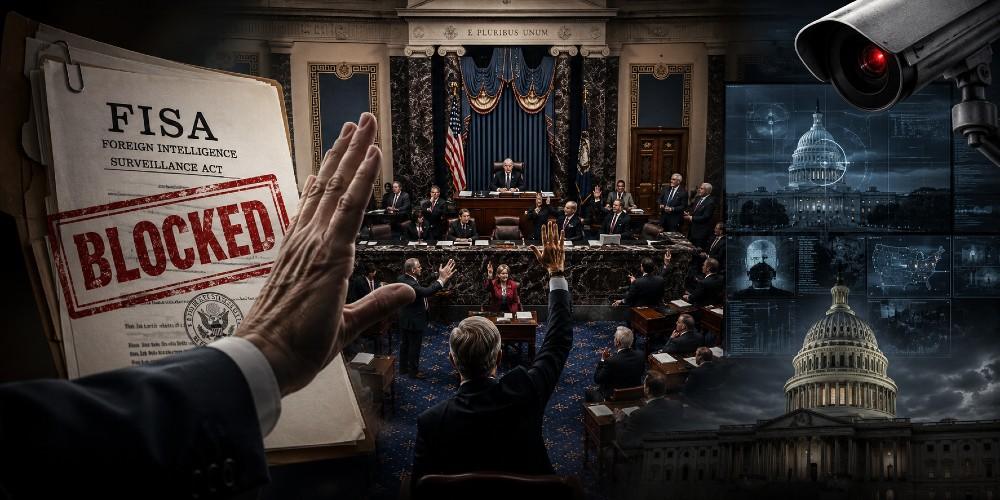
(The Epoch Times)—The Senate on Friday morning blocked a measure to extend a surveillance program used by U.S. agencies, in part because of opposition to President Donald Trump’s new acting director of national intelligence.
The vote was 47–52 against a motion that would have set up a final vote on extending a provision of the Foreign Intelligence Surveillance Act (FISA) that lets agencies such as the CIA collect communications from foreign targets without a warrant, and has in the past enabled collection of information from Americans communicating with foreigners.
Trump’s selection of Federal Housing Finance Agency Director William Pulte, who lacks a background in intelligence, as the acting national intelligence director spurred opposition to the extension measure.
“His appointment … is one more reason every single Democrat should vote against rubber stamping the Trump administration’s FISA Section 702 spying powers,” Sen. Ron Wyden (D-Ore.), who voted against the motion, said in a post on X this week.
Sen. Mark Warner (D-Va.), the top Democrat on the Senate Intelligence Committee who had worked to negotiate the bill, said Thursday that he and committee Chair Sen. Tom Cotton (R-Ark.) had reached what he described as a compromise on a “strong bill,” but that the “complete irresponsibility of putting forward” Pulte had changed the equation.
All Democrats but one voted against the measure, with seven Republicans also voting against it.
Sen. Rand Paul (R-Ky.), one of the Republicans who voted against, has called on Congress to require warrants to surveil Americans.
Other Republicans and Sen. John Fetterman (D-Pa.) voted in favor of the motion.
Senate Majority Leader John Thune (R-S.D.) said following the vote that the Senate “will take another run at it” next week, but that opposition over Pulte serving as acting national intelligence director is a “terribly irresponsible position.”
“The naming of Pulte to that position, although the timing arguably wasn’t the best, I still don’t think it ought to derail something that’s this important,” Thune said.
Pulte has faced pushback over his appointment from both Democrats and Republicans due to his lack of experience. Thune said the position shouldn’t be weaponized and should be led by professionals.
Any agreement would still need to clear the chamber’s 60-vote threshold before heading to the House, where lawmakers have yet to resolve differences over a provision restricting a central bank digital currency that House Republican leaders added to secure support for the bill.
Trump told reporters in Washington on Thursday that Pulte would not be nominated to be the intelligence director, a position that requires Senate confirmation.
National Intelligence Director Tulsi Gabbard recently announced her resignation, citing a desire to spend time with her husband, who was diagnosed with cancer.
The Associated Press contributed to this report.