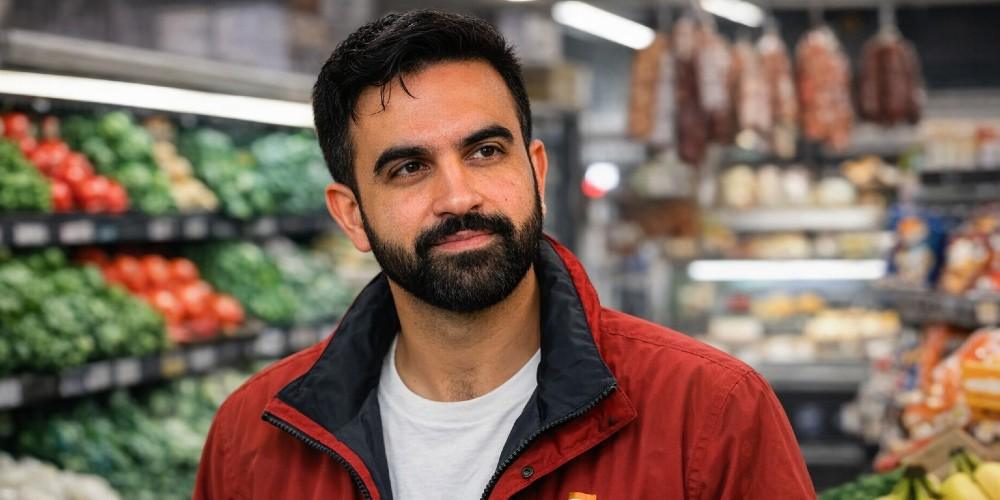
New York City Mayor Zohran Mamdani’s latest pitch for government-run grocery stores has all the hallmarks of socialist experimentation: grand promises of affordability wrapped in bureaucratic caveats. On Tuesday, the democratic socialist admitted that his city-owned markets will only guarantee lower prices for a narrow “core basket of goods”—staples like bread, milk, and eggs—while everything else receives vague aspirations of affordability without any binding commitment.
This revelation comes as Mamdani announced the first site at La Marqueta in East Harlem, with the flagship store not opening until 2029 at a staggering $30 million price tag. The broader plan calls for five stores across the boroughs by the end of his term, at a projected total cost of $70 million in taxpayer funds still awaiting City Council approval. A private operator will handle day-to-day management, but the city sets the rules and foots the bill for subsidies.
Mamdani framed the initiative as a solution to volatile grocery prices, allowing families to budget with predictability. Yet the partial guarantee exposes the scheme’s inherent limits. Officials speak of subsidizing “things that families actually need every week” and listening to community input on inventory, but non-essential items may not sustain perpetual discounts. The result? A government store that mimics private enterprise in theory while delivering selective relief in practice, all while risking distortion of the broader market.
- Mayor Zohran Mamdani, a Democratic Socialists of America member, announced the first city-owned grocery store at La Marqueta in East Harlem, set to open in 2029 after ground-up construction.
- Additional stores planned for each of New York City’s five boroughs, with the earliest expected in late 2027.
- Total projected cost: $70 million, including $30 million for the La Marqueta location, funded by taxpayers pending City Council approval.
- Only a yet-to-be-defined “core basket” of essentials—likely including bread, milk, and eggs—will carry guaranteed lower, fixed prices cheaper than current market rates.
- Other goods will aim for low costs but without perpetual discount guarantees, relying on subsidies and community-driven selection.
- A private operator will manage daily operations under city standards and oversight.
- Grocery executives criticized the $30 million build cost, noting typical private stores of similar size cost far less, with nearby properties available for purchase at lower prices.
- Bodega owners and industry voices warn of harm to private businesses, potential long lines, and inefficient competition in a city of eight million residents.
- The plan echoes Mamdani’s campaign promises to address food affordability without profit motives, leveraging no rent or property taxes for the public stores.
Critics rightly question the economics. Building a 9,000-square-foot store from scratch for $30 million strains credulity when comparable private developments cost a fraction of that, and vacant retail space nearby sits for sale at $7 million to $15 million. Mamdani’s team touts the absence of rent and taxes as a built-in advantage, yet this ignores the realities of supply chains, labor, spoilage, theft, and operational inefficiencies that private grocers navigate daily on razor-thin margins. Taxpayers, not shoppers, ultimately absorb the shortfalls.
The proposal revives familiar progressive instincts: treat food as a public utility rather than a product shaped by competition and innovation. History offers stern warnings. Price controls and state intervention in Venezuela led to empty shelves, hyperinflation, and black markets as producers withheld goods or fled the country. Soviet central planning delivered bread lines, not abundance, because bureaucrats could never replicate the price signals and incentives that drive efficient allocation in free markets. Even well-intentioned municipal efforts elsewhere have struggled against the complexity of perishable inventory and consumer preferences.
Mamdani’s partial admission—that only a core basket earns ironclad discounts—reveals the practical constraints his ideology cannot escape. Government cannot magically lower costs without trade-offs: either subsidies balloon, quality suffers, or shortages emerge when demand outstrips the fixed supply at capped prices. Bodega owners already foresee chaos, with limited stores drawing crowds and long lines in a metropolis of millions. Private competitors face unfair subsidized rivalry, potentially driving small businesses under while delivering no net gain for consumers.
New Yorkers have watched similar experiments unfold. Public markets like the existing EDC sites, including La Marqueta’s own evolution from Fiorello La Guardia’s 1936 pushcart initiative, have served niche roles without displacing the private sector. Scaling this into full-service groceries under political direction invites waste, favoritism in vendor selection, and endless debate over what belongs in the “essential” basket. Who decides the boundaries? Community input sounds democratic until it becomes a vector for special interests or ideological litmus tests.
The deeper contradiction lies in the socialist premise itself. Mamdani promises predictability and relief from corporate volatility, yet government stores introduce new uncertainties—budget battles, shifting political priorities, and bureaucratic delays that already push the first opening years into the future. Private enterprise, for all its imperfections, responds to consumer demand with speed and variety because failure means bankruptcy, not another tax hike.
As the plan advances, New Yorkers should weigh whether entrusting staples to City Hall advances genuine affordability or merely expands the administrative state at public expense. True relief from high grocery costs flows from unleashing supply through deregulation, reducing energy and regulatory burdens on producers, and fostering competition—not from selective subsidies that mask underlying failures of intervention.
In the end, this venture tests an old question: Can government do what markets do better, cheaper, and with greater responsiveness? The evidence from past experiments, and the mayor’s own qualified promises, suggests the answer remains no. Families seeking real predictability would do well to recall the wisdom that diligent hands bring wealth, while hasty shortcuts lead to poverty.
“The hand of the diligent shall bear rule: but the slothful shall be under tribute.” (Proverbs 12:24)