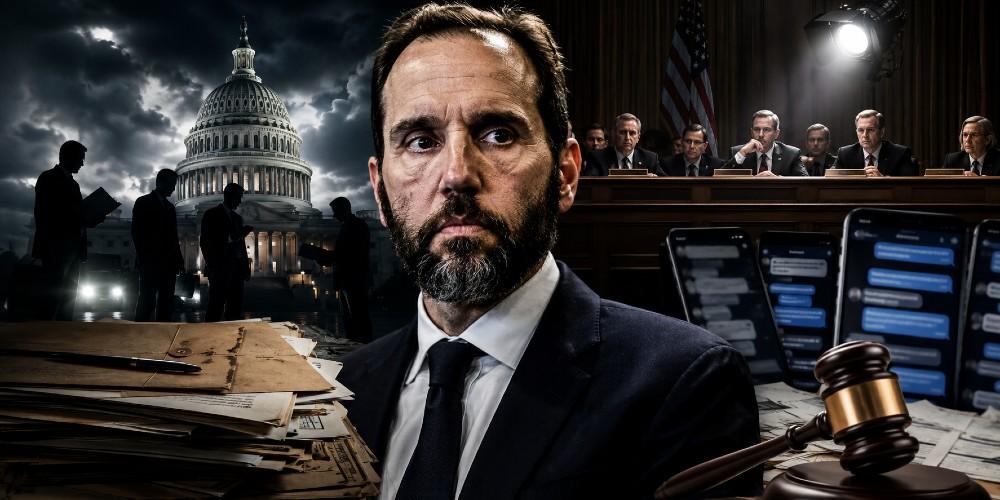
The special counsel who spent years trying to put Donald Trump in prison just got referred for criminal investigation himself. House Judiciary Chairman Jim Jordan dropped the hammer Wednesday, accusing Jack Smith of willfully lying under oath about how deep his team dug into private text messages from members of Congress.
This is not some technical dispute over paperwork. This is about a prosecutor who told Congress one story under oath, then got caught by documents showing something else entirely.
During his closed-door deposition on December 17, 2025, Smith was asked whether he sought a search warrant for the content of any text messages from members of Congress. His answer: “No, I don’t recall that.” He insisted his team only pulled toll records—the kind that show when a message was sent, not what it said.
Jordan’s referral letter to Acting Attorney General Todd Blanche lays it out plainly. Those answers “gave the impression that neither Mr. Smith nor his team had access to the content of Members’ privileged text messages.” Then the records landed.
“We now know this to be false,” Jordan wrote.
Newly released Justice Department material handed over to Senate Judiciary Chairman Chuck Grassley shows Smith’s investigators directly accessed the actual content of text messages involving more than 40 members of Congress. The messages ran between lawmakers and White House staff from October 2020 through January 20, 2021. The list included both Republicans and Democrats. Jordan himself was on it. So was Grassley. So were Steve Scalise, the late Lindsey Graham, Susan Collins, and even Cory Booker.
Worse, Smith’s team bypassed its own Filter Team—the internal safeguard designed to keep investigators from reading privileged or constitutionally protected communications. They went around the gatekeepers and looked anyway.
Jordan’s letter calls this “strong evidence” of false statements under 18 U.S.C. § 1001. He argues Smith’s testimony was not a fuzzy memory problem. It was an intentional effort to obstruct congressional oversight.
“His conduct can only be understood as an effort to thwart the Committee’s inquiry by intentionally making false statements and representations before Congress.”
Democrats, predictably, are howling. Ranking Member Jamie Raskin called the referral “laughably weak and vindictive,” claiming Republicans are upset that Smith did not volunteer information they failed to ask for. That defense requires believing that a seasoned prosecutor somehow forgot his own team had read dozens of lawmakers’ private messages while investigating a former president. It also requires ignoring the constitutional Speech or Debate Clause protections that cover official legislative communications.
This is the same Jack Smith who treated the Justice Department like a personal weapon against the leading political opponent of the Biden administration. He obtained phone records of Republican lawmakers. He chased theories about 2020 that collapsed under scrutiny. Now the documents show his team was reading the actual words elected officials were sending to the White House—and then he told Congress he never sought the content.
Scripture is not silent on this kind of deception. “Wherefore putting away lying, speak every man truth with his neighbour: for we are members one of another.” That is Ephesians 4:25. Public officials who swear an oath and then shade the truth to protect their own power are not serving the public. They are serving themselves.
The Justice Department under the current administration has confirmed receipt of the referral and stated it “will investigate all evidence of criminal conduct.” Whether that investigation produces an actual indictment remains to be seen. But the pattern is hard to miss. The man who spent years demanding accountability from one side of the political aisle is now being forced to answer for his own statements under oath.
Americans were told for years that Jack Smith was the impartial guardian of the rule of law. The records say otherwise. So does the criminal referral now sitting on the Acting Attorney General’s desk.