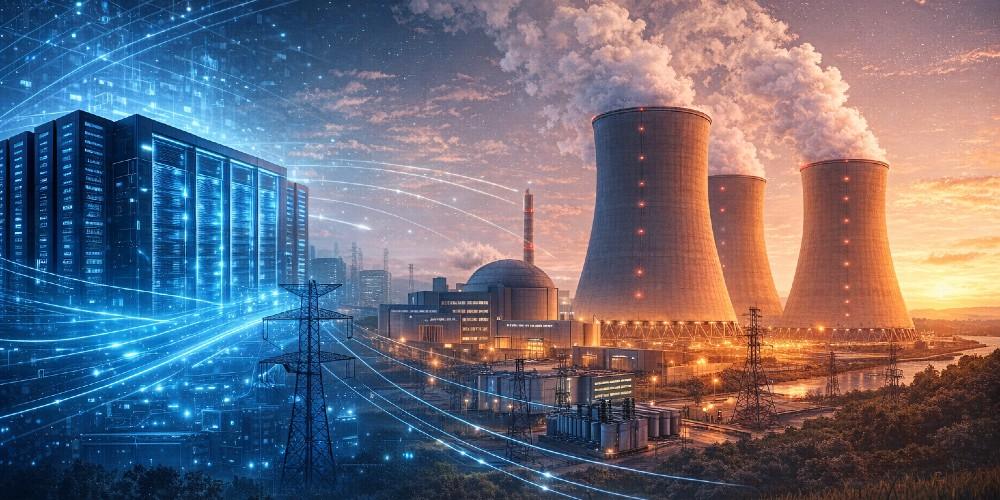
When the artificial intelligence industry decided it needed more power than most American cities consume, it did not call its friends in the Sierra Club. It called the nuclear industry.
That single fact — quietly buried beneath the triumphalist press releases and the breathless tech coverage — is the most clarifying moment in American energy policy in a generation. The same Silicon Valley titans who spent years funding climate activism, flying private jets to Davos, and lecturing the rest of us about our carbon footprints are now signing long-term contracts with nuclear operators, reviving shuttered reactors, and building natural gas turbines on-site. Reality, it turns out, does not negotiate with ideology.
The AI data center boom has produced an energy crisis that no amount of solar panels or wind turbines can fix, and the industry knows it. The question the rest of the country should be asking is why it took a trillion-dollar tech build-out to make powerful people admit what engineers have been saying for decades.
- U.S. data centers now consume approximately 41 gigawatts of power — a 150 percent increase over the past five years — roughly equal to the combined output of every nuclear plant in the country.
- A single hyperscale AI data center requires between 100 and 300 megawatts of continuous power, equivalent to the demand of a mid-sized city, and a single AI task can consume up to 1,000 times more electricity than a traditional web search.
- PJM Interconnection, the nation’s largest grid operator serving 65 million people across 13 states, projects it will be six gigawatts short of its reliability requirements by 2027. Its own market monitor says the grid is at “a crisis stage.”
- Retail electricity prices have risen 42 percent since 2019, outpacing overall inflation, with Goldman Sachs projecting data center demand will continue pushing consumer costs higher through 2027.
- Microsoft signed what is being called the largest corporate nuclear agreement in history — a 2-gigawatt commitment with Constellation Energy through 2040 — and Amazon secured 1.5 gigawatts of dedicated solar in Texas.
- Google, which in 2019 pledged to run entirely on clean energy by 2030, now calls that goal “a moonshot.” Microsoft describes its parallel carbon-removal pledge as “a marathon, not a sprint.”
- Roughly 56 percent of current U.S. data center electricity comes from fossil fuels, with natural gas and coal carrying the load that wind and solar cannot.
- Approximately 30 percent of all planned data center power capacity is now expected to be generated on-site — bypassing the public grid entirely — up from nearly zero a year ago.
- The data center industry’s own experts acknowledge that 70 percent of the U.S. grid is approaching the end of its designed lifecycle, most of it built between the 1950s and 1970s.
- The Department of Energy projects AI energy demands could represent as much as 12 percent of total U.S. electricity consumption by 2028.
The Physics Didn’t Change. The Politics Did.
America’s power grid was not built for this. Most of the grid’s infrastructure dates to between the 1950s and 1970s, and approximately 70 percent of it is approaching the end of its designed lifecycle. Into that aging system, the tech industry is now attempting to inject demand at a scale and speed that engineers describe as unprecedented. A single AI-related computational task can consume up to 1,000 times more electricity than a traditional web search — which means even a handful of AI facilities can destabilize a regional power supply in ways that hundreds of conventional data centers never could.
U.S. data centers now draw approximately 41 gigawatts of power, a 150 percent increase over the past five years — roughly equivalent to the combined generating capacity of every nuclear power plant in the United States. And the trajectory is not leveling off. The Department of Energy projects that AI energy demands could double or triple in the next few years and may represent as much as 12 percent of the country’s total energy consumption by 2028.
The consequences are already arriving on household doorsteps. Retail electricity prices have risen 42 percent since 2019, outpacing the 29 percent increase in the Consumer Price Index over the same period. That is not an abstraction. That is families choosing between groceries and utility bills. Rob Gramlich, president of power consulting firm Grid Strategies, has said he expects the political debate over data centers to intensify further as Americans absorb even higher utility bills — and he believes the repercussions are far from over.
The Grid Operator’s Warning No One Wanted to Hear
PJM Interconnection, the largest U.S. grid operator serving over 65 million people across 13 states, projects it will be a full six gigawatts short of its reliability requirements in 2027. Joe Bowring, president of independent market monitor Monitoring Analytics, told CNBC he has never seen the grid under such projected strain. “It’s at a crisis stage right now,” Bowring said. “PJM has never been this short.”
Six gigawatts is not a rounding error. That is the equivalent of six large nuclear power plants’ worth of missing capacity on a grid that serves the Mid-Atlantic and Midwest — and the shortfall is growing faster than permitting processes, transmission lines, or transformer manufacturing can accommodate. In the mid-Atlantic and Midwest region that PJM serves, projects approved in 2025 had been in the interconnection queue for eight years. Eight years. The AI industry is doubling its capacity in months. The grid operates on a timeline measured in presidential administrations.
The core problem is a mismatch in development timelines. AI technology and demand are growing exponentially, while energy infrastructure — new high-voltage transmission lines, generation capacity, grid connections — operates on a linear, decade-long permitting and construction cycle. No amount of political willpower bridges that gap quickly. The laws of physics, procurement lead times, and bureaucratic permitting processes are not moved by quarterly earnings calls.
The Green Energy Reckoning
Here is where the story becomes genuinely instructive — not just as an energy policy debate, but as a case study in what happens when ideology meets an immovable physical reality.
Six years ago, Google publicly committed to powering all its operations with clean energy sources — wind and solar — by 2030 and to removing as much carbon as it produces. Today, the company calls those goals “a moonshot.” Microsoft says it’s still aiming to remove more carbon than it creates by 2030 but now describes the effort as “a marathon, not a sprint.” Both companies are now signing contracts with natural gas plants and nuclear operators as fast as their lawyers can process the paperwork.
Three natural gas plants will provide electricity to a massive Meta data center in rural Louisiana, while the company invests in solar elsewhere. Google plans to buy electricity from a natural gas plant to be built at an Archer Daniels Midland corn processing plant in Illinois. These are not the energy profiles of companies that genuinely believed their own emissions pledges. They are the energy profiles of companies that made political promises and are now discovering what engineers always knew — that running civilization requires reliable, dispatchable power, not intermittent energy dependent on weather conditions.
Microsoft signed what is being described as the largest corporate nuclear agreement in history — a 2-gigawatt commitment with Constellation Energy through 2040. Amazon secured 1.5 gigawatts of dedicated solar in Texas. Constellation Energy is expected to restart the Three Mile Island nuclear plant to power Microsoft’s data centers in 2027. Three Mile Island — the name that for four decades served as the left’s most potent argument against nuclear power — is being brought back online by the technology industry because there is simply no other way to keep the lights on at the scale AI demands.
The irony is too rich to pass without comment. The same progressive coalition that spent decades litigating nuclear plants into closure, blocking natural gas pipelines, and mandating renewable portfolio standards that pushed utilities toward weather-dependent generation has now produced a grid so fragile that the companies most publicly committed to green energy are being forced to resurrect the very infrastructure the left spent a generation dismantling.
Going “Off the Grid” — And What That Means for Everyone Else
Faced with interconnection queues stretching nearly a decade and grid capacity that simply does not exist, the tech industry has begun building its own power — and bypassing the public grid entirely. Roughly 30 percent of all planned data center power capacity is now expected to be generated on-site, up from nearly nothing a year earlier. Michael Thomas, founder of Cleanview, a market intelligence firm, said the trend line suggests that figure could keep rising — potentially to 50 percent of planned capacity.
Companies building AI infrastructure say avoiding the grid can bypass years-long waits to connect, provide more control, and avoid straining the electric system with massive new demand. The natural gas industry, which stands to benefit substantially from this trend, frames it as a benefit to ordinary ratepayers. “The secondary benefit is it doesn’t hit the retail customers,” said Rob Wingo, executive vice president of Williams, a major natural gas pipeline company. “But it’s also much faster.”
Not everyone is convinced the island approach serves the broader public. Varun Sivaram, founder of startup EmeraldAI, argued that fully decoupling the AI ecosystem from the electric grid would make AI more expensive while causing the power sector to lose its largest and most lucrative potential anchor client. John Ketchum, CEO of NextEra Energy, offered a middle path: “A data center could start as an island. Most hyperscalers are going to want an extension cord between data centers and the grid. We should want that too.”
The practical reality is that ordinary Americans do not have the option of building their own power plant. When tech giants bypass the public grid, they also bypass the political pressure to modernize it — leaving the infrastructure question for regulators, ratepayers, and future administrations to sort out.
What Stewardship Actually Requires
There is a principle embedded in the biblical concept of stewardship that the current energy debate consistently ignores. It is not enough to announce good intentions. Stewardship requires honest accounting — of costs, consequences, and the limits of what any technology can actually deliver. “A false balance is abomination to the Lord: but a just weight is his delight” (Proverbs 11:1).
The green energy movement built its policy architecture on a false balance — promising emissions-free power while systematically obstructing the only proven source of it, nuclear energy, and then papering over the gap with natural gas while publicly pledging to eliminate it.
The AI energy crisis has stripped that pretense away. The contradiction at the heart of modern energy policy is that politicians who loudly demand zero-emissions electricity have, in practice, enacted the policies most hostile to the one source that reliably delivers it. California remains the most instructive example — a state that sends delegations to international climate conferences while depending on neighboring states to keep its own grid stable, and which came within a hair’s breadth of shuttering its last nuclear facility even as it pleaded for more clean power.
The AI industry did not create that contradiction. But it has made it impossible to ignore. When the world’s most sophisticated technology companies — companies whose founders and executives have been among the most vocal champions of climate policy — are forced to restart shuttered nuclear plants and sign long-term natural gas contracts to keep their servers running, the argument for reliable, dispatchable energy has been made more effectively than any policy paper or congressional hearing ever managed.
The Right Lesson
The AI data center crisis presents a genuine opportunity — not to score political points, but to have an honest national conversation about what a functional energy policy actually requires. That conversation should start with a few plainly stated realities.
First, the grid is old, underpowered for modern demand, and incapable of rapid expansion under the current regulatory regime. Permitting reform is not a luxury — it is a precondition for both AI competitiveness and energy reliability. Second, nuclear power is not a fringe option or a relic of Cold War thinking. The IAEA Director General has stated that only nuclear energy can simultaneously meet the five requirements of low-carbon power generation: round-the-clock reliability, ultra-high power density, grid stability, and true scalability. The tech industry figured this out through market pressure. Policy should follow. Third, the cost of ideologically driven energy policy is not borne by the executives making the pledges or the activists drafting the regulations. It is borne by the retired couple in Ohio opening an electricity bill that has risen 42 percent in seven years.
The AI boom did not create America’s energy problem. It exposed it — with a clarity and urgency that three decades of policy debate could not produce. Whether the country uses that clarity to build something durable, or simply waits for the next crisis to arrive, is the question that will define the next generation of American infrastructure.