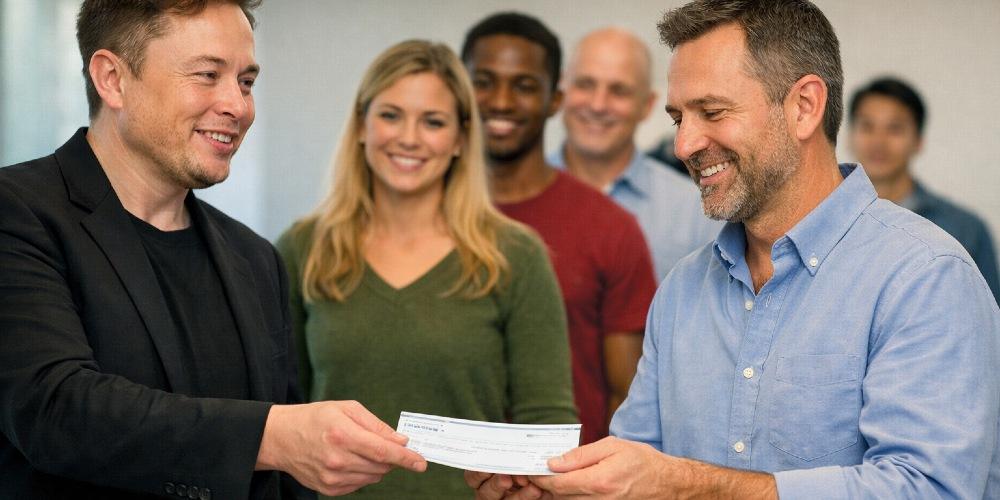
Elon Musk is a man of extraordinary vision. He looked at the American space program, concluded that government bureaucracy had made it sclerotic and expensive, and built reusable rockets that changed the industry. He bet his own fortune on electric vehicles when the sector was a punchline and dragged it into commercial viability. He bought Twitter, renamed it X, and restored a platform that had become a censorship apparatus for progressive gatekeepers. On each of those fronts, Musk saw clearly what others refused to see.
Which is precisely why his latest proposal deserves a direct and honest answer: he is wrong. Not confused, not misguided in a forgivable way — wrong in a manner that conservatives, Christians, and anyone who has thought seriously about human nature should be able to identify immediately.
Late on a Thursday evening, Musk posted to his own platform that “Universal HIGH INCOME via checks issued by the Federal government is the best way to deal with unemployment caused by AI.” He added that inflation would not be a concern because “AI/robotics will produce goods and services far in excess of the increase in the money supply.”
As he famously once said, “Let that sink in.” The man who just spent months at the helm of the Department of Government Efficiency, lecturing the country about the catastrophic dangers of federal spending and the moral bankruptcy of dependency culture, is now proposing that Washington mail high-income checks to every American citizen as a permanent response to artificial intelligence. The irony is so thick you could cut it with Occam’s razor.
But his track record of unmatched successes will have many believing him regardless of how ludicrous the concept. Like all successful people, Musk has failed at many things. But the one that sticks out may be the least consequential. When he was unveiling the Cybertruck, he had someone try to break the “unbreakable” glass. They did. Twice.
He had so much confidence that it wouldn’t break that he did it with the world watching. Now, he’s asking for even more faith in a plan in which he appears to have equal confidence. The difference is he lost nothing with the Cybertruck stunt other than a little pride. With Universal High Income, he risks causing a global economic collapse and the end of modern Western society.
The Economics Don’t Add Up — And Economists Are Saying So
Musk’s inflation argument rests on a claim that AI-generated abundance will outpace any increase in the money supply, making government checks essentially cost-free. It is a seductive theory, and it is not entirely without merit as a long-run projection. But Sanjeev Sanyal, who served as the principal economic adviser to India’s Ministry of Finance, rejected the premise without hesitation.
“He is so wrong on this,” Sanyal wrote on X. “AI will certainly cause dislocation, but like all technology it will also create new jobs and opportunities in the medium term. AI and robots will also not produce goods and services in excess of money or demand that there will be no inflation.”
Sanyal’s critique cuts to the root of a well-documented economic fallacy. The assumption that AI will produce a fixed, finite number of jobs while simultaneously eliminating others rests on what economists call the “lump of labor” fallacy — the idea that there is only so much work to go around. By that same logic, the industrial revolution should have left every displaced artisan destitute forever. History has repeatedly demonstrated that technological disruption creates new categories of employment, often in industries that were entirely unimaginable before the disruption occurred.
Pratyush Rai, co-founder and CEO of Merlin AI, made the point about inflation with blunt arithmetic. “The basic math on UHI doesn’t add up,” he wrote on X. “If everyone gets a high income check, everyone’s competing for the same houses, land, schools, lifestyle.”
He is correct. You cannot flood an economy with purchasing power without bidding up the price of everything that is finite — and land, housing, and human services are very finite indeed. AI can automate a software task. It cannot manufacture more coastline.
The Numbers Don’t Justify the Panic — Or the Prescription
In the first quarter of 2026, employers announced over 27,000 AI-linked job cuts — a 40% rise year over year, according to Challenger, Gray and Christmas. That number is real and should not be dismissed. But it must be placed in context. The U.S. economy generates and destroys millions of jobs every quarter through normal market churn. Every major technological wave — from mechanized agriculture to the internet — produced displacement and then, with time and policy space to adapt, net employment growth.
The question is not whether AI disrupts; it is whether the correct response to disruption is to wire every American to a permanent government stipend or to build the conditions under which new industries, new trades, and new forms of value creation can emerge.
Musk’s own companies are among the most aggressive deployers of automation in the world. Tesla’s factories use more robots per square foot than almost any facility in manufacturing. SpaceX has relentlessly automated processes that once required large engineering teams. There is nothing wrong with that — it is innovation. But one might ask, with genuine curiosity, what exactly Musk believes will happen to the engineers, machinists, and logistics workers displaced by his own technology when their replacement income arrives via federal check. Will they spend the rest of their lives on the couch, optimized by abundance? Or will the human drive toward purpose, mastery, and contribution reassert itself — as it always has?
When the Left Agrees With You Immediately, Reconsider Your Position
Perhaps the most revealing moment in the entire episode came swiftly. Andrew Yang — the Democratic candidate who made Universal Basic Income the centerpiece of his 2020 presidential campaign and has been pushing the idea ever since — immediately embraced Musk’s proposal. “It’s clear that AI will wind up funding universal income,” Yang posted on X. “Let’s make that happen ASAP.”
When Andrew Yang is your most enthusiastic ally, something has gone wrong. Yang’s UBI vision was always about more than economics — it was about redefining the relationship between citizen and state, replacing the dignity of earned income with the managed comfort of government distribution.
Universal High Income goes further still. While UBI at least envisions citizens continuing to work while receiving support, UHI is openly predicated on a future in which work itself becomes unnecessary. That is not a conservative proposal. That is not even a liberal proposal in the classical sense. It is a utopian fantasy dressed in the language of technological inevitability — and utopian fantasies, as history has consistently demonstrated, tend to require totalitarian enforcement mechanisms before they are abandoned.
The Question Nobody Is Asking — But Should Be
The deepest problem with Musk’s proposal has nothing to do with inflation rates or fiscal projections. It has to do with the nature of man. Work is not merely an economic activity. It is, in the Judeo-Christian tradition that built Western civilization, a calling. When God placed Adam in the Garden, it was not to recline in passive abundance — it was to tend and keep it. The apostle Paul was not hedging when he wrote to the Thessalonians, “If any would not work, neither should he eat.” That is not a statement about poverty. It is a statement about dignity, purpose, and the ordering of human life toward something greater than consumption.
A culture in which meaningful work is replaced by government checks is not a culture at leisure — it is a culture in crisis. The social pathologies already associated with long-term unemployment — despair, addiction, family breakdown, community dissolution — do not disappear when the checks arrive. They accelerate. The problem was never the absence of money. The problem was the absence of purpose.
The Conservative Alternative Is Not Indifference
None of this is an argument for pretending that AI disruption is painless or that displaced workers should be abandoned. The conservative answer to technological displacement has always been grounded in the same principles that built the most prosperous economy in human history — free markets that create new industries faster than old ones die, an education and retraining infrastructure that prepares workers for emerging opportunities, and a safety net calibrated to transition rather than permanent dependency. The goal is not to make idleness comfortable. The goal is to make work possible.
Musk has done more than almost any private citizen alive to advance the productive capacity of the American economy. That record earns him enormous credibility on questions of innovation. It does not exempt him from scrutiny when he wanders into policy territory where the instincts of a tech optimist collide with the realities of governance, human nature, and fiscal sanity.
As Sanyal concluded, “Elon Musk’s universal high income will bankrupt any government that attempts it.” That is a verdict that should be taken seriously — not because Musk is malicious, but because well-intentioned proposals with catastrophic structural flaws have a way of becoming law.
The man who built rockets to escape Earth’s gravity should know better than anyone that some forces cannot simply be engineered away. Dependency is one of them.