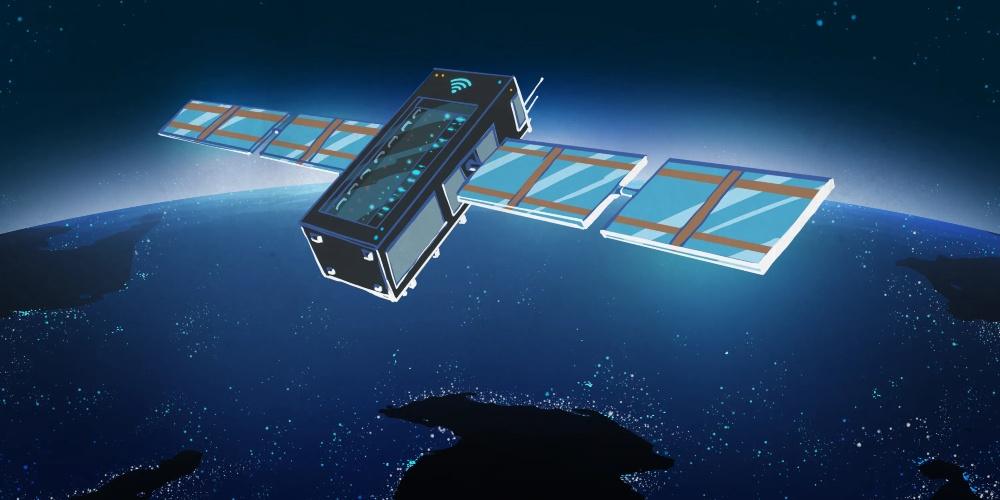
 (DCNF)—Data centers were once thought to be a driving force for economic growth. Now, Americans don’t want them in their backyards. Could space be a better fit?
Data centers started sprawling across most of the American South and the Midwest as politicians have embraced them to foster economic growth. However, as Americans have increasingly spurned the big tech warehouses, governors and lawmakers alike have pushed for moratoriums and more stringent rules against data center construction. That pushback is forcing some AI companies to look toward the stars.
But making that happen is no easy task, experts told the Daily Caller News Foundation, as orbital data centers lack the power of land-based data centers and need to have its hardware protected against radiation.
“We are going to need more data centers in more places,” Kristian Stout, the director of innovation policy at the International Center for Law & Economics, told Daily Caller News Foundation.
Stout added that AI labs may face more pressure to explore orbital data centers due to Americans’ dislike of their presence in their communities.
Elon Musk, CEO of SpaceX, in August said that Nvidia, the world’s largest AI chipmaker, designed a “space-optimized” AI chip that will launch in orbit in the fourth quarter of 2027 “with more scale in 2028.”
“Our design is significantly simpler, lower cost, denser and lighter than a traditional rack,” Musk added. SpaceX said in August it would use Nvidia’s technology for orbital data centers.
SpaceX filed for approval with the Federal Communications Commission (FCC) to launch as many as one million satellites to do artificial intelligence, which now remains pending at the FCC, according to agency documents.
Other companies have jumped onto the space bandwagon.
Space startup Cowboy Space filed for a 20,000 satellite constellation system it calls the “Stampede Data Center System,” according to FCC filings. Another startup, Starcloud, asked the FCC to approve to launch as many as 80,000 orbital data center satellites. Amazon’s Blue Origin hopes to set up a constellation of as many as 51,600 satellites. Space startup Orbital applied to deploy up to 100,000 data center satellites.
The FCC believes the Trump administration will facilitate a new age of American leadership in space.
“President [Donald] Trump is unleashing a new golden age of American innovation in space, and the FCC is helping to execute. Across the board, the Commission is moving quickly to ensure that the United States is the best place to launch, operate, and build the orbital infrastructure of tomorrow,” an FCC spokesperson told the DCNF.
In November 2025, Google announced Project Suncatcher, which would launch solar-powered satellite constellations into space. The tech giant plans to launch two prototype satellites in early 2027, it stated in a press release.
China, led by ADA Space and Zhejiang Lab, launched the first 12 of its 2,800 orbital satellite network in 2025, according to Space News. Many other Chinese firms such as China Mobile, Bailing Aerospace and Shanghai Xingshu Space Technology plan to launch their own orbital data centers, per Space News.
The European Space Policy Institute (ESPI) warned in August that Europe may fall behind China as it continues to plan how launch its orbital data centers.
“While European institutions continue to debate the future of computing in orbit, China is already building it,” the European think tank report stated.
How Would Orbital Data Centers Work?
Orbital data centers could offer flexibility, but they would likely pale in comparison to the average data center in terms of raw power, Benjamin Lee, a professor of electrical and systems engineer at the University of Pennsylvania, told the DCNF.
“The constraint is that right now it’s kind of the best proven case is like in the kilowatts, like low kilowatts of capacity, and we’re talking about putting up like 200 megawatt data centers on the ground. It’s very speculative right now is proven like it works, but it doesn’t work at the hyperscale level,” Stout remarked, arguing that orbital data centers would not match the raw power of data centers on Earth.
Lee argued that orbital data centers would focus on answering users’ questions via an AI chat bot instead of doing agentic work, which focuses on having the AI model do a job such as writing code or conducting work on behalf of the user.
However, orbital data centers would have other issues.
Companies would have to design orbital data centers to protect them from radiation from space.
“Cooling is actually complicated because in space you don’t radiate heat into the vacuum; there’s no medium. So, they need to have specialized radiators on these things in order to radiate away the heat,” Stout said.
“I know that Google has been collaborating with some companies. They’ve been bombarding a tensor processing unit with radiation and showing that even though radiation accumulates, the chip doesn’t fail,” Lee said.
Lee argued that orbital data centers need to have error-correcting software.
He added that radiation from space may change the code on the orbital data center, which raises questions about how the orbital data center would account for the radiation when running compute for artificial intelligence models.
“We need to actually check that that’s true, and I think that means launching things into space, running computations up there, and then seeing what happens,” Lee said.
Stout questioned if AI labs will have a plan to maintain and repair these orbital satellites. He said that most satellites last five to seven years and then often crash or burn up in the Earth’s orbit.
He asked rhetorically, “Do you take a billion dollars worth of GPUs [AI chips] and just burn them up in the atmosphere in seven years?” He noted that prior generation AI chips have a lot of value and flying the AI chips back to Earth would become very expensive.
Stout said that orbital data centers could help AI companies, but not at the scale of land-based data centers.
“Nobody has really proven that there’s a hyperscaler capability in the near term, so what you’re talking about is like edge computing or modifying existing satellite capabilities for better imaging,” he remarked.
All content created by the Daily Caller News Foundation, an independent and nonpartisan newswire service, is available without charge to any legitimate news publisher that can provide a large audience. All republished articles must include our logo, our reporter’s byline and their DCNF affiliation. For any questions about our guidelines or partnering with us, please contact [email protected].