Six hundred forty-nine years before Zohran Mamdani decided City Hall should sell eggs, a Muslim scholar in North Africa wrote down why that idea wrecks a city.
Ibn Khaldun finished the Muqaddimah in 1377. He had watched dynasties rise on light taxes and private trade, then rot when the ruler started buying and selling for himself. Chuck DeVore walked through that warning at Fox News this morning and pointed it straight at New York’s first Muslim mayor.
The coincidence is almost too clean. The son of a postcolonial scholar is running the late-stage version of the cycle Khaldun described.
Khaldun’s observation was simple. Early in a dynasty, taxes stay modest. Merchants work. Revenue grows. Civilization thickens. Later the palace wants more luxury and more soldiers. Taxes climb. Profits shrink. Then the ruler does the fatal thing. He enters commerce. He sets prices. He subsidizes. He competes with the men who actually generate the tax base. Those men leave, or they quit. Production falls. The treasury hollows out. The empire follows.
Six centuries later economists would call the tax half of that story the Laffer Curve. Khaldun already had the second half. Government as grocer is not compassion. It is the late-dynasty move.
It should be known that the finances of a ruler can be increased, and his financial resources improved, only through the revenue from taxes. (The revenue from taxes) can be improved only through the equitable treatment of people with property and regard for them. … Other (measures) taken by the ruler, such as engaging in commerce or agriculture, soon turn out to be harmful to the subjects, to be ruinous to the revenues, and to decrease cultural activity.
That is not a Heritage Foundation memo. That is a 14th-century Maghrebi historian watching kingdoms eat themselves.
City Hall as Competing Grocer
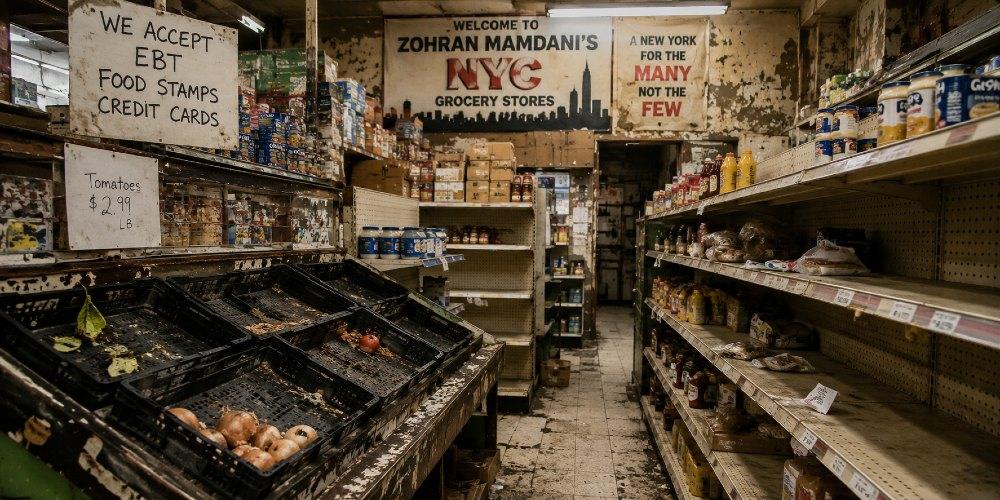
Mamdani is building five city-owned grocery stores, one in each borough. The first is slated for Hunts Point in the Bronx in 2027, inside the old Spofford juvenile jail site now branded The Peninsula. East Harlem’s La Marqueta store is supposed to follow by 2029.
The city owns the land, pays construction, waives rent and property taxes, and then orders a private operator to sell a “core basket” of staples roughly 30 percent below ordinary retail. Capital cost on paper is $70 million. A Republican comptroller candidate already put the first few years closer to $206 million once operating subsidies and lost sales at neighboring stores are counted.
Supporters talk about cheaper eggs. They do not talk about who pays for the 30 percent. Manhattan Institute analyst Adam Lehodey told Fox the discount is an illusion. Taxpayers cover the subsidies. The stores sit on public land with the meter off. New Yorkers still pay full freight.
They just pay it on the tax bill instead of at the register. Heritage economist E.J. Antoni added the obvious math. Grocery margins already sit near 2 percent. A mandated 30 percent haircut is a loss the city will keep writing checks to cover.
Ohio Rep. Mike Rulli grew up in a family grocery chain. He told Fox those stores will bleed from the day the key turns. They may not last a year. City officials have already admitted the shops will skip butchers and hot food, which is another way of saying they will skim the politically useful items and leave the hard parts to the private operators they claim not to be competing with.
Mamdani insists he is not trying to kill bodegas. He just wants government to “set the terms.” That is the whole trick. Private grocers pay rent, property tax, insurance, union rules, and New York’s regulatory army. The municipal store does not. Then DSA co-chair Gustavo Gordillo shrugs that if a subsidized city store puts a neighbor out of business, maybe that neighbor should not have been in business.
Khaldun would have recognized the tone. It is the voice of a court that has decided merchants exist at the ruler’s pleasure.
Harlem is not even a food desert. The New York Post walked the blocks around La Marqueta and found City Fresh, Fine Fare, and Cherry Valley already selling milk and soda below the prices in richer neighborhoods. The $30 million Harlem box is not filling a vacuum. It is undercutting stores that already serve the same customers without a tax waiver.
The Irony Sitting at the Family Table
DeVore noted the personal twist. Mamdani is the son of Mahmood Mamdani, the Columbia postcolonial theorist. The elder Mamdani even published a 2017 essay titled “Reading Ibn Khaldun in Kampala.” The family has every reason to know the text. The son is governing as if the warning were a museum piece.
That is the pattern. Academic familiarity with decline is not the same as refusing to repeat it. Khaldun was not writing a diversity seminar. He was writing an autopsy. When the state moves from keeping order to stocking shelves, the productive class withdraws. Civilization does not expand. It contracts.
New York already knows the first half of his cycle. Taxes are high. Businesses have left. Regulation is a second rent. Layering municipal groceries on that stack does not reverse the incentives. It speeds them up. Shortages follow artificial prices. Quality slips.
The political win of cheaper bread is purchased with a thinner commercial city, and the city is what pays the pensions.
Except the Lord build the house, they labour in vain that build it: except the Lord keep the city, the watchman waketh but in vain.
America’s great cities got rich because independent men and women created abundance. Not because a mayor decided to become a grocer with a printing press. Khaldun saw the ending in 1377. New York is volunteering for a rerun.