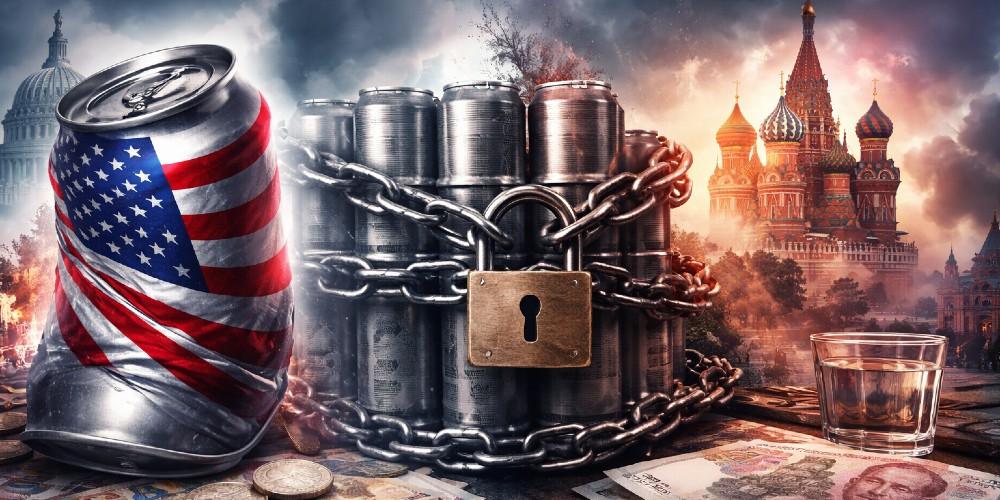
While Moscow extends diplomatic overtures toward Washington in hopes of normalizing relations and advancing Ukraine peace talks, the Kremlin continues to nationalize valuable foreign assets on its soil. The latest high-profile case involves CANPACK, a major aluminum beverage can manufacturer with deep Pennsylvania ties, whose entire Russian business has been stripped away by presidential decree. This development exposes the sharp contradiction at the heart of current U.S.-Russia dynamics: talk of renewed economic partnership on one hand, aggressive property redistribution on the other.
CANPACK’s Russian operations, built over nearly three decades and commanding an estimated 35 to 40 percent of the domestic aluminum can market, were placed under state “external administration” through a decree signed by Vladimir Putin on December 31, 2025. Company CEO Peter Giorgi described the reality bluntly: after state administrators arrived in mid-January, the owners lost all control. “I’m only a nominal shareholder,” Giorgi told Fox News Digital. “I lose all control of the company.” The business, valued at roughly $700 million, now answers to Kremlin-appointed managers through a shell entity called Stalelement.
This is no isolated incident. Since Russia’s full-scale invasion of Ukraine in 2022, authorities have increasingly invoked a 2023 legal framework to assume temporary control over foreign-owned assets. Similar actions have targeted subsidiaries of Danish insulation maker Rockwool, French food giant Danone, and brewer Carlsberg. Experts estimate dozens of companies have faced such measures. The pattern reflects a broader Kremlin strategy of bringing profitable or strategically important enterprises under tighter state influence, often justified as protecting “national interests” amid Western sanctions and corporate exits.
- Russian President Vladimir Putin signed a December 31, 2025 decree placing CANPACK’s Russian operations—valued at roughly $700 million—under state “external administration,” transferring 100% control to Kremlin-appointed managers.
- CANPACK, owned by a Pennsylvania-based holding company, lost all operational authority in mid-January 2026; senior executives including the general manager and CFO were removed.
- The takeover follows a pattern of asset seizures targeting Western firms that remained in Russia after the 2022 invasion of Ukraine, including subsidiaries of Rockwool, Danone, and Carlsberg.
- Despite the move, Putin’s envoy Kirill Dmitriev has been meeting with Trump administration officials to discuss Ukraine peace negotiations and future economic cooperation.
- Analysts note American-linked companies have sometimes faced lighter treatment than European ones, as Moscow seeks to preserve possibilities for improved U.S. relations.
- CANPACK operated in Russia for nearly 30 years and held 35-40% of the country’s aluminum beverage can market before the seizure.
- The company reported pressure on remaining executives and significant financial transfers to pro-Kremlin causes, including support linked to the war effort.
Yet even as these seizures multiply, Russian officials signal interest in rebuilding bridges with the United States. Putin’s special envoy for foreign investment, Kirill Dmitriev, has traveled to Washington for discussions with members of President Donald Trump’s administration on potential Ukraine peace terms and longer-term economic cooperation. The timing raises pointed questions. How does one reconcile the nationalization of a major U.S.-linked manufacturer with overtures for renewed partnership? The mixed signals suggest Moscow seeks selective engagement—preserving leverage through asset control while testing Washington’s appetite for de-escalation.
Observers note that American-linked firms have sometimes received comparatively cautious treatment compared to their European counterparts. Alexander Kolyandr of the Center for European Policy Analysis observed that “American companies fared much better than the European ones,” attributing the difference to Russia’s desire to keep future U.S. ties viable. Still, the CANPACK case demonstrates that even U.S.-connected businesses remain vulnerable when they remain in Russia long after many peers departed. Giorgi explained that the company weighed leaving but struggled to unwind decades of investment or find a fair buyer, choosing instead to “stay the course” in hopes conditions would stabilize.
Under external administration, CANPACK’s Russian executives have reportedly faced pressure to approve financial decisions, with threats of dismissal for noncompliance. The company has had no direct access to or communication with its former operations. Russian business outlet Vedomosti reported that the division donated approximately 500 million rubles to a pro-Kremlin fund supporting the war in Ukraine. Company sources indicated roughly $18 million may have flowed to state-linked causes, with another $6 million directed toward a Russian Orthodox church—figures the firm has not independently verified but which underscore how quickly financial flows can shift once control is lost.
The episode carries clear lessons for Western investors and policymakers. Remaining in a hostile jurisdiction carries escalating risks, particularly when geopolitical tensions persist. Property rights that appear secure under normal commerce can evaporate through decree when governments prioritize state control. For American companies and their shareholders, the CANPACK seizure illustrates the limits of hoping for stability in an environment where rule of law bends to political necessity.
From a broader strategic standpoint, the contrast between asset seizures and diplomatic outreach highlights the transactional nature of Kremlin policy. Russia appears eager to ease sanctions pressure and reopen economic channels with the United States, yet unwilling to relinquish tools of coercion at home. This duality tests the wisdom of any renewed engagement. History warns that partnerships built on selective property respect and uneven reciprocity rarely deliver lasting mutual benefit.
As the Trump administration navigates these overtures, the CANPACK matter serves as a sobering case study. American interests demand clear-eyed realism. Economic cooperation cannot flourish where private enterprise faces arbitrary seizure, nor can genuine peace negotiations proceed without addressing the pattern of aggression that prompted Western sanctions in the first place. Families and businesses watching from afar deserve policies that protect rather than expose hard-earned assets to foreign predation.
The seizure of CANPACK’s Russian holdings stands as more than a corporate footnote. It reveals the enduring tension between Moscow’s ambitions for renewed Western engagement and its domestic practices of centralized control. Until Russia demonstrates consistent respect for property rights and international norms, any talk of partnership must be met with caution. In the meantime, Western firms would do well to learn from this episode: presence in uncertain markets requires more than hope—it demands rigorous risk assessment and contingency planning.
Ultimately, the path forward for U.S.-Russia relations hinges on deeds, not declarations. Nationalization of foreign assets while courting American goodwill sends a contradictory message that prudent leadership cannot ignore. The American people, long weary of entanglements that favor adversaries, expect policies rooted in strength, reciprocity, and the defense of legitimate economic interests.