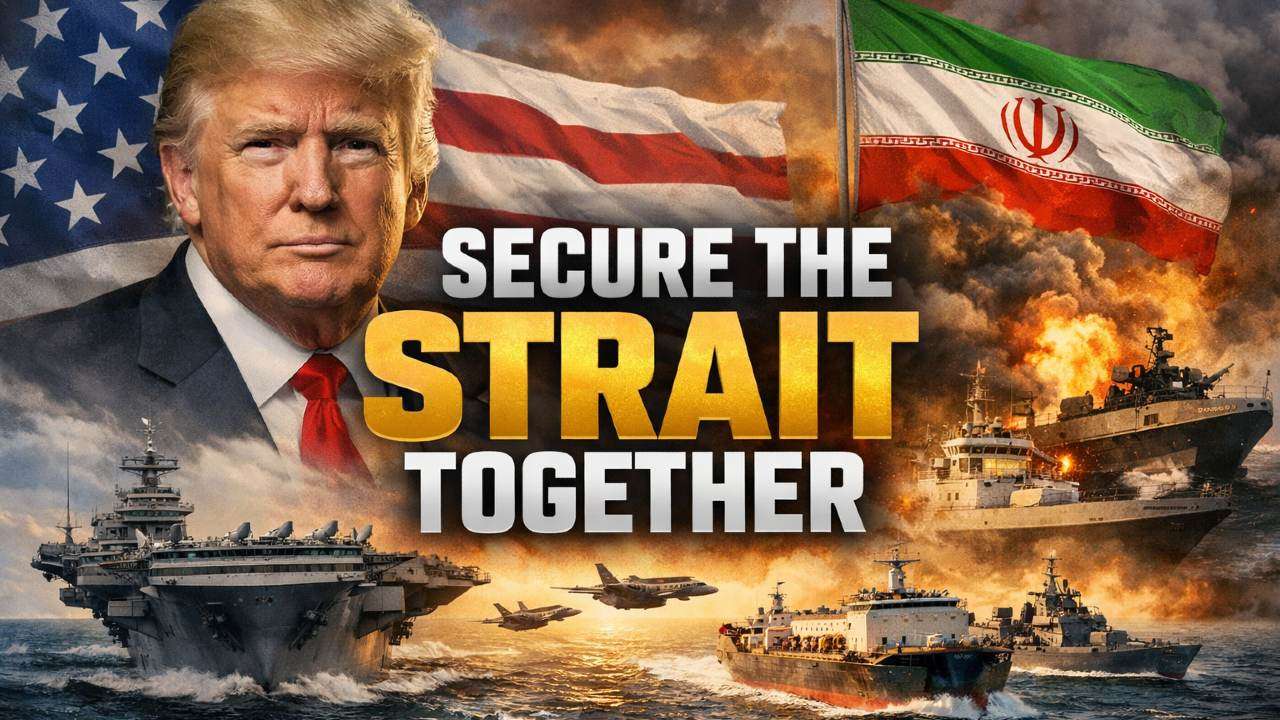
For decades, the world’s most consequential waterway has sat beneath the shadow of a hostile regime. The Strait of Hormuz — a sliver of water just 21 nautical miles wide at its narrowest point — serves as the jugular vein of the global economy. Approximately a fifth of the world’s oil passes through it, carried by roughly 3,000 ships each month. And for decades, the Islamic Republic of Iran has held that jugular in its hands. The current war has finally shown the world what happens when that grip tightens.
President Trump is right. He was right to call on allies to act, and he was right to frame it as a shared responsibility. More importantly, the principle behind his call — that no single hostile nation should ever again be permitted to weaponize the world’s most critical maritime corridor — ought to become permanent doctrine for every freedom-loving nation on earth.
The Cost of Complacency Is No Longer Theoretical
We are now living with the consequences of allowing this vulnerability to fester. The effective closure of the Strait of Hormuz has sent oil prices soaring above $100 a barrel, with Iranian officials threatening they could rise beyond $200. U.S. gas prices have spiked 23% since the conflict began. Around 1,000 oil tankers are currently stranded, unable to pass. Global supply chains are seizing. Economies that had nothing to do with the decisions that led to this war are now paying an enormous price because one rogue government holds the keys to one narrow stretch of water.
This is not a hypothetical scenario ripped from a think-tank white paper. This is happening right now, today, and the damage compounds with every passing day.
The Strait of Hormuz has become a key strategic battleground, and blocking vast amounts of oil has allowed Iran to impose a financial cost on the United States, its Gulf allies, and the broader global market — giving Tehran leverage in a war in which it has been thoroughly outgunned militarily. That is the fundamental injustice of the situation: a militarily defeated adversary is still winning on the economic battlefield because the world allowed it to retain a chokehold on global commerce.
A Universal Principle, Not a Partisan One
President Trump’s call to action has been met with diplomatic hedging and bureaucratic caution. Japan has suggested that naval operations in the Strait might not pass legal muster under its own constitutional framework. France positioned its naval assets in a “defensive” posture in the eastern Mediterranean rather than committing to escort operations. Australia announced it had not been asked and would not be sending ships.
These responses are understandable in the narrow political sense. But they are shortsighted in every other sense.
The United Kingdom, to its credit, appears to be moving in the right direction. UK Energy Secretary Ed Miliband stated plainly that his country is “intensively looking with allies at what can be done because it’s so important that we get the strait reopened.” That is the right instinct. The question of whether to secure international waters is not a question of loyalty to any one country or administration. It is a question of whether the international community believes that a hostile state actor should be permitted to switch off the global economy at will.
The answer must be an unambiguous no.
Trump’s Logic Is Sound — And It Goes Beyond This War
The president framed his appeal in terms of shared burden and shared interest. On Truth Social, Trump wrote that “the Countries of the World that receive Oil through the Hormuz Strait must take care of that passage,” calling it a “team effort” and pledging that the United States would coordinate and help “A LOT.” This is not the language of unilateralism. It is, in fact, a refreshingly honest articulation of what collective security ought to look like: nations that benefit from a resource bear a responsibility to defend it.
Trump made the point directly: “We’re always there for NATO. We’re helping them with Ukraine. It’s got an ocean in between us. Doesn’t affect us, but we’ve helped them. And it’ll be interesting to see what country wouldn’t help us with a very small endeavor, which is just keeping the strait open.” The logic is unimpeachable. If the principle of collective security means anything, it cannot be selectively applied only when the threat is geographically convenient for Europe.
But the argument for securing the Strait of Hormuz must not end when this war ends. That is the broader lesson that policymakers and strategists must absorb. The international community cannot wait for the next crisis to rediscover the obvious: that allowing a single state — particularly one with a decades-long record of hostility toward Western interests — to retain unilateral control over a waterway this economically vital is a standing invitation to catastrophe.
A Permanent International Framework
What President Trump’s call demands, in the long run, is more than a temporary naval coalition. It demands a permanent doctrine: that the Strait of Hormuz, like other critical global commons, must be secured by an international framework that prevents any one nation from weaponizing it. Whether that takes the form of a standing multinational escort mission, a treaty-based freedom-of-navigation guarantee, or some other architecture is a matter for negotiation. But the principle itself should not be up for debate.
The EU’s foreign policy chief, Kaja Kallas, pointed toward exactly this kind of thinking when she raised the idea of replicating the Black Sea Initiative — the framework that kept Ukrainian grain exports flowing during wartime — as a model for the Strait of Hormuz. That instinct is correct. International commerce cannot be perpetually held hostage to the political calculations of whatever regime happens to control the shoreline of a critical passage.
Free nations built the postwar order on the premise that open seas mean open economies, and open economies mean greater peace. That premise is being tested in real time. The lesson of the current crisis is not merely that Iran overplayed its hand. The lesson is that the world handed Iran that hand in the first place — and must never do so again.
President Trump is calling on allies to act. They should. Not because Washington demands it. Not because of tariff threats or alliance politics. But because the alternative — a world where any hostile power can shut down a fifth of the global oil supply whenever it chooses — is a world none of them can afford to live in.
The Strait of Hormuz must be free. And keeping it free must become a permanent commitment of the free world.