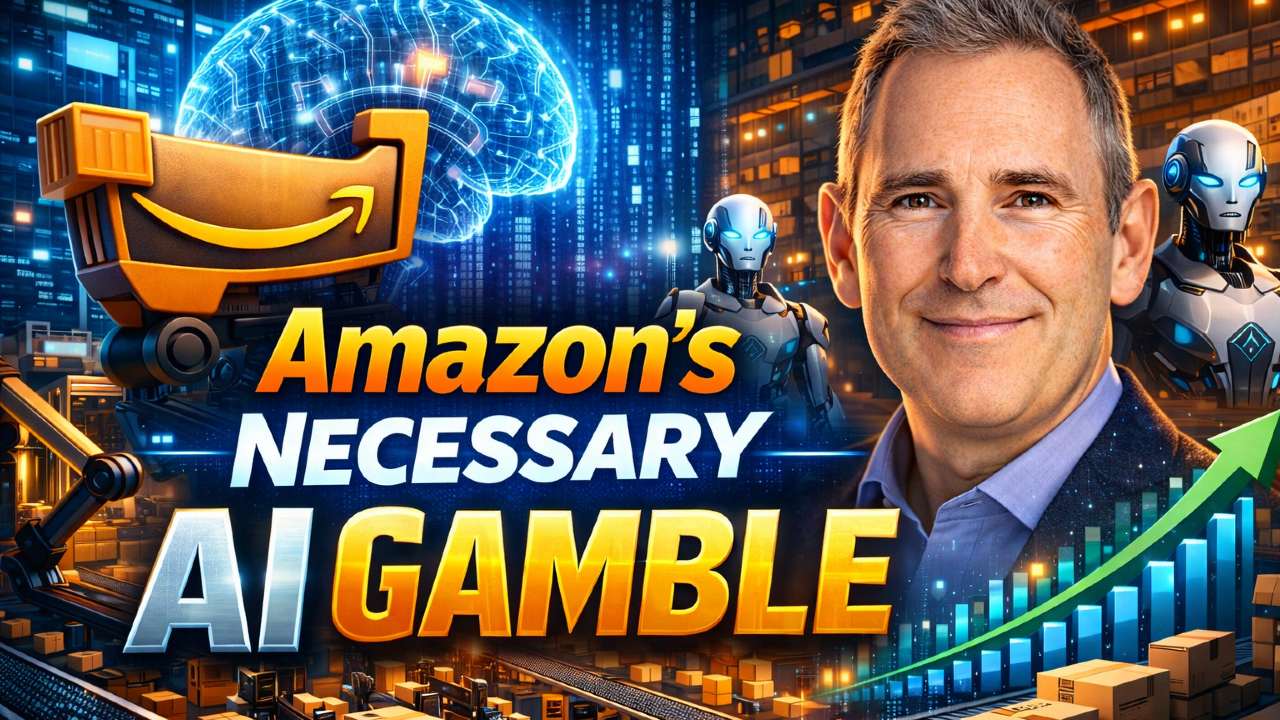
- The core argument: Amazon CEO Andy Jassy’s shareholder letter, released Thursday, isn’t just a business update — it’s a meditation on institutional courage, specifically the courage to tear down something that works rather than patch new technology onto old systems.
- The AI bet: Amazon is committing ~$200 billion in capital expenditures in 2026, primarily for AI infrastructure. Free cash flow dropped from $38B to $11B as a result, spooking Wall Street — but Jassy argues the demand is real, backed by a $100B+ OpenAI commitment and AWS AI revenue already running at $15B annually.
- Self-disruption: Jassy wants to rebuild the retail shopping experience from a blank page rather than layering AI onto existing systems. He calls going back to the starting line “one of the hardest decisions” a leader can make — and argues it’s less risky than standing still.
- The parallel-paths philosophy: Amazon runs multiple bets simultaneously (same-day fulfillment centers, Prime Air drones, Amazon Now 20-minute delivery) not as redundancies but as complements. This tolerates short-term messiness in exchange for a higher probability of finding the breakthrough.
- The Washington parallel: The article draws a direct line between Amazon’s institutional self-disruption and what the federal government should — but struggles to — do with its own obsolete systems. The resistance Amazon faces internally mirrors the political resistance to bureaucratic modernization.
- The broader lesson: Survival requires more than optimizing what already works. The article closes with Isaiah 43 as the grounding frame — the discipline of releasing what succeeded before because the new moment demands it.
There is a particular kind of corporate courage that rarely gets credited — not the courage to launch something new, but the courage to tear down something that works. Andy Jassy’s annual letter to shareholders, released Thursday, is a meditation on exactly that kind of nerve. At its center is a deceptively simple idea: that Amazon, one of the most successful commercial enterprises in human history, intends to rebuild its retail shopping experience from a blank page because the alternative — patching AI onto what already exists — would be a slower form of suicide.
“The temptation is to just add a little AI to the existing experience,” Jassy wrote. The trick, he argued, is “reimagining your experiences from a clean sheet of paper.” And then the admission that any honest executive must eventually face: “When you have a product that’s working at scale, one of the hardest decisions to make is to go back to the starting line.”
That sentence deserves more attention than it will probably receive amid the breathless AI coverage of 2026. Going back to the starting line is not merely a business decision. It is an act of institutional humility — the willingness to concede that even your greatest strengths can become liabilities if the world changes fast enough.
The Scale of What’s at Stake
Amazon closed 2025 at $717 billion in revenue, a 12% increase year over year. Operating income climbed to $80 billion. By any conventional measure, the company is winning. And yet Jassy is committing an estimated $200 billion in capital expenditures in 2026 alone — a figure so large it caused Amazon’s free cash flow to crater from $38 billion to $11 billion in a single year. Wall Street flinched. Amazon’s stock fell as much as 10% after the capex announcement in February.
Jassy’s response to the skeptics is characteristically direct. “We’re not investing approximately $200 billion in capex in 2026 on a hunch,” he wrote. He pointed to an agreement with OpenAI worth more than $100 billion as evidence that the demand is real, not imagined. AWS’s AI revenue already runs at $15 billion annually in the first quarter of 2026, growing at triple-digit rates year over year. Three years after generative AI became a commercial reality, that figure is nearly 260 times larger than where AWS itself stood three years after its own commercial launch. The comparison is not idle. It is the framework through which Jassy wants investors to understand the moment.
And the moment, he insists, is unlike anything the technology industry has previously seen. When ChatGPT launched in November 2022, it reached 100 million users in two months — four times faster than TikTok, fifteen times faster than Instagram. The analogy Jassy reaches for is electricity, and it is not an overreach. When Thomas Edison opened his first commercial power station in Manhattan in 1882, most observers understood it as a better lamp. They could not have mapped what would follow — the reorganization of every factory, home, and industry on the planet across the next four decades. Jassy’s estimate is that AI is moving ten times faster than electricity did. If he’s right, the companies that hedge their bets now will find themselves on the wrong side of a chasm that polite incrementalism cannot bridge.
Self-Disruption as Strategy
What makes Jassy’s argument genuinely interesting from a business philosophy standpoint — and what the Fox Business headline only grazes — is the willingness to name a failure mode that most large companies will never acknowledge publicly: the comfort trap. Institutions that have built something at scale develop enormous gravitational pull around that thing. Engineers, product managers, and executives build careers defending and optimizing existing systems. The incentive structure of a successful company works, almost by design, against the kind of creative destruction that produced the success in the first place.
Amazon has run into this wall before, and it has a track record of walking through it anyway. AWS itself was born over internal skepticism so severe that at a 2014 operating plan review, a senior company leader reportedly opened the discussion by asking aloud why Amazon was in the cloud business at all. The answer turned out to be hundreds of billions of dollars in revenue. The shopping experience reinvention Jassy is now promising carries that same weight of institutional risk and institutional potential.
The letter’s broader architecture reflects a company that has learned to pursue multiple paths simultaneously rather than debating which single path is correct. Jassy describes running three parallel delivery systems — same-day fulfillment centers, Prime Air drone delivery, and the Amazon Now twenty-minute service — not as redundancies but as complements, each serving different demand profiles and feeding the others. The same logic drives the grocery strategy, where years of experiments, some failed, crystallized into a business that now stands as the second-largest grocer in America with more than $150 billion in gross sales.
This instinct — to tolerate the mess of parallel bets in exchange for a higher probability of finding the breakthrough — runs directly against the tidy, committee-driven decision culture that suffocates most large organizations. It also requires a particular kind of leadership confidence that cannot be faked, because the short-term financial signals almost always argue against it.
What Washington Can Learn
It would be a missed opportunity to read Jassy’s letter as merely a tech CEO defending a capital budget. The deeper argument is about the relationship between institutional courage and institutional survival, and it carries lessons that extend well beyond Silicon Valley.
The federal government is in the middle of its own reckoning with obsolete systems — tax administration, healthcare delivery, defense procurement, immigration processing — all of which are held together with bureaucratic infrastructure built for a world that no longer exists. The difference is that when Amazon’s leadership fails to modernize, shareholders suffer and a competitor gains market share. When Washington’s bureaucracy fails to modernize, ordinary Americans pay the price in delays, errors, and a government that takes more than it delivers.
The efficiency push now underway in the executive branch — and the fierce resistance it is meeting from entrenched institutional interests — maps almost precisely onto the dynamic Jassy is describing. Going back to the starting line is hard. Defending the starting line is easy. Entire careers, entire agencies, entire political coalitions are built on the proposition that what already exists must be preserved.
Jassy quotes his own implicit framework when he notes that standing still in a moment of rapid technological change is riskier than rebuilding. “AI is not a standalone initiative,” he wrote. “It’s a multiplier. It will reshape every customer experience we offer and unlock entirely new ones.” Substitute “government service” for “customer experience,” and the sentence reads as a rebuke to every bureaucrat who has ever defended a broken process because it was the process.
The Weight of Beginning
Amazon has not perfected this discipline. The company has made expensive wrong turns, and the jury is still out on whether a $200 billion capital commitment is visionary or simply enormous. But the willingness to name the trap — to say plainly that the greatest risk is optimizing something that is already working — reflects a quality that distinguishes companies, and for that matter governments, that endure from those that simply plateau.
What Jassy is really saying is that survival requires more than competence. It requires the willingness to earn what you have all over again, against conditions that did not exist when you first built it. That is not a technology lesson. It is a lesson about the nature of achievement in a world that does not hold still. The question for every institution watching Amazon make this bet is not whether AI changes everything — it does — but whether they have the nerve to begin again.