

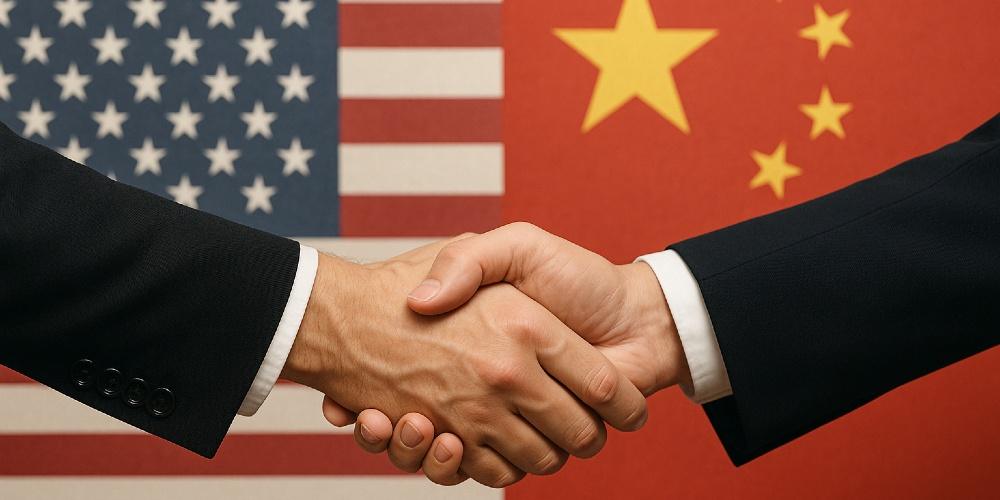
The global economy is holding its breath as reports suggest the United States and China are on the verge of finalizing a new trade deal—one that could mark a dramatic shift in the post-COVID economic order. According to Bloomberg, the agreement’s framework has been ironed out and now awaits the signatures of President Donald Trump and Chinese leader Xi Jinping. But beneath the surface of diplomatic pageantry lies a complex web of economic and political motives that could redefine how global trade, currency power, and supply chains operate for decades.
For the first time since Trump’s return to the White House, Washington and Beijing appear to be negotiating from positions of mutual necessity rather than dominance. The U.S. economy, burdened by record debt and inflationary pressures, is eager to restore stable trade flows and reduce cost pressures on key imports. Meanwhile, China faces an internal crisis of its own making: deflation, youth unemployment, a collapsing property sector, and capital flight that threatens the Communist Party’s grip on economic legitimacy. Each side needs this deal—but for entirely different reasons.
For Trump, the optics are both economic and political. A U.S.-China trade breakthrough could restore confidence among American manufacturers and farmers who endured years of tariffs and disrupted exports. But this is not the “free trade” model pushed by technocrats for decades. It’s transactional, strategic, and nationalist at its core. Trump’s team wants reciprocal market access, commitments to curb intellectual property theft, and stricter rules to prevent Chinese dumping of state-subsidized goods.
The goal isn’t global integration. It’s leverage.
For Xi, agreeing to these terms is less about goodwill and more about survival. China’s economic miracle has run headlong into the brick wall of demographic decline and over-leveraged growth. They’ve made bold but foolish economic decisions for the last two decades; many have said they overplayed their hand.
The country’s once-mighty real estate engine—responsible for roughly 30% of GDP—has imploded. The yuan is under constant pressure as investors flee for safer assets. A trade deal with Washington offers Xi the illusion of external stability, giving the Communist Party breathing room to contain domestic turmoil. Yet it also risks tightening America’s control over key export channels and financial flows.
The broader question is what this deal represents in the context of a global economy already fracturing along political lines. Washington’s policy elite—especially the entrenched bureaucracy at the Treasury and Federal Reserve—spent decades nurturing China’s rise under the assumption that interdependence would prevent geopolitical conflict. That theory has failed. The United States imported deflation and dependency, while China exported manufacturing dominance and surveillance technology. Now both nations are clawing back autonomy, but at a time when the dollar system itself is under strain from unprecedented debt monetization and central bank manipulation.
Consider the monetary backdrop. Since the pandemic, the Federal Reserve has quietly enabled the largest transfer of wealth in modern history—printing trillions to keep Wall Street solvent while real wages stagnated. Inflation may have cooled on paper, but the purchasing power of the dollar continues to erode. Every imported good, from electronics to fertilizer, becomes a political weapon in this environment. A trade agreement with China might stabilize short-term prices, but it doesn’t fix the underlying disease: the decoupling of currency from productive value.
Bringing back manufacturing is a righteous and long-overdue goal. The Trump administration has worked wonders in this regard as future jobs will fall to Americans instead of being outsourced. But there’s still pain ahead in order to correct the massive mistakes of our past. It’s a necessary pain, but that doesn’t make it any easier to swallow.
In truth, this deal—if signed—will be as much about managing perception as managing trade. Wall Street wants predictability. Corporations want open supply chains. Beijing wants credibility. And the Biden-era remnants within the global economic establishment would love nothing more than to spin this as proof that globalization still works.
But President Trump’s base didn’t elect him to play by their rules. If this deal strengthens domestic production and restores pricing power to American workers rather than multinational conglomerates, it could mark the beginning of a genuine economic realignment. If not, it will be yet another chapter in the long decline of Western self-sufficiency.
History offers perspective. The first U.S.-China trade normalization in the 1970s—engineered under Nixon and Kissinger—ushered in half a century of offshoring and dependency under the banner of “free markets.” The cost was hollowed-out towns, stagnant wages, and a financial system addicted to cheap foreign goods and cheaper credit. This new negotiation presents an opportunity to reverse that legacy, but only if Washington resists the siren song of corporate lobbyists who profit from permanent imbalance.
Ultimately, Americans should watch not the handshakes, but the fine print. The strength of this deal will depend on whether it restores economic sovereignty or merely stabilizes the illusion of it. If it’s the latter, the United States will remain chained to a global system built on debt, speculation, and digital fiat—while China continues its quiet march toward economic control through state capitalism and surveillance-driven trade.
Either way, the global financial order that rose from the ashes of Bretton Woods is nearing its breaking point. Trump and Xi may sign a document that eases tension for now, but the deeper forces reshaping global trade—monetary instability, resource scarcity, and technological bifurcation—will not be solved with a pen stroke. They require something far rarer in modern economics: a return to tangible value, sound money, and honest trade. Until that happens, every “deal” is just another patch on a sinking ship.
References:
- https://www.bloomberg.com/news/articles/2025-10-26/us-china-trade-talks-approach-final-details-greer-says
- https://www.imf.org/en/Publications/WEO
- https://fred.stlouisfed.org/series/M2SL
- https://www.wsj.com/world/china
- https://www.reuters.com/markets/asia/china-economy




I give it until the groups leave the room where the signing takes place before the CCP reneges on the deal and continues to screw the world. Show me just one time that the CCP held their part of any bargain.