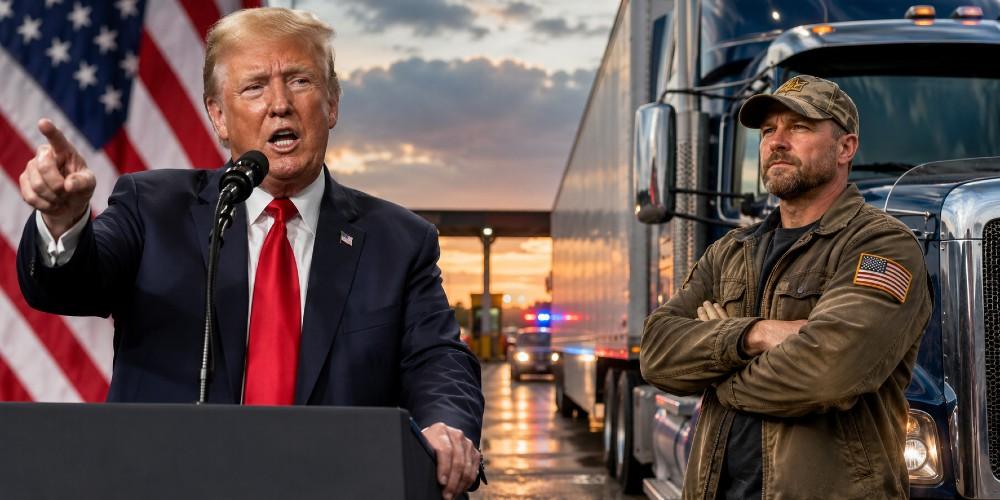
President Trump stood before the Pennsylvania Defense and Innovation Summit in Carlisle on Wednesday and made a promise that will resonate with every American who has watched an 18-wheeler drift across a lane line and wondered who was behind the wheel. Veterans who drove heavy trucks for the military will be automatically eligible for commercial driver’s licenses, and they will take the seats now occupied by illegal aliens the administration is stripping of their credentials.
“My administration will soon take historic action to get illegal alien truck drivers who are just killing a lot of people,” Trump said. “They can’t read signs. Many of them are on drugs or alcohol, and they shouldn’t be driving these things. And they came in totally illegally. We don’t want them, but they are driving all over American roadways, and we’re going to replace them with proud American veterans.”
The setting was not incidental. Pennsylvania State Trooper Michael Pahira Jr. was killed on July 1 while conducting a routine inspection on the shoulder of Interstate 81, struck by a truck driven by a Haitian national whose humanitarian parole had been terminated more than a year earlier. Massachusetts renewed his CDL anyway, this past February.
Let that sequence sink in. The federal government said the man had no right to be in the country in June of 2025, and a blue-state DMV handed him the keys to an 80,000-pound machine eight months later.
The veterans plan is good policy and better symbolism. A soldier who hauled fuel through Helmand Province can certainly handle I-80, and there is something fitting about the men and women who defended this country replacing those who broke into it. The administration’s enforcement numbers are already substantial; Transportation Secretary Sean Duffy has pulled more than 20,000 non-English-proficient drivers out of service and revoked over 28,000 illegally issued CDLs, with federal officers now working weigh stations in pursuit of roughly 194,000 more noncitizen license holders.
But here is the uncomfortable arithmetic. Weigh-station sweeps and license audits are retail enforcement, one driver at a time. The wholesale fix requires cutting off the demand side, meaning the trucking companies that knowingly put illegal aliens in their cabs because they work cheap and don’t complain. And the one institution that could do that nationally, the United States Senate, has been sitting on the Dalilah Law, named for a seven-year-old girl critically injured by an illegal alien trucker, since Senator Jim Banks introduced it the day after the State of the Union.
Anyone waiting on sixty votes to secure American highways should also be prepared to wait for the Cubs to win another World Series.
Scripture has a category for officials who see the danger coming and do nothing about it.
But if the watchman see the sword come, and blow not the trumpet, and the people be not warned; if the sword come, and take any person from among them, he is taken away in his iniquity; but his blood will I require at the watchman’s hand. (Ezekiel 33:6)
The DMV clerks, governors, and licensing bureaucrats who handed CDLs to unvetted foreign nationals were watchmen who saw the sword and pocketed the trumpet. The good news is that other watchmen have started blowing it, and they are not waiting for Washington.
Tennessee Already Did What the Senate Won’t
Two weeks ago, on the same day Trooper Pahira died, a new Tennessee law took effect making it a Class A misdemeanor, punishable by up to a year in jail and a $2,500 fine, for anyone unlawfully present in the United States to operate a commercial motor vehicle in the state. The same legislation makes it a misdemeanor for a company to knowingly let an illegal alien drive its trucks, and it exposes state employees who improperly issue CDLs to civil liability if that driver later maims or kills someone.
Officers who make arrests under the law must notify federal immigration authorities. Tennessee’s courts have shown no appetite for blocking this posture either; a companion state law criminalizing illegal presence survived its court challenge and took effect July 1.
State Senator Jack Johnson explained the gap his bill closed. “Current law restricts driver licensing eligibility, but does not expressly prohibit the operation of a commercial motor vehicle by a person unlawfully present,” he said.
Read that carefully, because it is the legal key to this entire fight. Tennessee did not criminalize hiring. It criminalized operating, and that distinction is what makes the whole strategy bulletproof.
Florida is going further. Legislation moving through Tallahassee would impound any truck driven by an illegal alien, fine the truck’s owner $50,000, and bar any motor carrier that owns, leases, or operates such a truck from doing business in Florida at all, with the shutdown order remaining until violations are cured and fines paid.
State Senator Don Gaetz put it plainly. “The purpose of the bill is to remove imminent hazards from our highways and to discourage and penalize those who would use illegals to operate a commercial vehicle on Florida roads,” he said.
A companion measure would force carriers that hire illegal aliens to pay out of pocket for crash injuries. Arizona lawmakers want falsified CDL possession treated as a felony, Indiana Governor Mike Braun has pledged to revoke illegal aliens’ CDLs and penalize the companies employing them, and Ohio has begun revoking noncitizen CDLs by the thousands.
The Supreme Court Already Drew the Map
Honesty requires acknowledging the obstacle first. Federal law does preempt state fines and criminal penalties against employers for the act of hiring unauthorized aliens. Congress claimed that ground in the Immigration Reform and Control Act of 1986, and the Supreme Court’s decision in Arizona v. United States in 2012 showed what happens when states wander into pure immigration regulation. Any state that passes a law reading “thou shalt not employ illegal aliens, penalty $50,000” is inviting a federal judge to shred it.
But Congress left two doors wide open, and the Court has already walked states through both. The first is the licensing carve-out. The same federal statute that preempts employer sanctions explicitly exempts “licensing and similar laws,” and in Chamber of Commerce v. Whiting in 2011, the Supreme Court upheld an Arizona law that revoked the business licenses of companies employing unauthorized workers. States license carriers, register vehicles, and grant intrastate operating authority. Every one of those privileges can be conditioned and revoked.
The second door is even wider. Highway safety is the oldest and most jealously guarded of state police powers, and federal transportation law expressly preserves state safety authority over motor vehicles even while preempting economic regulation of trucking.
That is why Tennessee and Florida wrote their laws around who may operate a commercial vehicle on their roads rather than who may be hired. A trucking company headquartered in Chicago or Fresno submits to Tennessee’s jurisdiction the moment its rig crosses the state line, exactly as it submits to Tennessee’s weight limits, inspection regime, and speed laws.
Out-of-state carriers enjoy no immunity here. If your driver is an imminent hazard on our pavement, the state can impound the truck, park the company, and let a jury sort out the rest.
Let the Trial Lawyers Finish the Job
That last piece deserves emphasis, and to be clear, this is a roadmap rather than enacted law in most states. If legislatures declare that putting an unvetted illegal alien behind the wheel of a big rig constitutes negligence in itself, every plaintiff’s attorney in America becomes an unpaid enforcement agent. No prosecutor needed, no agency budget required.
The trucking industry already trembles before nuclear verdicts, and insurers will simply refuse to write coverage for carriers running dirty driver rosters. Florida’s pay-out-of-pocket provision points in exactly this direction. The moment the cheap illegal driver becomes the most expensive liability on the balance sheet, the business model that created this crisis dies of natural causes.
Expect the coming lawsuits to produce a spectacle worth savoring. The same progressives who spent a decade wrapping sanctuary cities in the sacred mantle of state sovereignty will race into federal court to argue that states have no authority over their own highways. Their reverence for federalism, it turns out, extends precisely as far as its usefulness for shielding lawbreakers.
Trump’s veterans will fill the cabs, and they will be welcome. But the frame that holds the picture is being built in Nashville, Tallahassee, and Phoenix, where legislatures have discovered they possess constitutional tools no filibuster can touch.
Roughly two dozen red states have not yet copied Tennessee’s statute. Every one of them should do it before the next trooper’s funeral, because the watchman who sees the sword coming and stays silent will answer for the blood.