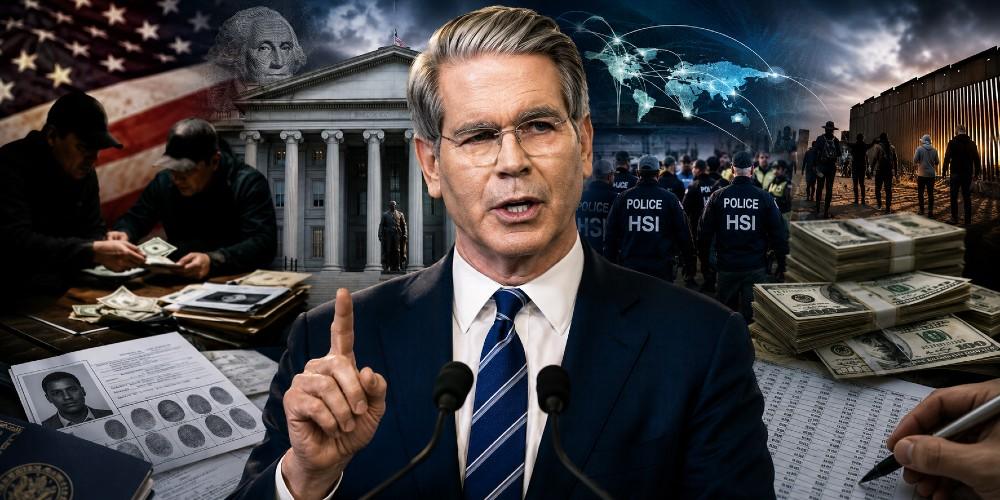
Treasury Secretary Scott Bessent delivered a stark warning this week: illegal employment schemes fueled more than $2.5 billion in suspicious payroll tax fraud activity in 2025 alone. Speaking to Texas bankers in Houston, Bessent exposed how labor brokers, shell companies, and identity theft operations exploit America’s financial system at the expense of law-abiding citizens.
These schemes do not merely bend rules. They systematically undermine the wages of American workers, drain taxpayer resources, and create pipelines for transnational criminal organizations. Under the previous administration’s open-border policies, such exploitation flourished. The Trump administration is now moving decisively to shut it down.
Financial institutions reported the massive suspicious activity tied directly to unlawful employment practices. Bessent connected the dots clearly: criminal networks use these arrangements to hire unauthorized workers while evading payroll taxes, often through complex layers of shell entities and stolen identities.
“In 2025 alone, financial institutions reported more than $2.5 billion in suspicious activity associated with payroll tax fraud schemes,” Bessent stated. “These schemes hurt law-abiding businesses, depress wages, steal taxpayer dollars, facilitate identity theft, and create opportunities for transnational criminal organizations to generate and move illicit proceeds.”
The remarks align with a new FinCEN advisory that equips banks to spot red flags without turning them into immigration enforcers. Instead, it calls on financial institutions to do what they already do best: monitor for risk, recognize suspicious patterns, and report illicit activity. Updated guidance further enables faster information sharing among banks to combat fraud more effectively.
Texas stands at the epicenter of these challenges after years of unchecked illegal immigration. Criminal organizations and cartels have treated the financial system as just another tool for exploitation. Bessent emphasized that community banks often serve as the first line of defense, detecting emerging threats before they register in national data.
“Economic security is national security,” he declared. This principle undergirds the broader White House Task Force to Eliminate Fraud, led by Vice President JD Vance. The administration refuses to allow illegal aliens to abuse financial institutions and rob hardworking American taxpayers.
Payroll tax evasion through these schemes has long plagued sectors like agriculture, construction, hospitality, and domestic services. Employers and labor brokers hide unauthorized workers off the books, underreport wages, or cycle them through third-party arrangements that obscure true employment relationships. The result is not just lost revenue for Social Security and Medicare. It depresses wages across entire industries and leaves American workers competing against a shadow labor force that operates outside the law.
This crackdown represents more than bureaucratic housekeeping. It strikes at the heart of a system that rewarded lawlessness while punishing those who play by the rules. Law-abiding businesses faced unfair competition. Taxpayers footed the bill for services strained by a population that contributes little while extracting much. And families watched their communities transformed by policies that prioritized globalist ideals over American sovereignty.
The Bible reminds us that justice and righteousness form the foundation of any thriving society. As Psalm 89:14 declares, “Justice and judgment are the habitation of thy throne: mercy and truth shall go before thy face.” Restoring integrity to our financial and immigration systems honors this divine order, protecting the vulnerable while holding the wicked accountable.
By empowering banks to report these patterns and coordinating across government agencies, the Trump administration signals a return to basic governance: secure borders, fair competition, and fiscal responsibility. Americans have endured enough of the previous era’s deliberate blindness to these costs. The $2.5 billion figure represents just the visible tip of a much larger problem now coming under scrutiny.
The path forward demands continued vigilance. As enforcement ramps up, the true scale of this underground economy will likely prove even more staggering. Yet the message from Treasury rings clear: the era of exploiting America’s generosity and institutions for criminal gain is ending.