For generations, the conventional wisdom went something like this: serious money lives in New York. The serious decisions about who gets capital, who gets to list on an exchange, who gets to participate in the grand machinery of American finance — all of it emanated from a few square miles of lower Manhattan, governed by institutions so entrenched they seemed geological. Wall Street wasn’t just an address. It was a statement about where power lived and who held it.
That era is ending. And the remarkable thing isn’t simply that it’s ending — it’s why it’s ending, and what that tells us about the fundamental incompatibility between left-wing governance and economic vitality.
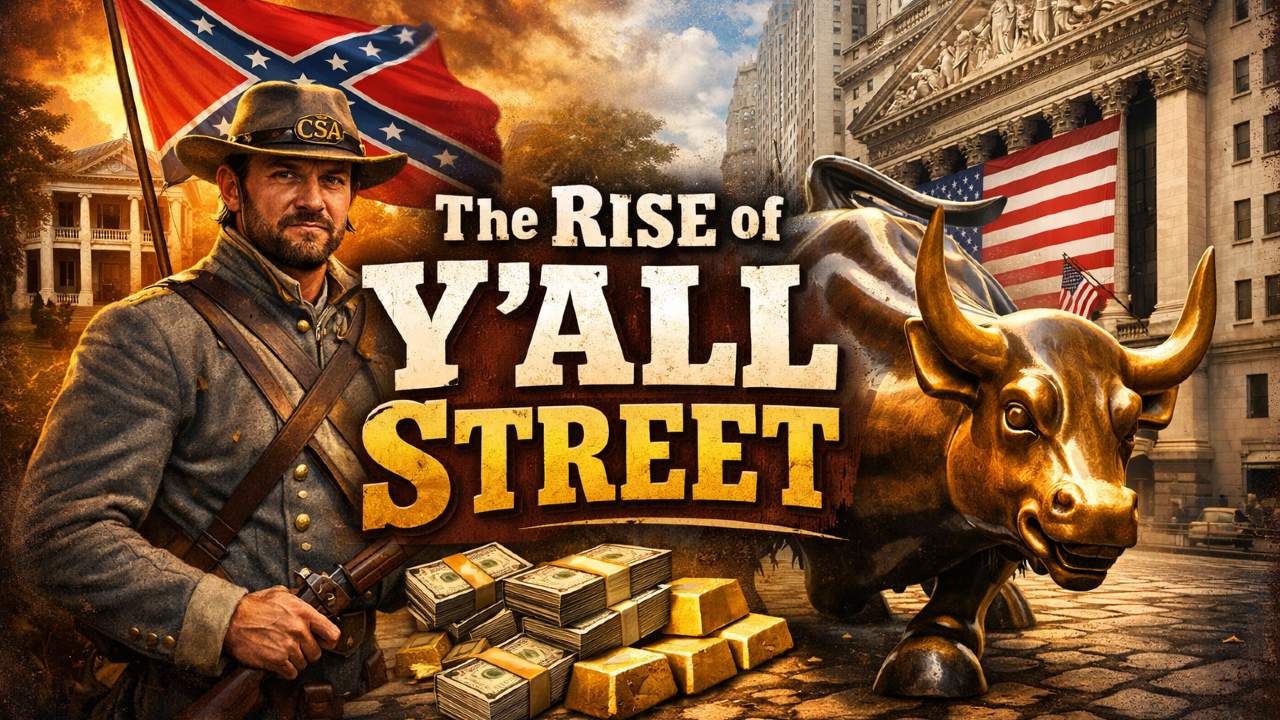
The Rise of Y’all Street
The numbers are no longer subtle. The Dallas-Fort Worth-Arlington metro area now employs more than 386,000 professionals in financial activities, placing it second in the nation — trailing only New York City — in financial services employment. That is not a footnote. That is a tectonic shift. New York has seen just 16% growth in investment and securities employment over the past twenty years. Texas, in that same period, experienced 111% expansion. One hundred and eleven percent. The comparison isn’t even sporting.
What’s assembling in North Texas represents not merely a relocation of bodies and desks, but the wholesale reconstruction of financial infrastructure. Goldman Sachs is building a $500 million campus in Dallas that will house more than 5,000 employees — which will make it the bank’s largest hub outside of New York. JPMorgan Chase’s headcount in Texas has now surpassed its presence in New York City, with roughly 31,000 employees in the Lone Star State compared to 24,000 in New York. Wells Fargo opened its two-tower, 850,000-square-foot facility in Irving in October 2025. Charles Schwab relocated its corporate headquarters from California to the Dallas suburbs five years ago and never looked back.
Meanwhile, the New York Stock Exchange relocated its Chicago branch to Dallas, rebranding it as NYSE Texas, citing Texas’s growing population, strong economic fundamentals, and business-friendly regulatory policies. And perhaps most symbolically, the SEC authorized the Texas Stock Exchange to operate as a national securities exchange, with backing from BlackRock, Citadel, Charles Schwab, and other major institutions — planning to launch in 2026 as a direct competitor to the NYSE-Nasdaq duopoly.
The Texans have named this corridor, with characteristic humor and without an ounce of self-consciousness, “Y’all Street.” It is not an ironic name. It is a confident one.
The Policy Verdict
Let’s be precise about what is happening here, because the temptation to frame this as mere Sun Belt lifestyle preference — warm weather, lower housing costs, a slower pace — badly understates the case. People don’t move Goldman Sachs. They don’t relocate JPMorgan’s center of gravity because of the barbeque, however excellent it may be. These are hard-nosed calculations made by institutions whose entire purpose is the efficient allocation of capital. When they vote with their balance sheets, it means something.
What they are voting against is not hard to identify. Between 2005 and 2025, New York lost 9.6% of its prime working-age population, while Texas grew its working-age population by 32.5% over the same period. A survey of more than 500 New York business leaders found that 72% do not believe the state’s economic conditions are good, and only 21% believe New York is on the right track. The state ranked 50th in both migration and taxation for the 2020-2022 period. Dead last. In the most powerful nation in the history of the world, the Empire State has achieved the remarkable distinction of being the most hostile environment for both taxpayers and transplants.
New York state income tax reaches 10.9%, and New York City adds up to an additional 3.876%, creating one of the highest combined tax burdens in the country. The state has lost $111 billion in net adjusted gross income over the last decade to tax migration. One hundred and eleven billion dollars in income — gone. Departed. Relocated to states that chose to govern rather than confiscate.
The political class in Albany and New York City has responded to this data with the bureaucratic equivalent of sticking their fingers in their ears. Rather than acknowledge the obvious relationship between punishing taxation and capital flight, New York’s progressive leadership has proposed doubling down. New York City’s mayoral primary winner ran on a platform that would raise the combined city and state top rate to 16.776% — the highest in the nation. Add federal obligations, and the total tax burden for the city’s top earners would rise to nearly 54%. Fifty-four cents of every dollar earned, surrendered to government before the earner can deploy it, invest it, hire with it, or keep it. The progressive mind looks at this number and sees justice. The market looks at the same number and sees a moving van.
What Texas Did Right
The Spectator article framing this migration in terms of “Y’all Street eating Wall Street’s lunch” is generous. Texas didn’t just set a better table — it built an entirely different kitchen, staffed it, and invited the entire financial industry in for supper.
Texas, and particularly the Dallas-Fort Worth area, attracted major firms with a combination of zero state income tax, affordable housing, and a welcoming business climate — a formula that has turned the region into the second-largest financial services hub in the United States. The state did not achieve this through subsidies, corporate welfare, or the kind of crony arrangements that progressives rightly condemn. It achieved it by getting out of the way — by refusing to treat productive enterprise as a piggy bank to be cracked open whenever the political class runs short of spending ideas.
The population shift to the South is accelerating. According to the 2026 HireAHelper Moving Migration Report, South Carolina gained 79 net residents per 10,000 in 2025, Tennessee gained 47, and Alabama gained 36. New York, by contrast, lost 28 per 10,000, and California lost 25. Even more telling for the long-term cultural and economic trajectory: between 2014 and 2023, SEC universities saw a 91% surge in undergraduates from out of state, with many students seeking a campus culture that is the antithesis of Northeastern or West Coast woke progressivism. The flight is not merely economic. It is civilizational.
U-Haul’s 2025 data, compiled from over 2.5 million one-way rental transactions, shows Texas leading the nation for the seventh time in a decade as America’s top domestic migration destination. California sits at the bottom of the rankings for an unprecedented sixth consecutive year. Joining it there are Illinois, New Jersey, New York, and Massachusetts. Every state in that bottom tier is governed by the same philosophy: that government knows better than the market how to allocate resources, that high earners are a permanent feature of the landscape who can be taxed without consequence, and that progressive virtue expressed through regulation and redistribution is a substitute for sound governance. The U-Haul data is the market’s verdict on that philosophy.
The Parable the Left Won’t Read
There is a simple parable embedded in all of this, one whose lesson has been available for centuries. Proverbs 14:23 puts it plainly: “In all labour there is profit: but the talk of the lips tendeth only to penury.” The progressive project is, in its essence, the talk of the lips — endless promises, expansive programs, and the serene confidence that righteous intention can overcome the basic arithmetic of human incentive. The market is the labor. And the labor, patient as it is, eventually picks up and goes somewhere it is welcomed.
New York’s governors and mayors can hold any number of press conferences about economic equity and the moral imperative of the wealthy paying their fair share. The conference rooms of Goldman Sachs’s new Dallas campus won’t be listening. Texas can hold any number of ribbon-cuttings, and it has been. The difference is that Texas’s ribbon-cuttings come at the end of actual construction, for actual buildings, housing actual jobs.
The Broader Lesson
What is unfolding in the American financial landscape is not an accident or a trend destined to reverse itself when the next Democratic administration adjusts the federal tax code. It represents something more durable: a structural rebalancing of economic gravity toward states that have chosen to be governed rather than managed, toward environments that treat enterprise as a virtue rather than a necessary evil to be extracted from.
TXSE executive leadership has stated plainly that Dallas will, whether before the end of this decade or in the next, become a financial capital. That is a bold claim. It is also, given the trajectory of the data, a reasonable one.
The question facing the governing class in New York and California is not whether this is happening. The numbers are unambiguous. The question is whether they possess the intellectual honesty to understand what they caused and the political courage to change course before the damage becomes irreversible. Their track records do not inspire confidence. New York’s response to its millionaire exodus has been to propose a new millionaire’s tax. California’s response to its corporate exodus has been to propose a wealth tax. These are not the responses of governments capable of honest self-examination.
The rest of the country, meanwhile, is being run by people who have read the ledger and drawn the obvious conclusion. Freedom works. Low taxes work. Treating citizens as sovereign adults capable of directing their own economic lives works. The proof isn’t ideological. It’s demographic, financial, and architectural — five thousand Goldman Sachs employees making their way to Dallas, with more to follow.
Y’all Street didn’t steal Wall Street’s lunch. Wall Street handed it over, one punitive tax hike at a time.