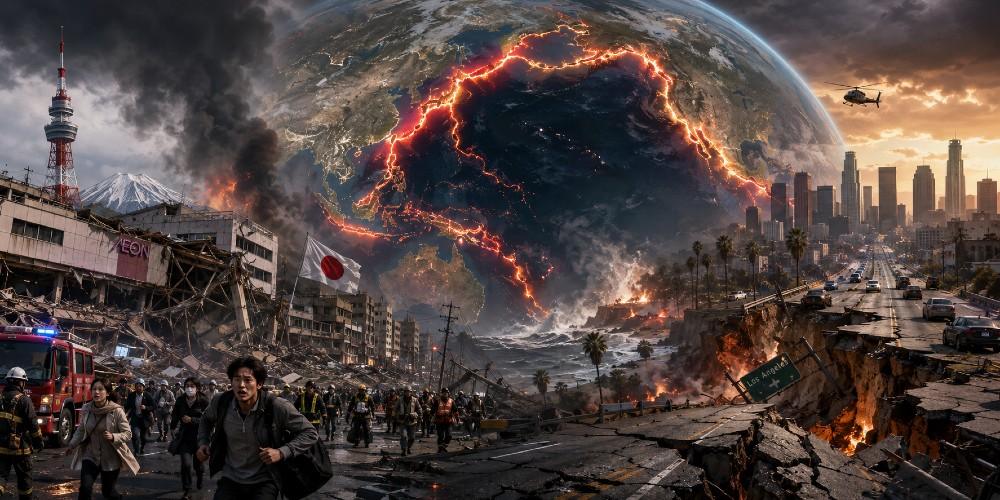
(The Economic Collapse Blog)—The Pacific Ring of Fire has been extremely active this year, and that should deeply alarm all of us. Approximately 90 percent of all global earthquakes occur along the Pacific Ring of Fire, and we have just gotten another reminder that danger is potentially lurking every single moment of every single day.
Those that were killed by the magnitude 7.1 earthquake that just hit Japan were just living their lives like normal when disaster suddenly struck. Unfortunately, the entire west coast of the United States also sits directly along the Pacific Ring of Fire, and scientists openly acknowledge that the clock is ticking.
As far as I know, nobody was forecasting that a magnitude 7.1 earthquake would hit Japan on Tuesday.
But that is precisely what happened…
A 7.1-magnitude earthquake hit Japan’s southern Kumamoto prefecture on Tuesday, knocking out power to thousands of homes, rupturing roads and leaving some trapped and others presumed dead inside a partially collapsed shopping mall.
Speaking to reporters from her office in Tokyo, Japanese Prime Minister Sanae Takaichi said authorities were still assessing the full extent of the damage in the area, which was devastated by a deadly quake a decade ago.
“We have already been informed that people have been injured. Power outages and fires have occurred in some areas, and there has also been damage to roads and bridges and the collapse of buildings,” Takaichi said.
One moment, local residents were casually strolling through a shopping mall.
But then everything started shaking and the shopping mall collapsed right on top of them…
Footage on social media shows members of the public running for cover and crouching down on the floor as the ground shook at the shopping centre.
An unknown number of people are believed to have become trapped in the rubble of the mall, with rescue operations being carried out, the Fire and Disaster Management Agency said.
There have also been several reports of injuries and damage to roads, bridges and buildings, as well as blackouts and fire.
Videos on social media showed clouds of smoke billowing into the air as flames engulfed a building, while firefighters scrambled to tackle the blaze.
This is a great tragedy, and it shows how quickly something like this can occur.
But it shouldn’t be a surprise to any of us.
Throughout 2026, Japan has been hammered by sizable earthquakes over and over again.
Back on April 20th, northern Japan was hit by a magnitude 7.7 earthquake…
On April 20 this year, a tremor measuring 7.7 hit the country’s north, injuring at least 10 people and shaking large buildings in Tokyo.
This prompted authorities to issue a special advisory warning of an increased risk of earthquakes of magnitude 8.0 or stronger.
That one made headlines all over the planet.
About a month ago, a magnitude 7.2 earthquake shook northern Japan on June 25th…
At least 10 people were injured after a magnitude 7.2 earthquake hit northern Japan on Thursday morning, registering a rare upper 6 on the Japanese seismic intensity scale of 7 in the town of Hashikami, Aomori Prefecture. No tsunami warning has been issued.
A mild quake was also felt in Tokyo.
The Japan Meteorological Agency said the epicenter was 44 kilometers deep off the coast of Iwate Prefecture.
One day later, a magnitude 5.6 earthquake rattled Yamanashi Prefecture’s Fuji Five Lakes area…
An earthquake with an estimated magnitude of 5.6 hit Yamanashi Prefecture’s Fuji Five Lakes area at 10:28 p.m. on Friday, registering a lower 6 on the Japanese seismic intensity scale of 7 in Fuji-Kawaguchiko, according to the Japan Meteorological Agency.
The JMA estimates that the earthquake originated at a depth of 20 kilometers. The earthquake did not trigger a tsunami.
Two days after that, residents of Iwate Prefecture were awakened by a magnitude 6.1 earthquake…
A magnitude 6.1 earthquake struck off the coast of Iwate Prefecture early Sunday, the latest in a spate of temblors to shake the area.
The quake, which occurred at 5:21 a.m., registered a lower 5 on the Japanese seismic intensity scale of 7 in Hachinohe, Aomori Prefecture. No tsunami warning was issued.According to the Japan Meteorological Agency, the epicenter was at a depth of approximately 40 kilometers.
I could provide many more examples, but I think that most of you get the point by now.
Japan is being shaken over and over again, and there is no end in sight.
Here in the United States, we have been very fortunate.
There have been a lot of sizable earthquakes along the west coast this year, but no really big ones.
That is the good news.
The bad news is that the amount of accumulated tectonic stress in Southern California is “higher today than at any point over the last 1,000 years”…
And the time is ripe. According to a new paper, published in the Journal of Geophysical Research, accumulative stresses in the Earth’s crust in California are higher today than at any point over the last 1,000 years, raising concerns over the potential for a massive rupture in the Los Angeles region.
The research could help scientists better understand the specific conditions that come ahead of massive earthquakes, giving us a clearer picture of what range of potentially devastating scenarios we should be ready for. Predicting when these events will occur, however, remains next to impossible, despite scientists’ best efforts.
The densely populated LA region is home to the Cajon Pass, a “critical fault junction,” meaning that a major earthquake could cross from one fault line to the other. The international team led by University of Bern Earth sciences researcher Liliane Burkhard modeled 1,000 years of earthquake history along these fault systems. They found that tectonic stresses, measured in force per unit area, have been building up since the last 7.9 magnitude quake that shook the LA region in 1857, reaching and even exceeding the highest levels over the last millennium.
Yes, a “massive rupture” is most certainly coming.
This is something that I have been warning about for many years.
So what would such a disaster look like?
One expert is warning that a magnitude 7.8 earthquake in Southern California would cause more than a trillion dollars in damage…
When the next “Big One” hits, it could carry a massive price tag, according to a California earthquake expert.
A magnitude 7.8 earthquake along the southern San Andreas Fault, rupturing from Imperial County to Los Angeles County, could result in an estimated $1 trillion in damage across Southern California.
That’s according to a state earthquake expert who calculated the costs based on previous disasters, including the recent Los Angeles wildfires. The estimate has also been adjusted for inflation.
In my opinion, when the “Big One” finally arrives it will do far more damage than that.
Much of Southern California is just barely above sea level.
When the “Big One” strikes, the ground on one side of the San Andreas fault could end up sitting much higher than ground on the other side of the San Andreas fault.
The magnitude 7.8 earthquake that hit the Philippines earlier this year raised the seabed in some areas by about 6 feet.
So don’t think that it can’t happen.
What we have witnessed so far is just a preview.
Much larger earthquakes are on the way, and the vast majority of those living along the Pacific Ring of Fire are completely and utterly unprepared.
Michael’s new book entitled “10 Prophetic Events That Are Coming Next” is available in paperback and for the Kindle on Amazon.com, and you can subscribe to his Substack newsletter at michaeltsnyder.substack.com.