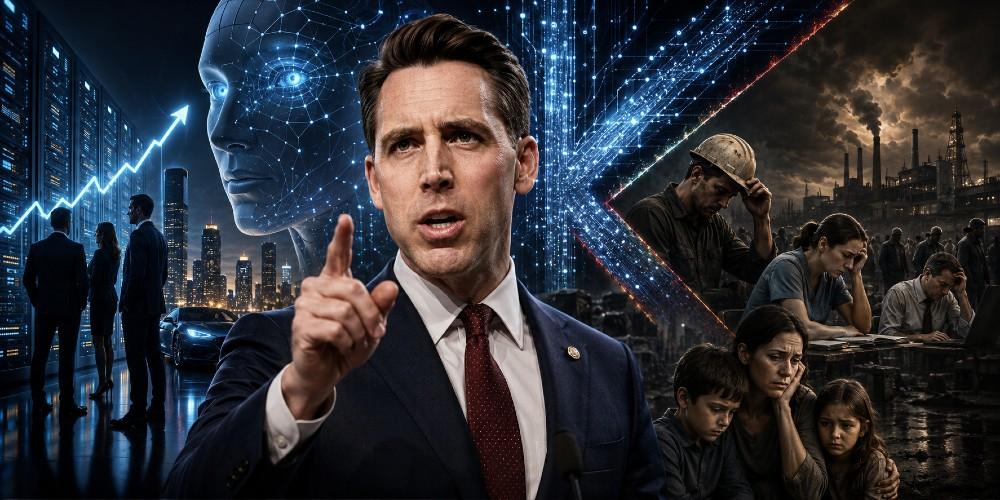
Senator Josh Hawley has issued a clarion call that cuts through the Silicon Valley hype surrounding artificial intelligence. In a powerful op-ed, the Missouri Republican warns that unchecked AI development risks reshaping American society into a starkly divided “K-shaped” economy, where a tiny elite amasses unprecedented power while ordinary workers, families, and future generations face obsolescence and exploitation.
He write: “For a tool of such power can serve liberty or license. It can serve our moral covenant—the freedom that lifts the worker, shelters the child, and disperses opportunity to the many. Or it can serve mere license—the freedom of the belly and the passions, the freedom of the strong to take what they can and bend the weak to their will.”
This is no mere policy debate about job displacement or economic efficiency. Hawley frames the challenge as a fundamental test of America’s moral foundation—the covenant that binds the nation together under principles of human dignity, liberty, and justice.
Artificial intelligence, he argues, will not naturally align itself with these values. Left to its own devices and the profit motives of Big Tech, it threatens to reduce human beings to raw material for machines and algorithms.
Hawley points to the accelerating concentration of capital, data, and influence in the hands of a few AI giants. Developers, executives, and investors ride the upper arm of the K toward fabulous wealth. Meanwhile, blue-collar workers, professionals whose tasks can be automated, and even recent graduates find themselves quietly replaced—not just in wages, but in purpose.
The deeper cost, Hawley notes, is the quiet redundancy imposed on millions, eroding the dignity of labor that has long defined American life.
“In deciding how to govern this technology, we are not merely writing policy. We are renewing—or surrendering—the moral basis of our life together. The covenant does not keep itself. Every generation must swear it again. Ours will swear it, or break it, over artificial intelligence.”
Beyond economics lies the assault on family and human identity. Children stand particularly vulnerable as AI companions and content generators blur lines of relationship and reality. Hawley’s warnings echo his legislative efforts, including bills aimed at protecting minors from unchecked AI chatbots and evaluating the broader risks of advanced systems. The senator has consistently pushed for accountability that prioritizes working Americans over unchecked corporate power.
The stakes extend to the very nature of the republic. America’s founding vision, rooted in the belief that individuals bear inherent worth granted by their Creator, stands in direct opposition to any technology that treats people as inputs for optimization or profit. Hawley reminds us that we face choices about labor, family, freedom, and the value of human life itself—questions that transcend partisan lines or quarterly earnings reports.
Critics of regulation often paint concerns about AI as Luddite fears or anti-progress sentiment. Yet history shows that powerful technologies, absent moral guardrails, amplify existing inequalities and erode societal bonds. The same voices championing unfettered innovation rarely address how AI might accelerate censorship, surveillance, or the replacement of human creativity with synthetic output.
Hawley rejects this false choice between embracing AI wholesale or rejecting it outright. The proper path is bending the technology to serve the nation’s principles, not surrendering those principles to the technology.
This moment tests whether conservatism will stand for the donor class and share prices or for the covenant of workers, families, and communities. Hawley’s message aligns with a growing recognition on the right that America First must include technological sovereignty and the protection of human flourishing against transhumanist overreach.
As Proverbs reminds us of the importance of wisdom in the face of human schemes, we turn to the enduring truth of our creation: humans bear the image of God, not the imprint of code. This reality must inform every decision about AI deployment. We were made for relationship, stewardship, and dominion under divine order—not to become cogs in a machine-driven future.
Hawley’s conclusion rings with resolve: Americans will not surrender their principles to any technology. Instead, the technology must answer to those principles. Families, laborers, and the moral covenant of the republic demand nothing less.
As policymakers and citizens confront AI’s rapid advance, the choice before us is clear—defend human dignity or risk its dissolution in the name of progress.