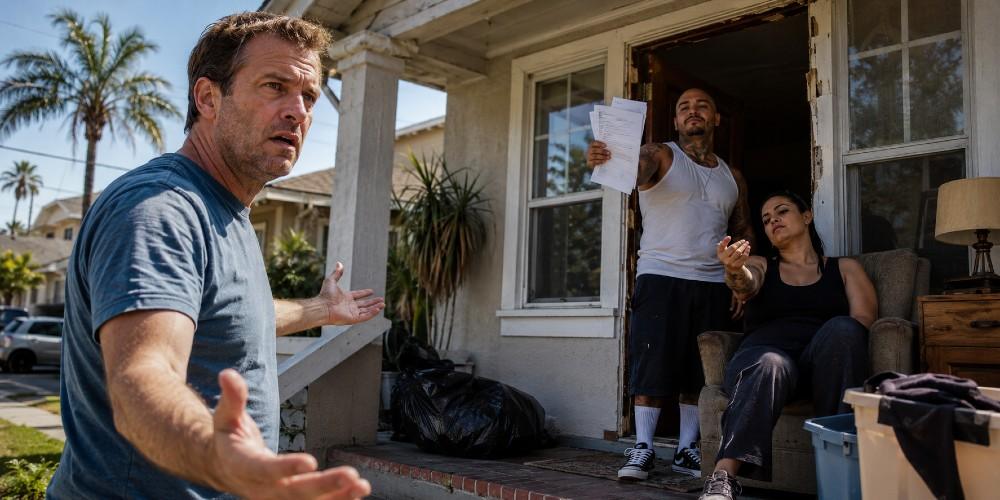
There is a word for demanding tens of thousands of dollars from a man before you’ll give him back what you took from him. That word is extortion. But in Los Angeles, when the thing taken is a house, the state calls it a landlord-tenant dispute and tells the victim to hire a lawyer.
That single act of miscategorization, repeated thousands of times across California, has built an entire criminal industry, and the people who investigate it for a living are now begging the city to admit what everyone already knows.
Former LAPD Lt. Moses Castillo and veteran private investigator Michael Youssef told Fox News Digital that professional squatters are exploiting fake leases, forged documents, and legal loopholes to take over homes in Los Angeles, and that many of these cases extend far beyond traditional landlord-tenant disputes into allegations of fraud, identity theft, forged property documents, and in some instances gang activity, narcotics activity, and extortion-style demands for money.
Both men are calling for a dedicated anti-squatter task force so law enforcement can distinguish a genuine tenant dispute from an organized crime operation wearing a tenant dispute as a costume.
Youssef’s description of what happens to these homeowners should be read carefully, because it is not the language of a housing problem. “They basically hijack the property and they hold it hostage until you pay them off,” he said. “It’s almost like the property is being held for ransom.”
And the ransoms are real. Castillo described homeowners forced to hire attorneys and private investigators before ultimately paying so-called cash-for-keys settlements just to persuade unlawful occupants to leave. “You want me out? Then pay me $20,000. Pay me $40,000,” Castillo said. “That’s what’s happening.”
Youssef says he has seen worse. In one Long Beach case, he said, the occupants demanded half a million dollars.
An Industry With Its Own Consultants
What separates this from the drifter-in-a-vacant-house story of decades past is the professionalization. Youssef says squatters have grown increasingly sophisticated, using online forums, social media groups, and what he calls “criminal consultants” who provide step-by-step instructions on exploiting tenant-protection laws.
“They give you step-by-step what to do and what laws to invoke,” he said. Occupants learn how to manufacture documentation supporting false residency claims and how to drag out procedural delays that were designed to protect actual tenants from actual abusive landlords.
Think about what that means. California’s tenant protections have become so lopsided, so mechanically exploitable, that a cottage industry of instructors now teaches strangers how to weaponize them against homeowners. The law was written to shield the vulnerable. It now functions as a burglary manual with a table of contents.
This is not a fringe observation. Flash Shelton, whose anti-squatter confrontations became an A&E series this year, told Fox News that a squatter merely has to create reasonable doubt to be treated as a full tenant, with no requirement to produce a lease or show rent payments.
“If you have possession you have rights,” he said. “The whole system is wrong.”
One alleged serial squatter who worked her way through Malibu homes is now the subject of a Hulu docuseries, accused of charming her way into houses and refusing to leave, with alleged victims including an elderly widow and a yoga teacher — accusations she denies. When your state’s property law produces enough victims to sustain a streaming franchise, the problem has graduated from anecdote to genre.
The Categorical Error at the Heart of It
Castillo put his finger on the precise failure. “When somebody breaks locks, breaks windows, gains access to a vacant property and then claims residency, that’s not a housing dispute,” he said. It is breaking and entering followed by fraud. But because California processes nearly all of it through civil eviction machinery, the burglar gets due process designed for tenants while the homeowner gets a court date months away and a legal bill in the meantime.
Trespassers routinely persuade responding officers they are authorized occupants by presenting false documentation or claiming an oral lease exists, forcing owners into eviction actions that can take up to a year.
Other states looked at this and acted. Florida’s HB 621, signed by Gov. DeSantis with unanimous bipartisan support, allows a property owner to request that law enforcement immediately remove a squatter who unlawfully entered, refused a directive to leave, and is not a legitimate tenant in a legal dispute. Unanimous. Bipartisan. Even Florida Democrats understood that defending the home is not a partisan position.
California had its chance to do the same. Senate Bill 448 would define a squatter in statute, create a sworn demand-to-vacate process, require law enforcement to remove verified unlawful occupants without unreasonable delay, and make it a felony to present false documentation to interfere with a removal. What happened to it? It was held in committee and carried over to the 2026 session.
The best Sacramento has actually delivered is SB 602, which extended the validity of no-trespass letters from 30 days to a year — a genuine but modest improvement that does nothing once a squatter has manufactured a residency claim. Meanwhile, procedural changes elsewhere in the code have made evictions slower, not faster.
The First Duty of Government
The task force Castillo and Youssef propose is a reasonable ask, and Youssef makes a compelling case that basic investigation changes everything. “A simple investigation could reveal who these people are and how they got into the property,” he said — identify the occupants, verify the documents, interview the neighbors, run the backgrounds.
In other words, treat it like the crime it is. That Los Angeles requires a dedicated task force to be persuaded to do ordinary police work tells you how deep the institutional rot runs.
But a task force treats the symptom. The disease is a legal philosophy that has decided possession, however obtained, generates rights, while ownership, however lawful, generates only obligations. A government that cannot secure a citizen’s home against people who broke into it has failed at the most elementary purpose for which governments are instituted.
Everything else the state of California does, every program and initiative and commission, is decoration on a foundation it refuses to defend.
The prophet Micah described exactly this spirit among the powerful of his own day, and pronounced judgment on it.
And they covet fields, and take them by violence; and houses, and take them away: so they oppress a man and his house, even a man and his heritage. (Micah 2:2)
The men Micah condemned at least had the honesty to take houses by open violence. California’s professional squatters take them with forged leases and procedural motions, and the state hands them the paperwork.
Until Sacramento passes something with the teeth of SB 448 and Los Angeles starts investigating hijacked homes as crimes rather than filing them as disputes, every vacant house in the county remains an invitation, and every homeowner a hostage negotiation waiting to happen.