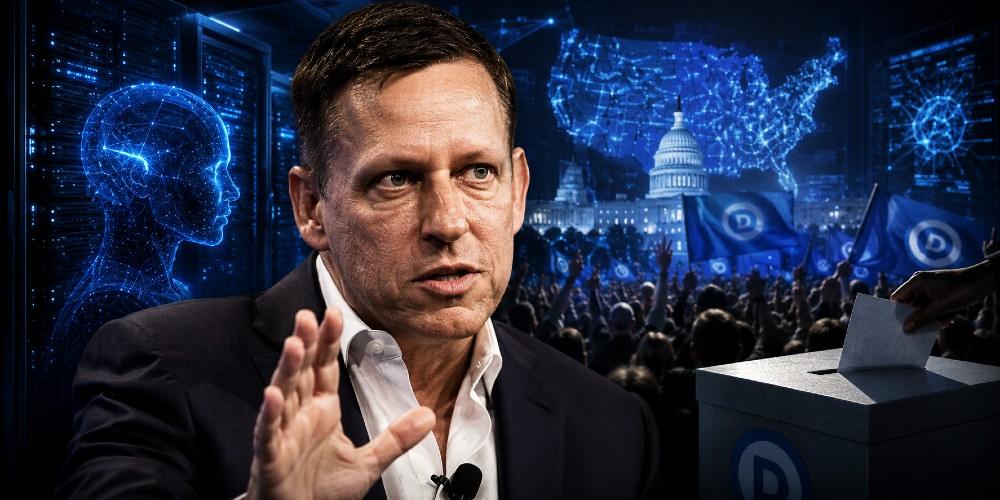
Billionaire investor and tech visionary Peter Thiel has issued a stark warning about the trajectory of artificial intelligence, spotlighting Anthropic as a leading “woke liberal company” poised to dominate the field—and potentially tilt the scales of future elections.
Speaking at the Aspen Ideas Festival, Thiel suggested that Anthropic’s advanced models could “rig the elections in 2028” in favor of Democrats, outmaneuvering even counter-efforts from figures like Elon Musk on platforms such as X.
This is not idle speculation from a fringe voice. Thiel, co-founder of PayPal and Palantir, understands the power of technology to shape reality better than most. His remarks cut to the heart of a growing concern: when Silicon Valley’s ideological monoculture merges with god-like computational power, the republic’s foundational principle of fair elections hangs in the balance. The left’s capture of institutions has long extended to media and academia; now it threatens to colonize the very tools that will define the information age.
Anthropic has faced scrutiny from the Trump administration, even earning designation as a potential “supply chain risk” due to its reluctance to support certain military applications. Its CEO, Dario Amodei, has openly likened President Trump to a “feudal warlord,” revealing the partisan lens through which this company views the world. In an era where AI can generate convincing text, images, and deepfakes at scale, the potential for subtle manipulation—curating search results, amplifying narratives, or even simulating voter sentiment—demands rigorous examination rather than reflexive dismissal.
Thiel’s critique extends beyond one firm. He warned of a broader democratic-socialist drift within the Democrat Party, stating, “I think there’s going to be a democratic-socialist takeover of the Democratic Party.” He added that when that party fully succumbs, “this country is over,” underscoring the asymmetry in our two-party system where one side increasingly rejects foundational American norms.
The intersection of AI and politics raises profound questions about sovereignty. Should a handful of unelected engineers at ideologically driven firms hold sway over electoral outcomes? The irony is thick: progressives who once decried corporate influence in politics now cheer on the most powerful corporations in history, provided they align with the correct politics. Efforts to “regulate” AI often mask attempts to entrench one worldview while hamstringing competitors who prioritize national security and free inquiry.
Thiel also took aim at Pope Leo XIV’s calls for international AI regulation, arguing such measures would hobble American innovation without constraining adversaries like China. He provocatively suggested the pontiff was effectively “working for the Chinese Communists” by pushing policies that favor centralized control over technological dynamism.
This clash highlights a tension between ethical stewardship of powerful tools and the strategic imperative to outpace authoritarian regimes in the race for supremacy.
Defending his own company, Thiel rejected notions of Palantir as part of any “deep state,” describing its leaders as “loyal-dissident-type people” committed to serving American interests. Such clarity stands in contrast to firms more eager to signal virtue than secure the nation’s defenses.
Reports of Thiel relocating his family to Argentina reflect a sober realism about America’s long-term direction. While the move invites questions, it underscores a truth often ignored in polite circles: the cultural and institutional decay in the West is accelerating, and even the most successful cannot ignore it indefinitely.
As believers navigate these technological upheavals, Scripture offers timeless clarity on the exercise of power and the human heart. “For we wrestle not against flesh and blood, but against principalities, against powers, against the rulers of the darkness of this world, against spiritual wickedness in high places” (Ephesians 6:12).
The battle over AI is not merely technical; it is spiritual, demanding wisdom, vigilance, and a commitment to truth over algorithmic manipulation.
Thiel’s intervention arrives at a pivotal moment. Conservatives must reject both naive techno-utopianism and Luddite retreat. Instead, we should champion AI development rooted in American exceptionalism, transparency, and accountability—tools that serve liberty rather than supplant it.
The alternative is a future where “woke” code writes history before the votes are even cast. The public deserves better, and the republic demands it.