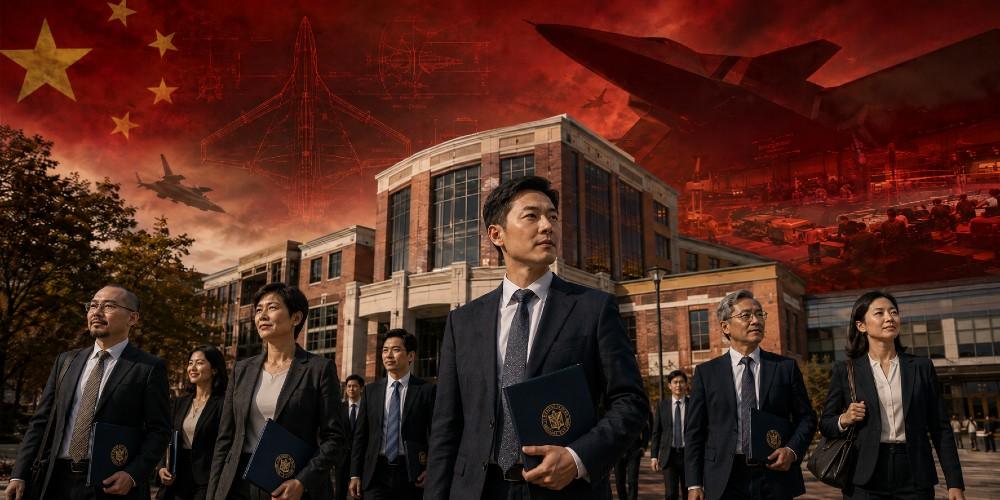
For a quarter century, a public university in the American heartland ran a finishing school for the managerial class of the Chinese Communist Party’s defense establishment. Not a rumor, not an exchange program gone sideways, but a sustained, deliberate arrangement in which Beijing handpicked its rising executives and shipped them to Springfield, Missouri, to collect American MBAs and American accreditation before returning home to run the enterprises that build China’s fighter jets.
The remarkable part is not that it happened. The remarkable part is that it took a private research firm, not a single committee or agency in Washington, to figure it out.
The report is called Heartland for Hire, produced by the geopolitical research outfit Strategy Risks, and it lays out how Missouri State University operated MBA and Executive MBA pipelines that trained more than 1,500 Chinese executives, government officials, and state-owned enterprise managers beginning in 2001.
Among the graduates were figures linked to the Aviation Industry Corporation of China, the country’s largest state-owned aerospace and defense conglomerate. AVIC is not a borderline case. The Pentagon has formally designated it a Chinese military company, it sits under U.S. investment restrictions through Executive Order 14032, and it functions as a pillar of Beijing’s military-civil fusion strategy, the doctrine by which the Chinese state erases any wall between commercial enterprise and the People’s Liberation Army.
The detail that should stop anyone reading is who chose the students. According to the report, enrollees were not recruited through Missouri State’s ordinary admissions process at all. They were selected through Chinese government agencies, state-owned enterprises, and CCP-linked organizations, with Chinese documents describing the partnership as a “China-U.S. state-to-state cooperation project.”
Strategy Risks puts it bluntly, noting that the Communist Party, not the university, picked who came. An American institution, in other words, outsourced its admissions desk to a hostile foreign government and called it international education.
Missouri State’s response leans on what the program was not. A university spokesperson noted, accurately, that the report found no evidence of espionage, intellectual property theft, or harassment, that students followed a conventional business curriculum, and that everyone complied with State Department visa rules.
All true, and all beside the point. The danger was never that these students were stealing secrets in a Springfield classroom. The danger is that the United States voluntarily upgraded the management and technical sophistication of the people who run the industrial base of a regime openly preparing to contest American power. You do not need to smuggle a blueprint out of a lecture hall when the lecture hall itself is the gift.
The weakest thread in the reporting, and the one worth naming honestly, is the money. Chinese recruiting materials claimed portions of the program’s cost were covered by U.S. government or Missouri state subsidies, a figure the report speculates could reach tens of millions of dollars.
But Strategy Risks concedes that no public American records confirm any taxpayer payment and that the total cannot be independently verified. The likelier story, judging from Missouri State’s own published tuition figures, is that the Chinese government and its students paid full out-of-state freight, possibly double the actual cost of the degree, turning a cash-strapped regional university into a willing vendor.
That is arguably worse than the subsidy theory. Subsidy implies bureaucratic negligence. A premium price implies the school knew exactly what it had and sold it anyway.
What makes the episode instructive is the blind spot it exposes. Congressional scrutiny of Chinese penetration of American campuses has fixated on three things, the report observes: theft of STEM research, the harassment of Chinese dissident students, and PLA-affiliated graduate students in sensitive doctoral programs.
A two-decade pipeline producing defense-sector executives at a regional public business school fell cleanly between every one of those tripwires. The watchdogs were all watching the laboratory door while the front gate stood open.
The simple believeth every word: but the prudent man looketh well to his going.
That counsel was written for individuals, but it scales to institutions and to nations. A prudent country looks well to where it is going, asks who is walking through its doors and why, and declines to mistake the language of “cooperation” and “exchange” for the thing itself.
For twenty-five years the United States believed every word, and a regime that does not hide its ambitions took exactly what was offered.
The deeper question this raises has nothing to do with one university in Missouri and everything to do with a posture. President Trump has resisted calls to bar Chinese students outright, warning it would damage relations, and more than 260,000 Chinese nationals studied at American colleges last year.
Reasonable people can argue about blanket bans. What is not arguable is that a free society owes itself the basic discipline of knowing whom it is educating and to what end. The men who graduated from Springfield did not deceive anyone. They told us who sent them and where they were going. We simply chose not to listen.