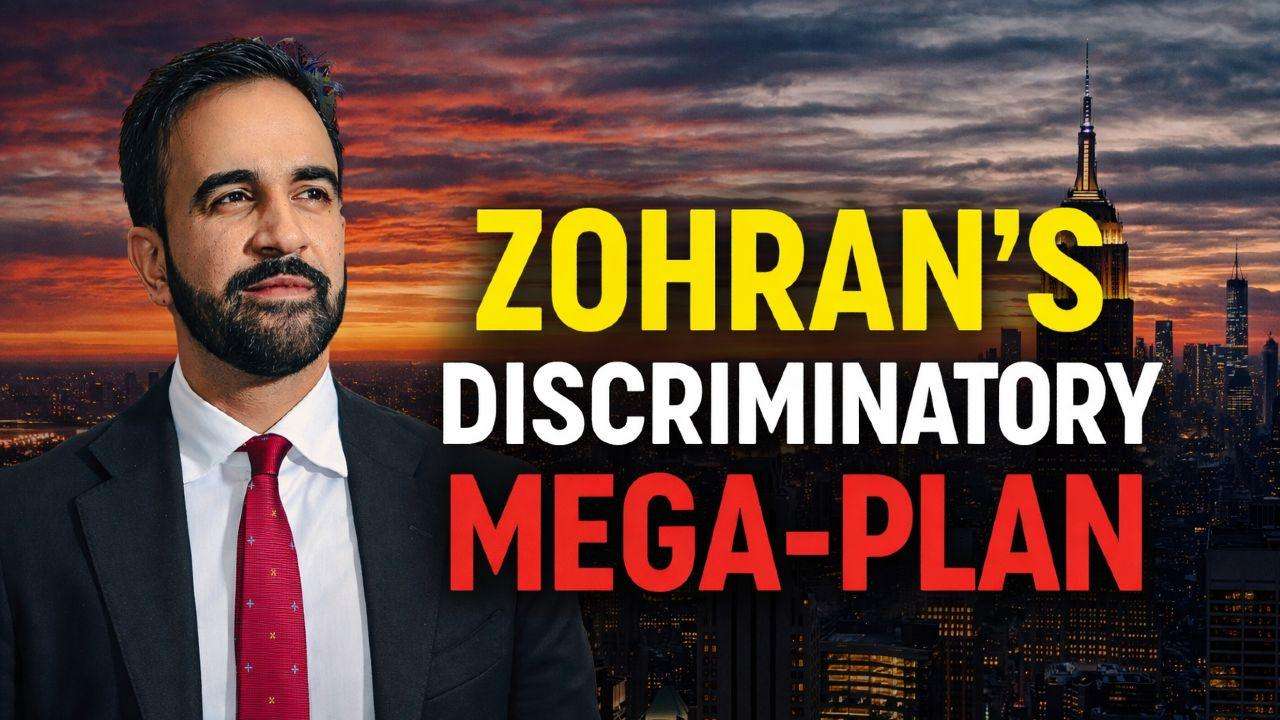
New York City Mayor Zohran Mamdani stood before cameras at Medgar Evers College in Brooklyn on Monday and unveiled what his administration calls the city’s first-ever “Preliminary Citywide Racial Equity Plan” — a sweeping, 45-agency framework built on the explicit premise that city government must view every policy decision, every spending allocation, and every programmatic goal through the lens of race. The Department of Justice, reviewing the plan the same day it dropped, is prepared to call it something else: discriminatory and potentially illegal.
Both assessments are correct. The fact that anyone needs an explanation of why it’s discriminatory and illegal should tell us something sobering about how far we have drifted from the foundational understanding that equal protection under the law means equal protection for everyone.
A Bureaucracy Built on Race
The plan itself is remarkable in its ambition and revealing in its architecture. It spans more than 200 agency-level goals, over 800 proposed strategies, and roughly 600 performance indicators. It requires every major city agency to evaluate its work through what the administration calls a “racial equity lens.” It yokes the city’s affordability crisis — a genuine and serious problem — to an ideological framework that attributes that crisis not to Democrat policy failures, high taxes, overregulation, or the inevitable consequences of decades of progressive governance, but to something called “systemic racial inequity.”
In practical terms, the plan envisions anti-racism training for city staff, revamped hiring and pay equity structures calibrated by race, and a reorganized data collection apparatus designed to track disparities by demographic group. The city has already allocated $10.2 million annually to the racial equity bureaucracy that will implement all of this — a 42% increase over the prior year’s allocation — even as New York City faces a projected $5.4 billion budget deficit and Mamdani simultaneously proposes cutting 5,000 police officers from the NYPD’s ranks. The message to New Yorkers is clear: more equity commissioners, fewer cops.
None of this is presented as a choice between competing priorities. It is presented as justice. And that framing deserves to be interrogated, because words mean things, and “equity” as deployed by this administration does not mean equal treatment. It means differential treatment organized around race, calibrated by a theory of collective irrational guilt, and imposed on 9 million people who didn’t sign up to be experimental subjects in a social transformation project.
The Legal Problem They’re Hoping You Won’t Notice
The Fourteenth Amendment to the United States Constitution guarantees equal protection of the laws to all persons. The Civil Rights Act of 1964 prohibits discrimination on the basis of race in programs receiving federal assistance.
These are not novel propositions. They are settled law, repeatedly affirmed, and deliberately blind to the direction of the discrimination. A government program that distributes benefits or burdens based on race is constitutionally suspect regardless of which racial group it favors. The Supreme Court’s 2023 ruling in Students for Fair Admissions v. Harvard made this point with particular clarity: racial classifications employed by government institutions must withstand the most exacting scrutiny, and the good intentions of those administering them are not, by themselves, sufficient justification.
DOJ Assistant Attorney General Harmeet Dhillon isn’t happy. Reviewing the plan on the day of its release, she flagged it as potentially illegal and indicated that her office would take a hard look. Given that New York City receives billions in federal funding across education, infrastructure, housing, and health programs, that scrutiny carries real consequences.
The Mamdani administration’s response, predictably, is to frame federal oversight as an attack on justice rather than an application of law. One wonders whether Mamdani would extend the same interpretive charity to a city plan that openly favored white applicants on similarly historical grounds. The answer is obvious, and the asymmetry is precisely the point.
Affordability as a Trojan Horse
The cleverest move in Mamdani’s political playbook is the fusion of a legitimate issue — New York’s crushing cost of living — with an ideologically loaded remedy. The city’s “True Cost of Living Measure,” released alongside the equity plan, found that 62% of New York City residents — more than 5 million people — fall short of what the city calculates as the threshold for genuine financial stability. For a family with children, that threshold exceeds $159,000, while the median family income sits around $124,000. These are real numbers that describe real hardship.
But notice how the move is made. The affordability crisis, which touches the vast majority of New Yorkers across every borough and every background, is immediately reframed as a racial crisis — as proof not of failed policy but of systemic racism requiring a race-conscious remedy. Mamdani himself made the pivot explicit: “We cannot tackle systemic racial inequity without confronting the affordability crisis head-on, and we cannot solve the cost-of-living crisis without dismantling systemic racial inequity.”
This is a rhetorical bait-and-switch of the first order. If 62% of New Yorkers cannot afford to live in New York City, that is an indictment of the governance model that has produced punishing rents, a hostile regulatory environment for small businesses, and tax structures that drive wealth and opportunity out of the city.
The solution to that problem is not a 600-indicator racial audit of every city agency. The solution is a fundamental reconsideration of what decades of progressive urban governance have actually produced. But that conclusion is unavailable to Mamdani, because it would implicate the very ideological project he represents. And so the affordability crisis becomes a racial crisis, and the racial crisis becomes justification for more government, more bureaucracy, and more differential treatment by race.
Discrimination Is Not Transformed by Its Intentions
There is an old and seductive error in progressive governance, and it runs something like this: past discrimination was wrong because it was motivated by malice and contempt; our discrimination is different because it is motivated by compassion and a desire to correct historical wrongs. This logic does not survive contact with either constitutional law or moral philosophy.
The Scriptures are unambiguous that God “is no respecter of persons” (Acts 10:34) — a principle that undergirds the entire Western legal tradition’s commitment to impartial justice. “Ye shall do no unrighteousness in judgment,” Leviticus 19:15 commands. “Thou shalt not respect the person of the poor, nor honour the person of the mighty: but in righteousness shalt thou judge thy neighbour.” The moral logic here is not complicated. Justice that tilts based on group membership is not justice. It is favoritism wearing justice’s clothing — and the weave changes nothing about the character of the garment.
What Mamdani’s administration is proposing — directing city agencies to view every decision through a racial lens, to measure outcomes by racial group, and to structure policies around closing racial gaps — is, by definition, governance by race. The fact that it is accompanied by the language of healing and equity does not change its essential nature. It creates a government that sees citizens first as members of racial categories and second, if at all, as individuals with equal standing before the law.
The Practical Consequences
Beyond the constitutional and moral problems, the plan raises a straightforward question that its advocates have never answered satisfactorily: does it work? Decades of race-conscious government programming — from affirmative action preferences to set-aside contracting to diversity hiring mandates — have produced mixed results at enormous cost and with considerable collateral damage to the principle of merit-based advancement. The cities that have most aggressively pursued racial equity frameworks have not, as a general matter, produced notably better outcomes for the communities those frameworks were designed to help. New York City itself, after years of progressive governance, is the city where 62% of residents cannot afford to live. One might ask what a racial equity plan adds to that track record, and why the answer should be trusted to cost another $10.2 million a year drawn from a budget already $5.4 billion in the red.
Meanwhile, the signal sent to New Yorkers of every background who did not design history but are nonetheless being sorted into its categories is corrosive. Government that distributes its attentions based on race does not build civic unity. It manufactures resentment, divides communities along lines that might otherwise remain permeable, and teaches citizens to understand themselves as members of groups rather than as free individuals standing equally before their government.
What the DOJ Review Actually Means
The Trump administration’s review of this plan is not, as Mamdani’s allies will inevitably frame it, a war on civil rights. It is the application of the civil rights framework that has existed in American law since 1964, extended to its logical conclusion: that race-conscious government programming requires extraordinary justification, and that federal funding cannot be conditioned on the acceptance of discrimination, even discrimination with aspirational names. The irony — that the Civil Rights Act, passed to protect Americans from government discrimination, may now be wielded to protect Americans from a different government’s discrimination — is not lost on anyone paying attention.
New York City has genuine problems: a housing shortage driven by zoning restrictions that prevent construction; a cost structure inflated by regulatory burdens that strangle small businesses; schools that fail the children they serve regardless of their racial composition; crime that falls disproportionately on low-income neighborhoods regardless of which equity plan occupies City Hall. These problems have structural causes. They demand structural reforms. What they do not demand, and what will not solve them, is a 600-indicator racial audit administered by 38 equity officers at $10.2 million a year while the NYPD loses 5,000 officers.
Zohran Mamdani is a capable and intelligent politician. He knows how to frame a crisis and point toward a solution that expands his administration’s reach while insulating itself from criticism by wrapping its ambitions in the language of justice. New Yorkers of good will — of every race and background — deserve to see through the framing and ask the harder question: will this actually help anyone, and at what cost to the principle that every citizen stands equally before the law? That principle is not a relic. It is the foundation. And foundations, once compromised in the name of equity, do not easily bear the weight of what comes next.