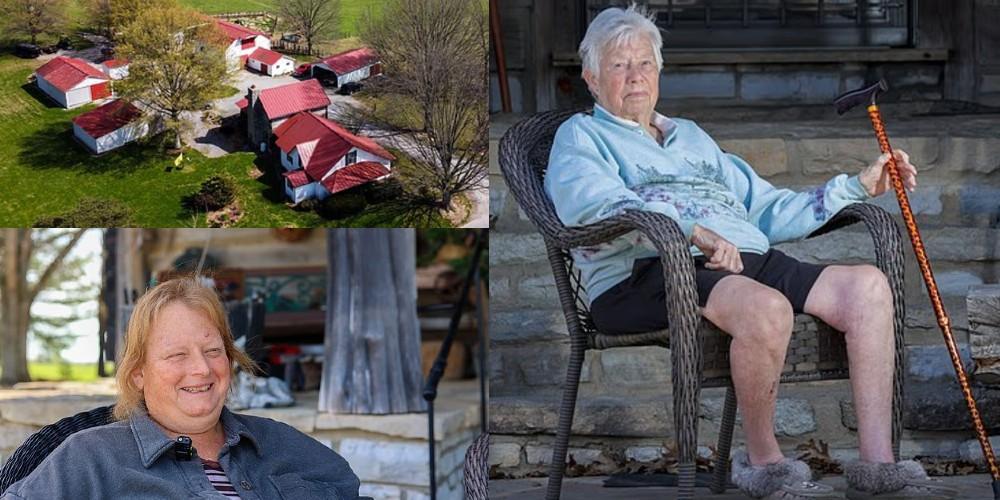
Two God-fearing Kentucky women just looked at a $26.48 million check and told the people writing it to take a hike.
Ida Huddleston, 82, and her daughter Delsia Bare, 54, own neighboring pieces of a family farm in Mason County that has been worked for nearly 200 years. Developers hunting land for a massive 2.2-gigawatt hyperscale data center offered Bare $48,000 an acre for 463 acres and Huddleston $60,000 an acre for her 71 acres. The total came to more than twenty-six million dollars. They signed papers at first. Then they found out what the land would become.
An artificial intelligence hub.
“Kick rocks and don’t come back,” Bare told the representative.
That six-word dismissal has turned these self-described “country hicks” into unlikely symbols of resistance against the latest wave of tech companies gobbling up productive American farmland. The story first broke wide through the Daily Mail and New York Post, and it is spreading because it cuts against the grain of everything the AI boom demands: more land, more power, more water, and less concern for the people who actually grow food.
Huddleston put the matter in plain spiritual terms. “What I believe in is something called Jesus Christ, and he said to occupy, wherever you’re standing, you occupy until he returns,” she said. “If I step off of this piece of property and it becomes something for an AI hub, then I have failed to occupy and I can be held accountable for that on the Judgment hour.”
That is not marketing language. That is a woman who understands stewardship. Her grandfather and great-grandfather raised wheat on that ground through the Depression and helped keep bread lines fed when the nation was hungry.
“You can’t get food out of a data center,” Huddleston has said repeatedly. Bare put it another way: even with $26 million in the bank, she would still rather sit in her own chair, drink her coffee, and eat her food where she has always done it.
The company behind the push has stayed carefully nameless in public, though reporting has pointed toward Meta. A Meta spokesman insisted no final decision has been made about the area. Local officials, meanwhile, have already rezoned more than 2,000 acres of surrounding farmland for rural industrial use.
The pitch is familiar. The developer will supposedly cover the cost of roads, water, sewer, fiber, and power. Four hundred permanent six-figure jobs are promised. Construction crews would number in the thousands. Some neighbors took the money, including the owners of a mobile home park that housed dozens of retirees on fixed incomes.
Huddleston is not buying the sales job. “I say they’re a liar,” she said. “That’s what I say. It’s a scam.”
Bare has joined a lawsuit filed by the local group We Are Mason County challenging the project and the way county officials handled the rezoning. Concerns include new power and gas lines cutting through the countryside and serious pressure on the local water supply.
Data centers of this scale do not sip. They guzzle. Rural counties across the country are discovering that the “economic development” sold by tech recruiters often arrives with higher utility rates, depleted aquifers, and permanent loss of agricultural land that will never grow another crop.
This is not an isolated skirmish. It is part of a broader pattern in which Silicon Valley’s appetite for compute power collides with the physical limits of rural America. Farmland that once fed a nation is being converted into server farms that feed algorithms. The people who live on that land are told they are standing in the way of progress. The women in Mason County answered that accusation by refusing to move.
Bare has been blunt about the technology itself. She believes artificial intelligence will prove the destruction of the human race. Whether one agrees with that assessment or not, the deeper point remains. A society that trades its ability to grow food for the ability to train larger language models is making a wager with eternal consequences. Scripture is not silent on the matter.
“The earth is the Lord’s, and the fulness thereof; the world, and they that dwell therein,” declares Psalm 24:1. Land is not merely a commodity. It is a trust.
Huddleston and Bare never set out to become national figures. “I never thought I’d be in a battle with a data center,” Bare said. “I thought I was about as far out in the boondocks as you could get.”
Yet here they stand, cane and all, refusing to surrender ground their family has occupied for two centuries. In an age when so many institutions seem eager to sell the inheritance for a bowl of digital pottage, two Kentucky women remembered what it means to occupy until He returns.
The data center may still rise on neighboring ground. Lawsuits move slowly. County officials have already voted. But the record is clear. When the money was on the table and the future of their land hung in the balance, Ida Huddleston and Delsia Bare chose the farm over the fortune. That choice should not be forgotten.