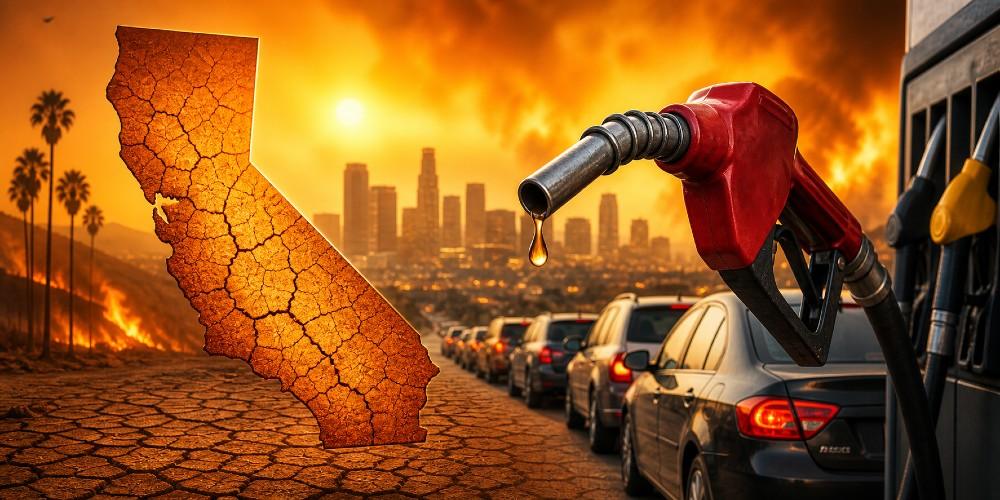
As fighting reignites in the Middle East and the Strait of Hormuz stays largely blocked, California drivers are staring down a brutal reality at the pump. Some in Los Angeles are already paying eight dollars a gallon, with prices poised to climb higher. The last tanker carrying Persian Gulf crude has docked at Long Beach, and no more are coming. This is not merely a temporary spike—it is the predictable consequence of decades of policy choices that left the Golden State dangerously isolated from reliable domestic energy sources.
While the rest of the nation grapples with a national average around $4.45, California’s unique vulnerabilities turn inconvenience into crisis. The state imports roughly 30 percent of its foreign crude from the Persian Gulf under normal conditions.
Decades of environmental mandates, refinery closures, and deliberate avoidance of pipelines have transformed California into an “energy island,” reliant on long-haul imports refined in Asia from Middle Eastern sources. When geopolitics disrupts that flow, there is no quick domestic alternative.
The irony could not be thicker. California’s leaders have spent years demonizing fossil fuels, shuttering refineries, blocking pipelines, and pushing electric vehicle mandates while the state’s vast car-dependent population and economy still demand enormous quantities of gasoline and jet fuel.
Now, when real-world events expose the fragility of that approach, the same policymakers who engineered this vulnerability offer little beyond hand-wringing. The result is pain at the pump that hits working families hardest—precisely the people progressive policies claim to champion.
Recent escalations have only worsened the outlook. Iranian attacks on vessels, including a South Korean ship, and strikes on U.S. naval assets prompted American retaliation. Missiles and drones targeted the UAE, damaging oil infrastructure. With traffic through the Strait of Hormuz severely restricted, Asian refiners that supply California have curtailed exports. The buffer of pre-war shipments has now run out. Even if some escorted tankers make it through under U.S. protection, the long-term outlook remains precarious as Iran asserts greater control over the waterway.
This crisis should prompt serious reflection on energy realism. America possesses abundant domestic resources, yet blue-state governance has prioritized ideology over resilience. California’s refusal to develop in-state production or secure reliable supply lines has left it exposed to the very volatility it helped invite through dependence on unstable foreign regions. Meanwhile, the broader national average, though elevated, benefits from states that maintained more balanced approaches.
The situation also raises deeper questions about national security and stewardship. When a single chokepoint halfway around the world can paralyze the economy of America’s largest state, something fundamental has gone wrong. Leaders who treat affordable, reliable energy as an afterthought—or worse, an enemy—have betrayed their duty to the people they govern.
Yet in the midst of these temporal troubles, Scripture reminds us of ultimate priorities. “And he called his ten servants, and delivered them ten pounds, and said unto them, Occupy till I come” (Luke 19:13). Faithful stewardship demands wisdom in the use of resources God has provided, not utopian schemes that ignore human realities and economic laws. California’s fuel crisis is a parable for our age: reject prudence and abundance, and scarcity will follow.
Americans watching this unfold should take note. Energy policy is not an abstract debate. It determines whether families can afford to drive to work, whether goods reach shelves, and whether our nation remains strong in a dangerous world. California’s Fuelmaggedon is a warning. Will the rest of the country learn from it before similar choices produce similar pain?