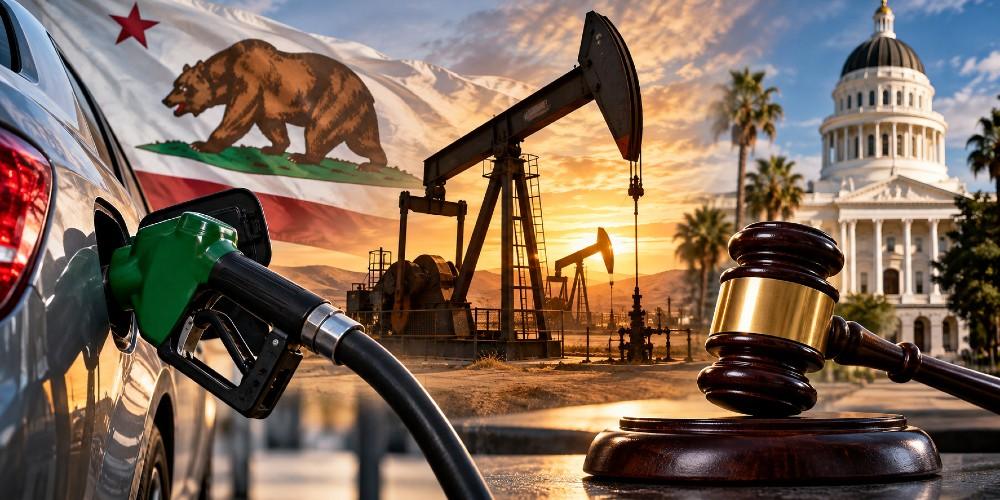
California drivers are staring at gas prices north of six dollars a gallon while the state sits on massive oil reserves it refuses to touch. A Kern County judge just told Sacramento its fracking ban was never legal in the first place.
Kern County Superior Court Judge Bernard C. Barmann Jr. issued a tentative ruling that could reopen hydraulic fracturing across the state’s oil heartland. The decision targets both the formal ban that took effect two years ago and the de facto freeze on permits that began five years earlier under Governor Gavin Newsom.
Barmann called the prohibition on well stimulation treatments an “invalid underground regulation” adopted without the rulemaking the Administrative Procedure Act requires.
The judge was blunt. Permit denials were “arbitrary and unsupported because they rested on a climate-change rationale that was not in fact the operative basis for the ban.”
He noted that the state agency’s own findings showed a categorical ban would increase global greenhouse gas emissions by forcing California to import more oil. That is not a conservative talking point. It is the regulators’ own paperwork.
Chad Hathaway, CEO of Hathaway Oil, put numbers to the opportunity. Kern County’s diatomite formation holds up to one billion barrels that cannot be recovered without fracturing the tight rock. “The rock is too tight,” he told KGET. Unlock that and production rises where the resource already exists, not somewhere else.
The Western States Petroleum Association called the ruling common sense. President Jodie Mueller said hydraulic fracturing applications should be evaluated on their merits rather than blocked by a blanket denial “that’s truly based on politics.”
Chevron and Aera Energy brought the consolidated lawsuits that forced the issue. A nearly month-long bench trial ended earlier this year.
Environmental groups immediately argued the ruling changes nothing useful. Cesar Aguirre of the Central California Environmental Justice Network pointed to last year’s SB 237, which already authorizes up to 2,000 new drilling permits without lifting the fracking ban. He said the decision would mainly help companies squeeze aging wells.
That claim treats a billion barrels of recoverable oil as an afterthought and ignores why California’s pumps keep posting the nation’s highest prices.
Newsom ordered the phase-out in April 2021 after legislative attempts stalled. CalGEM began denying applications and later formalized the ban. The state spent years in court denying it had imposed a categorical policy, only to concede the practice later. Barmann noted the contradictions. A final decision is expected within about fifty days. Appeals will almost certainly follow and could drag on for years.
“The state agency’s determination that a categorical ban is reasonably necessary to reduce greenhouse gas emissions is not supported by substantial evidence and lacks a rational connection to that purpose.”
California already imports the bulk of its crude. Refinery closures and production declines have left the state more dependent on foreign barrels while residents pay roughly two dollars more per gallon than the national average. SB 237 itself was a partial retreat, a quiet admission that ideology had outrun supply. The court simply pointed out that the ban was built on process violations and internal contradictions rather than evidence.
Dominion is not a license for waste. It is the opposite of locking resources underground while drivers and truckers absorb the cost. Kern County has the geology, the workforce, and the existing infrastructure. Sacramento has the regulations. One of those facts is about to face a real legal test. The other has already failed at the pump.