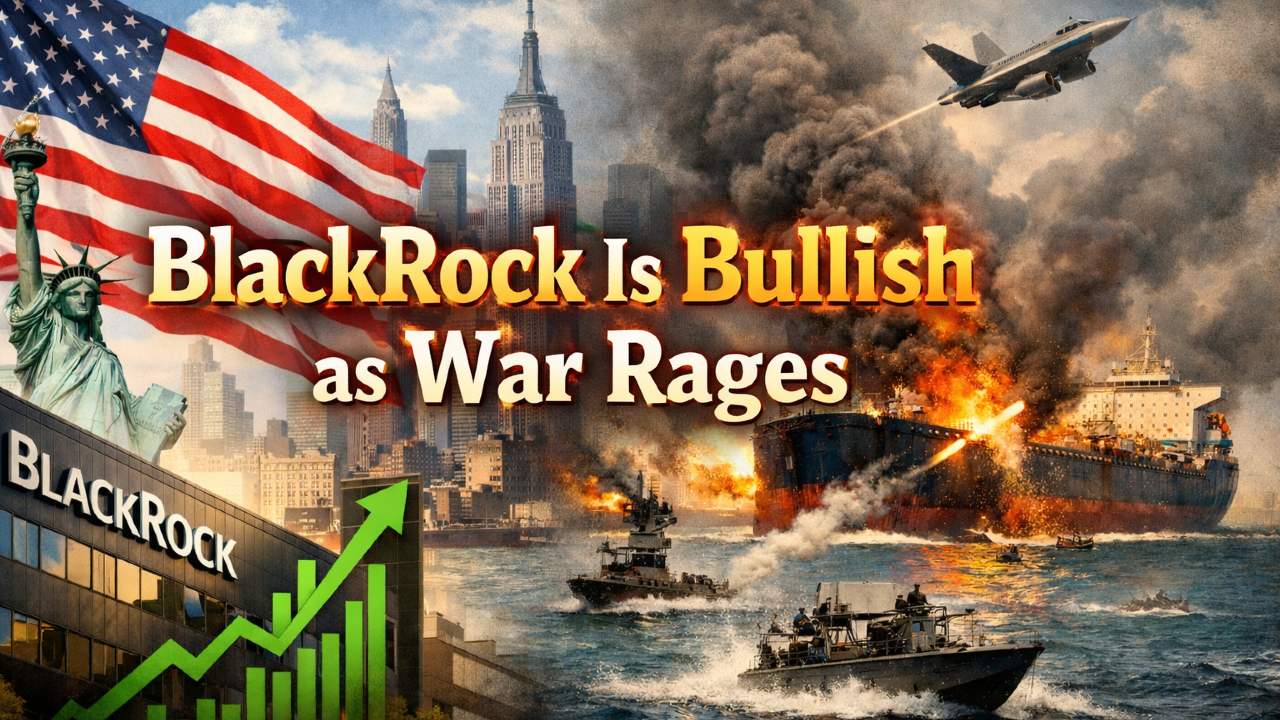
There is a particular kind of institutional confidence that doesn’t flinch at geopolitical chaos — it profits from it. That is precisely what we are watching unfold as BlackRock, the world’s largest asset manager, has upgraded its outlook on U.S. equities to “overweight,” citing resilient corporate earnings and what it calls the “contained” fallout from a shooting war with Iran that has already cost hundreds of lives, disrupted the global energy supply, and pushed oil briefly past $100 a barrel. The message from the corner offices of Wall Street is as blunt as it is clarifying: American companies are making money, and that is what matters.
To be clear, the situation in the Strait of Hormuz is anything but resolved. The two-week ceasefire brokered by Pakistan on April 8th — which required Iran to reopen the strait that normally carries roughly a fifth of the world’s oil and liquefied natural gas — has already unraveled at the negotiating table. Vice President JD Vance flew to Islamabad for high-stakes talks with Iranian representatives, only to announce on April 12th that the negotiations had failed. The sticking point was Iran’s nuclear program. Tehran refused to commit to ending uranium enrichment or dismantling its enrichment facilities.
President Trump, true to form, responded by declaring a naval blockade of Iranian ports, vowing that the U.S. Navy would intercept any vessels that had paid tolls to Iran. Oil promptly surged back above $100 a barrel on Sunday. The UN’s Food and Agriculture Organization warned that a global food crisis looms if normal shipping does not resume. And yet, BlackRock upgraded U.S. stocks.
- BlackRock upgraded U.S. equities to “overweight” on April 13th, citing strong corporate earnings and what it considers limited lasting damage to global economic growth from the Iran conflict.
- The U.S.-Israel war against Iran began February 28th with airstrikes that killed Iran’s Supreme Leader Ali Khamenei. Iran retaliated by closing the Strait of Hormuz, through which roughly 20% of the world’s oil and natural gas normally flows.
- A Pakistan-brokered ceasefire was announced on April 8th and almost immediately came under strain. Weekend peace talks in Islamabad collapsed on April 12th when Iran refused to commit to ending uranium enrichment.
- Trump declared a U.S. naval blockade of Iranian ports following the failed talks. Oil prices climbed back above $100 per barrel and the IRGC warned any military vessels approaching the strait would face a “severe response.”
- S&P 500 companies are expected to report first-quarter earnings growth of roughly 13-14%, with some forecasts suggesting that figure could climb to 19% if historical beat rates hold. Technology sector profits are projected to grow 43-45% in 2026.
- BlackRock’s Jean Boivin noted that technology’s valuation premium has eroded significantly even as earnings expectations for the sector have climbed sharply, creating what the firm sees as an attractive entry point.
- J.P. Morgan and Morgan Stanley issued similar guidance, arguing that geopolitical dips should ultimately prove to be buying opportunities for patient investors.
- The UN warned that a global food crisis could emerge if normal shipping traffic through the Strait of Hormuz is not restored soon, as fertilizers, fuel, and agricultural inputs remain choked off from global markets.
- Despite the backdrop of a hot war, the S&P 500 has recovered nearly 8% from its seven-month low struck in late March.
What BlackRock’s pivot illustrates — and what the financial press is largely failing to say plainly — is that the separation between geopolitical reality and market reality has grown to a chasm. The firm’s strategists, led by Jean Boivin, head of the BlackRock Investment Institute, watched “two signposts” before re-engaging with risk: evidence of actions that would reopen the Strait of Hormuz, and visibility on the conflict’s macro impact being “contained.” The ceasefire announcement gave them enough daylight to act. Whether the ceasefire holds is, apparently, a secondary concern.
“Tech’s valuation premium has been eroded,” Boivin said. “At the same time, the tech sector is now seen posting earnings growth of 43% in 2026, up from 26% last year. These bright spots partly inform our upgrade to U.S. equities.”
The numbers driving that optimism are genuinely striking. S&P 500 companies are expected to report first-quarter profit growth of approximately 13-14% year over year — and that figure has actually risen since the Iran conflict began on February 28th, not fallen. FactSet data indicates that if companies beat estimates at historical rates, the real growth rate could climb toward 19%. Technology profits are projected to expand 43-45% for the full year 2026, even as the sector’s valuation has moderated to its lowest relative to the rest of the market since mid-2020. J.P. Morgan strategist Mislav Matejka echoed BlackRock’s view, arguing that geopolitically driven market dips “should ultimately prove to be buying opportunities.” Morgan Stanley struck a similar tone.
American Productivity as the Durable Variable
There is something worth pausing on in all of this, and it is not merely cynical. The persistence of American corporate earnings in the face of a genuine shooting war — one that has disrupted global energy markets, rattled emerging market currencies, and sent oil prices surging toward levels not seen since the worst of prior energy crises — says something substantive about the structural resilience of the U.S. economy. The S&P 500 had fallen to a seven-month low in late March, when fears of sustained high oil prices and the specter of renewed inflation were most acute. It has since recovered nearly 8%. That recovery is not irrational. It reflects the fact that the American economy, driven by technology and artificial intelligence investment, has decoupled meaningfully from the energy-intensive industrial model that would have made such a conflict economically catastrophic in an earlier era.
This is the argument BlackRock is making, and it deserves to be taken seriously even by those who find the moral detachment of financial markets uncomfortable. The Magnificent Seven — Nvidia, Apple, Microsoft, Meta, Alphabet, Amazon, and Tesla — have seen their valuation premium over the broader S&P 500 compress sharply. Their forward price-to-earnings ratio has narrowed, even as their earnings trajectory has improved. This is not the dot-com bubble of 2000, where sky-high valuations were unmoored from profits. Today’s technology leaders are generating actual cash flows, actual margins, and actual earnings growth. BlackRock’s own research notes that return on equity among leading S&P 500 companies has expanded above 40%, and that from 2023 to 2025, those companies generating returns above their cost of capital delivered average annual returns of 22%, compared to 11.6% for those that did not.
The Deeper Question Nobody Wants to Ask
But if earnings are strong and the market is recovering, one is entitled to ask what the actual cost of this conflict is being measured in, and by whom. The UN’s Food and Agriculture Organization warned this week that the “clock is ticking” to prevent a global food crisis, because the fertilizers, fuel, and agricultural inputs that pass through the strait are not getting to farmers on the planting calendar they need. Energy analyst Karen Young of Columbia University’s Center on Global Energy Policy told CNN flatly that oil prices will likely remain elevated “into the end of 2026” even after any war’s end, because damaged infrastructure takes time to repair and the strait takes time to fully reopen. Some 230 loaded oil tankers were reportedly waiting inside the Gulf as of last week, unable to move. That is not an abstraction — it is agriculture, manufacturing, and transport costs rippling outward to households in developing nations who do not own S&P 500 index funds.
Scripture has long understood the difference between wisdom that accounts for the whole of creation and cleverness that benefits only those at the table. The prophet Isaiah warned, “Woe unto them that join house to house, that lay field to field, till there be no place, that they may be placed alone in the midst of the earth.” The consolidation of capital and the insulation of institutional wealth from the consequences it helps create has always been among the more durable human temptations — and the one least likely to be critiqued in quarterly earnings calls.
Where This Leaves the Investor — and the Citizen
None of this is an argument against investing in American companies or against recognizing that strong earnings reflect genuine productivity. The American economy’s relative insulation from the full impact of this conflict — owing in no small part to domestic energy production that has grown substantially over the past decade — is itself a policy argument conservatives have been making for years. Energy independence matters. Domestic manufacturing matters. The reshoring impulse that has driven investment back into the United States is not mere economic nationalism; it is strategic wisdom vindicated by exactly this kind of crisis.
BlackRock’s note specifically called out defense stocks as a continuing thematic opportunity, alongside U.S. technology. That is worth noting for the same reason. The companies building the AI infrastructure that is driving earnings growth are also, in many cases, the companies building the defense and intelligence infrastructure that makes American power projection possible. The distinction between the civilian and national security economies is blurring in ways that both complicate and clarify the investment picture.
What the BlackRock upgrade should prompt — beyond portfolio adjustments — is a clear-eyed reckoning with the way financial markets process geopolitical risk. The institution did not upgrade stocks because the war is over. The war is demonstrably not over. It upgraded stocks because earnings are strong enough to absorb the war’s costs at the index level, and because it calculates that any further escalation is unlikely to be sustained indefinitely. That may well prove correct. It may also prove to be one of those assessments that looks embarrassingly premature in retrospect. The Strait of Hormuz is still not fully open, the ceasefire is still fragile, the blockade is now in effect, and Iran’s IRGC has promised a “severe response” to any military vessel approaching the strait. What the market has priced in and what the world is actually living through are, for the moment, two different things.
The wise investor — and the wise citizen — holds both realities at once. American companies are performing. American power is engaged in a consequential test of wills with a regime that has long sought nuclear weapons and regional dominance. Profits and Providence are not always aligned on the same timeline. Those with long memories will recall that markets appeared orderly in the weeks before more than one historical catastrophe. The appropriate posture is neither panic nor complacency, but the disciplined attention that serious times demand.