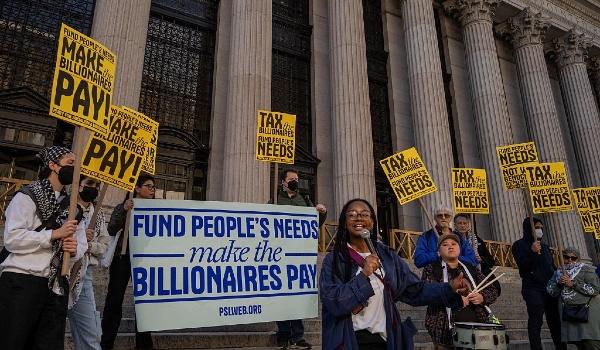
(The Epoch Times)—Although California voters rejected the state’s proposed “billionaire’s tax,” at the midterm ballot box, politicians and groups are persisting in efforts to tax savings and investments in the United States.
The sponsors of California’s Proposition 40 have pledged to resurrect it in 2028, while bills to implement a national wealth tax have been introduced in Congress this year by Sens. Bernie Sanders (I-Vt.) and Elizabeth Warren (D-Mass.), and Reps. Pramila Jayapal (D-Wash.), Brendan F. Boyle (D-Pa.) and Ro Khanna (D-Calif.), with the backing of 45 other federal lawmakers.
State legislatures are also considering wealth tax bills in Illinois, Maryland, Minnesota, Rhode Island, and Washington.
Proponents of wealth taxes say the richest Americans often avoid paying income taxes and that wealth taxes targeting the assets of billionaires and multi-millionaires will shift the tax burden more toward those whose wealth is realized as assets rather than income.
Sanders says his “Make Billionaires Pay Their Fair Share Act” would impose a 5 percent wealth tax on about 1,000 American billionaires, whose collective net worth is estimated at $8.2 trillion, and claims the government would give those dollars to lower-income people.
“The bill would provide a $3,000 direct payment to every man, woman and child in a household making $150,000 or less—$12,000 for a family of four—and use the estimated $4.4 trillion in revenue raised over the next decade to address the most pressing crises facing working families,” Sanders’ website states.
Warren claims her bill, which sets a lower threshold of $50 million in assets, would raise $6.2 trillion over the next decade to pay for universal child care, free community college, and Medicare expansion.
Critics, however, doubt wealth taxes will deliver the payoff promised to average Americans and say they will likely curtail investment and job creation.
“Wealth at the top isn’t in a vault of gold bars,” Adam Michel, director of Tax Policy Studies at the Cato Institute, told The Epoch Times.
“Roughly three-quarters of what the richest 0.1 percent hold is equity in operating companies, which includes firms that employ people, make things, and finance investment,” Michel said.
“Taxing this wealth converts productive capital into government revenue and shrinks the private sector’s most productive businesses.”
Capital Flight
In a September report, the Hoover Institution, a conservative think tank, analyzed California’s proposed “billionaire’s tax,” which advocates said would raise $100 billion.
The institute estimated that, because of “billionaire departures from the state,” the one-time tax would raise only $30 billion, and that ongoing income-tax losses would further reduce future state revenues.
Echoing that assessment, the California Tax Foundation projected that billionaire departures and consequent economic spillover effects would cut state income tax revenue by $3.53 billion to $4.49 billion per year.
“Already, the publicly identified departures of nine billionaires have created a $2.77 billion recurring tax revenue loss,” the foundation stated.
Billionaires who have already left California since the wealth tax was proposed include Google co-founders Sergey Brin and Larry Page, film director and Amblin Entertainment founder Steven Spielberg, PayPal Founder Peter Thiel, Uber founder Travis Kalanick, Hankey Group founder Don Hankey, and others.
Going Nationwide, Going Global
To prevent capital from escaping state-level wealth taxes, some proponents, including United Airlines CEO Scott Kirby, say the tax must be implemented nationwide in the United States.
“It won’t work by state because people will just move,” Kirby said in an October CNBC interview, “and I think we should have inheritance taxes that get close to 100 percent at some level.”
Critics say that could simply drive investment out of the United States.
Out-migration of investment is “the main reason why most countries that have adopted wealth taxes have since rescinded them,” Jason Sorens, an economist at the American Institute for Economic Research, told The Epoch Times.
Countries that imposed wealth taxes and then revoked them include Austria, Denmark, Germany, Netherlands, Finland, Luxembourg, Sweden, and France.
An exception is Switzerland, Sorens said, but that country has remained an attractive destination for investment because “its overall tax burden is low and the rates of wealth taxation are also held low.”
A national U.S. wealth tax “would just trade interstate competition for international competition,” Michel said. “People and capital cross country borders too, which is why the standard answer from wealth tax advocates is a global minimum wealth tax.”
Efforts to establish global taxes have gained momentum in recent years. In 2021, the Biden administration backed a global minimum income tax on companies, and in 2024, the Brazilian government proposed a 2 percent global wealth tax on the world’s 3,000 richest people.
However, a 2026 analysis of Brazil’s proposal by EY, an international consulting group, projected that a global 2 percent wealth tax would reduce worldwide GDP by $80 billion per year, eliminate 2 million jobs, and reduce labor income by $10 billion each year, and that these cuts would increase substantially over time.
Taxing Only the Ultra-Rich
There are also concerns that governments will expand wealth taxes beyond the ultra-rich once they have the mandate to impose them.
Warren claims her bill would affect only the wealthiest Americans, “without raising taxes on 99.85 percent of American households.” Sanders and Khanna likewise say that, according to their wealth tax bill, “no one who has a net worth of less than $1 billion would pay a penny more in taxes.”
But the history of income taxes casts doubt on these claims.
The first federal income tax, the Revenue Act of 1861, was repealed in 1872. In 1909, President William H. Taft proposed a new income tax of 2 percent on corporations. Over the next few years, progressive lawmakers pushed for an individual income tax. Conservative lawmakers, hoping to block the tax, proposed structuring it as a constitutional amendment, believing it would never be ratified by three-fourths of the states.
But, the Sixteenth Amendment was ratified, and the individual income tax came with with the Revenue Act of 1913.
This tax applied only to the top 1 percent of Americans, who at the time earned more than $3,000 per year, and the rate ranged from 1 percent to 7 percent of income.
However, the amendment set no thresholds, and an income tax that initially affected only the richest 1 percent of Americans was ultimately expanded to the vast majority.
The initial rate, capped at 7 percent of income, was increased to a maximum rate of 94 percent in 1944, then reduced in stages to the current top rate of 37 percent.
In addition, the question remains whether a federal wealth tax, as currently envisioned, is constitutional or would require an amendment, similar to the imposition of income taxes.
Current wealth tax bills are not legal, Michel says, because “the Constitution requires direct taxes to be apportioned among the states.”
Direct taxes are assessed on individuals rather than on transactions, such as sales tax or tariffs.
Under the Constitution, such taxes must be assessed in proportion to state populations rather than by wealth thresholds, which could require a national wealth tax, if passed, to be enacted through a Constitutional amendment.