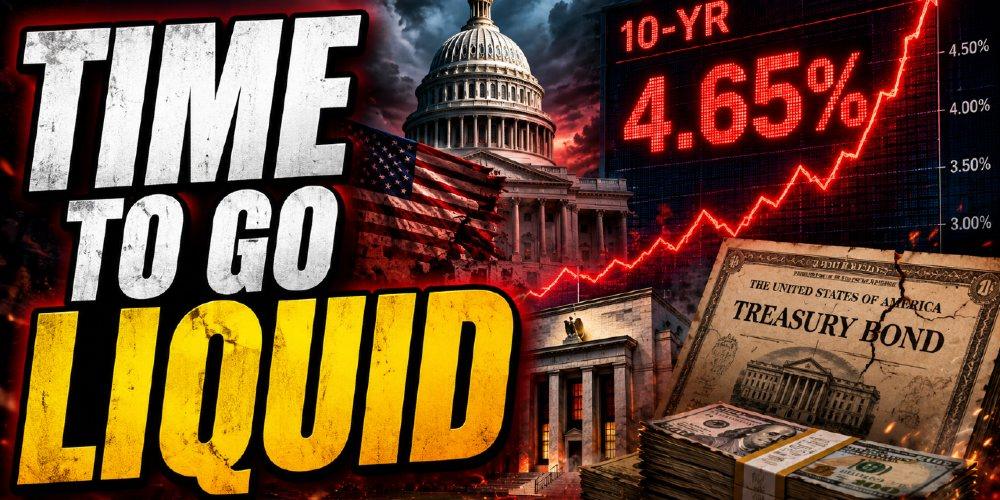
(International Man)—The 10-year Treasury yield is perhaps the most important financial benchmark in the global fiat system, as it drives valuations and market trends worldwide. It is widely—and erroneously—regarded as the risk-free rate of return.
The 10-year Treasury yield can be thought of as a key barometer of the US dollar-based fiat system—a critical measure akin to its beating heart.
Bond yields move inversely to bond prices. When bond prices fall, bond yields rise.
A rising 10-year Treasury yield signals trouble for the US dollar because it means investors are selling Treasuries, which pushes up the US government’s borrowing costs. That is why the 10-year Treasury yield is a major pain point for the US government.
The 10-year Treasury yield was 3.97% in late February 2026. Now it is around 4.65%, an increase of roughly 68 basis points. 68 bps might not seem like much, but with $39.3 trillion in debt and growing, every basis point matters.
At today’s debt levels, every 1 basis point increase in the government’s average borrowing cost adds roughly $3.9 billion in annual interest expense. So a 68 bps rise is not trivial—it translates to nearly $265 billion in additional yearly interest costs, materially widening a budget deficit that was already around $1.8 trillion.
I expect the 10-year Treasury yield to keep climbing over the coming weeks and months—until it forces the Fed’s hand.
At that point, the intervention will be sold as “stability,” but the mechanism will be familiar: suppress yields by debasing the currency.
Nobody knows exactly how high the 10-year yield must rise before the Fed is forced to act. If I had to guess, I would say around 5%—a level not seen since the 2008 financial crisis.
In more recent years, every time the 10-year yield has approached 5%, something has happened to push it back down.
That’s why I think 5% could be the line in the sand that forces the Fed’s hand.

Higher yields mean the US government must pay tens or even hundreds of billions more in interest on its debt. At the same time, the global economy faces even greater added costs because Treasury rates serve as the benchmark for borrowing worldwide.
The problem is that interest on the federal debt is already over $1.2 trillion and is now the second-largest item in the budget. The US government cannot afford yields going much higher because the interest expense would push it toward explicit bankruptcy.
That math simply does not work—not even with slightly higher interest rates.
Something has to give, and we will not have to wait long to find out what.
I think there is an excellent chance the Fed will be forced to engage in yield curve control—either implicitly or explicitly—and cap long-term yields.
If I am right, rising Treasury yields are only the beginning. Record debt, money printing, and growing political and social instability could create extraordinary volatility—and serious consequences for your wealth and personal freedom.