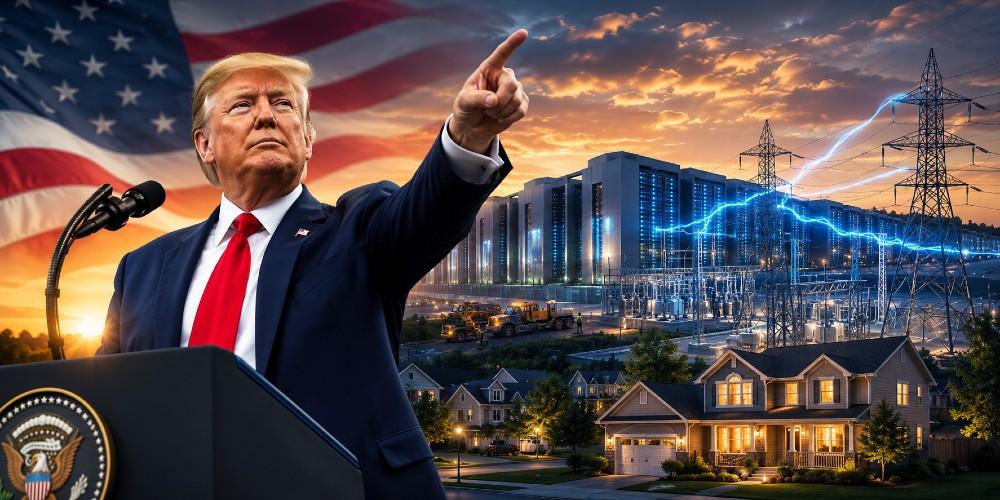
President Trump just drew blood in the data center wars. Big Tech pays. You don’t.
On Thursday afternoon at EPA headquarters, the president made it official. The Ratepayer Protection Pledge is no longer some polite suggestion. It now covers 80 percent of the power flowing into American homes and businesses. More than 220 utilities, tech giants, state governments, and power providers have signed on. That means 263 million Americans are shielded from the electricity bill spikes that data centers were about to dump on them.
Trump did not mince around the point.
“We’re here today to continue the incredible progress we’re making in communities nationwide to ensure that as new data centers go up… electricity bills for American families will actually come down,” he said. “With the Trump Administration’s Ratepayer Protection Plan, American innovators and consumers win together because we’re insisting that AI data centers and big tech companies pay their own way.”
Pay their own way. Build their own generation. Cover the transmission upgrades. Stop treating ratepayers like an open wallet.
That is the entire fight. Data centers are not going away. The AI race with China will not wait for the next committee hearing. Virginia already hosts nearly 400 of them. Texas is next. The buildings keep rising because the demand is real. The only question left is who gets stuck with the tab.
For years the answer was you. Utilities planned to socialize the cost of the new load across every household. Trump flipped that script. Companies like Amazon, Google, Meta, Microsoft, OpenAI, Oracle, and xAI already committed to build, bring, or buy the power they need. Now the list of partners has ballooned.
Southern Company’s Georgia Power has frozen base rates for households until 2029. American Electric Power projects up to $16 billion in cost offsets for its customers. In Louisiana’s Richland Parish, Meta’s massive project is delivering $2.6 billion in electricity savings while public school teachers pocket bonuses as high as $50,000.
These are not theoretical savings. They are signed contracts that keep residential rates flat or lower while the data centers go up. Other states are already seeing the same pattern.
The NIMBY crowd still howls. A new outfit calling itself Humans First staged protests last weekend, claiming the centers are an “unacceptable infringement on our liberty.” Some on the right worry about water use and local character. Fair enough. Communities should have a voice. But the alternative is surrendering the technological high ground to Beijing while your monthly electric bill climbs for the privilege of watching from the sidelines.
Trump cut through the noise. He told state and local officials the truth. Reject these projects and they will go somewhere else. Loudoun County, Virginia, already pulls in up to a billion dollars a year in property taxes from its data center corridor. That money has kept residential rates lower for a decade. Other places can have the same deal if they stop treating growth like a disease.
The left wants to regulate the centers into oblivion or tax them into submission. Democrats in Virginia spent months fighting each other over whether to keep the tax breaks that attracted the industry in the first place. One side called businesses evil.
The other side wanted to keep the revenue while still looking moderate. Classic. Trump’s approach is simpler. Let the private sector build. Make them pay the full freight. Let the benefits flow to the people who live nearby.
Scripture speaks to this kind of ordered provision. In Luke 10:7 the Lord says, “And in the same house remain, eating and drinking such things as they give: for the labourer is worthy of his hire.”
The companies building the infrastructure of the next economy are laborers of a sort. They should carry their own load. They should not shift the cost onto families who never asked for the bill.
America needs the data centers. America does not need higher utility bills to fund them. Trump just made sure those two facts stay separate. Big Tech can chase the AI future. American households will not be the ones left holding the bag.