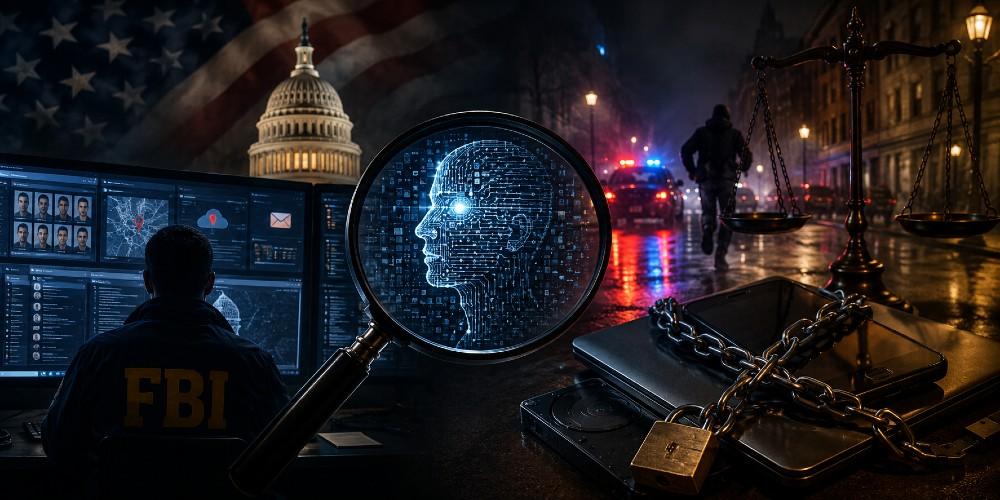
When a gunman charged the security checkpoint at the Washington Hilton on April 25 and put a round into the vest of a Secret Service officer, the federal government had a problem measured not in weeks but in hours. By the following Monday, prosecutors had a criminal complaint, a timeline, a manifesto, financial and travel records, and a name.
The speed was remarkable. According to the digital forensics firm Exterro, a large part of how that speed was achieved involved artificial intelligence sifting through the seized devices and digital trails of Cole Tomas Allen. That is a story worth celebrating and worth worrying about in equal measure, and a serious people should be able to hold both thoughts at once.
The firm told Axios that its FTK Suite was used by the FBI’s Washington Field Office during the frantic interval between the shooting and the filing of charges. The company would not detail exactly how the bureau deployed it, and the FBI declined to comment.
What Exterro will say is what the platform ordinarily does for its customers. It ingests enormous volumes of digital evidence, indexes it, and lets investigators query it in plain language. An agent can ask the embedded assistant to surface every image of a particular person, to map whether a suspect was at a given place at a given hour, or to pull a thread across messages, cloud accounts, and metadata that a human reviewer would need days to untangle.
In this case, the machine was pointed at a man who deserved it. Allen left behind writings investigators have described as a manifesto, declaring he was “no longer willing to permit a pedophile, rapist, and traitor to coat my hands with his crimes.”
He signed a scheduled email to family as the “Friendly Federal Assassin.” President Trump, who was evacuated from the ballroom along with the First Lady and Vice President Vance, said of the writings, “he hates Christians. That’s one thing for sure.”
Reporting tied Allen to the left-wing collective known as the Wide Awakes and to a “No Kings” protest in California. Whatever else this was, it was an attack on a sitting president by a man steeped in the politics of the activist left, and the tool that helped build the case against him did exactly what its makers promise.
So why the unease? Because power is not partisan, and neither is software. The same FTK platform that cracked this case is marketed for facial and object recognition, for covert collection from Gmail, Microsoft 365, Slack, and other cloud services, and for matching images against shared hash databases. It is built to scale from a single examiner to an enterprise-wide dragnet.
Read Exterro’s own materials and the value proposition is unmistakable. The product slashes manual review time, triples investigative throughput, and lets non-technical reviewers comb through a suspect’s digital life without ever touching the original devices. Aimed at a confessed would-be assassin, that is justice delivered at speed. Aimed at the wrong target, it is a surveillance apparatus of extraordinary reach, operating largely outside public view.
The question is never the tool, it is who holds it
Conservatives have spent a decade learning, the hard way, that federal investigative power does not stay in friendly hands and is not always wielded in good faith. The same Justice Department that pursued January 6 defendants with maximal zeal is the one Allen’s own attorneys invoked when they complained he was being treated worse than those defendants.
The bureau is being reformed under new leadership, and that is genuinely good news. But a constitution that depends on the goodwill of whoever currently runs the FBI is not a constitution at all. The relevant question about any tool this powerful is not whether it caught the right man this week. It is what happens when a future administration, with a different list of enemies, decides to ask the machine to find everyone who attended a particular protest, donated to a particular cause, or worships at a particular church.
There is a second, subtler danger buried in the same reporting. Courts are increasingly struggling to verify that the evidence in front of them was not itself generated or manipulated by artificial intelligence. Exterro’s own platform includes a feature meant to flag potential deepfakes, which tells you how real the problem has become.
We are entering an era in which the same broad category of technology can both discover evidence and fabricate it. When the instrument that finds the truth and the instrument that counterfeits it are cousins, the integrity of the entire process comes to rest on a single fragile question. Can the findings be validated and defended by human beings who answer to a court, or are we simply asked to trust the output?
Exterro’s vice president of product management, Harsh Behl, seemed to grasp the weight of it. “Based on the findings from our tool, somebody could be proved to be guilty or not, and that is the gravitas,” he said. He is right, and that gravitas is precisely why none of this should be waved through on the strength of a good outcome.
Scripture frames the matter with a precision our technologists cannot match. I the LORD search the heart, I try the reins, even to give every man according to his ways, and according to the fruit of his doings.
There is exactly one searcher of hearts who is both omniscient and just, and it is not the Washington Field Office, and it is not a software suite running on a secure server. When the state reaches for tools that promise that kind of total sight, it is reaching for an authority that belongs to God alone, and it had better do so with fear and trembling and under the closest scrutiny a free people can muster.
None of which means the FBI was wrong to use every lawful means to stop a man who tried to murder the president. It means that the celebration and the warning are the same story.
A tool that can assemble a defensible case against an assassin in two days is a magnificent thing in the hands of accountable men working a righteous case. It is a terror in the hands of anyone else. The work of conservatism is to insist on the accountability before the temptation arrives, not after.