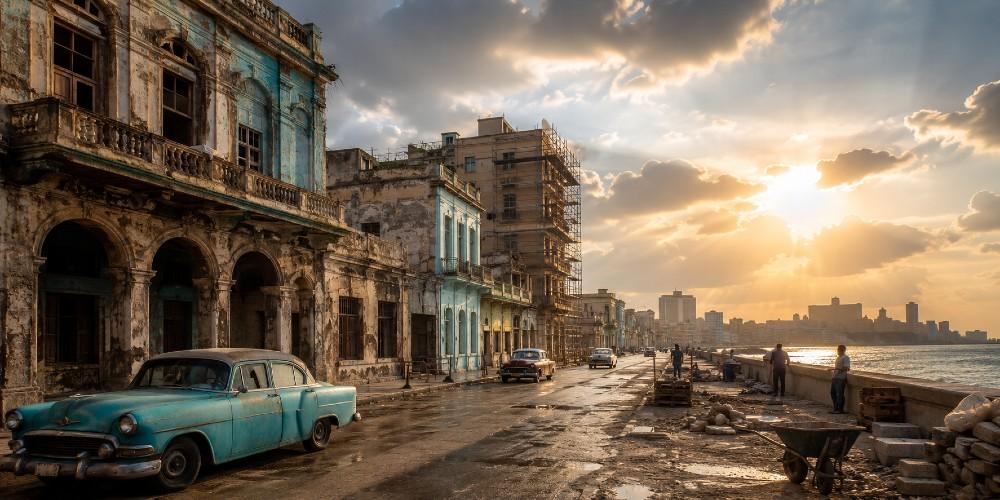
For sixty-five years, the Cuban regime built its identity on a single proposition. The Yankees were the enemy. American capital was a poison. The exile community in Miami was a band of traitors. And the embargo, however painful, was proof that the revolution still mattered.
Now, with the Trump administration squeezing Havana harder than any administration since Eisenhower, that proposition is collapsing in real time. Cuba is openly courting the very people and the very dollars Fidel Castro spent a lifetime denouncing.
The shift is not subtle. In recent weeks, Cuban officials have publicly invited Cuban Americans to invest in and even own businesses on the island, advertised the leasing of state-owned hotels to foreign chains, and confirmed they are in “serious” negotiations with Washington.
Prime Minister Manuel Marrero Cruz has promised that “the sanctions imposed on Cuba will not be permanent,” a curious thing to say if you genuinely believe your own propaganda. President Miguel Díaz-Canel has met with American businessmen at the presidential palace. The regime that nationalized U.S. property in 1960 is, in 2026, holding the door open and asking the descendants of those it dispossessed to please come in and bring their checkbooks.
This is not magnanimity. This is desperation dressed up as reform. And it deserves a clear-eyed reading.
The Pressure That Produced the Opening
None of this is happening because Havana suddenly discovered the virtues of free enterprise. It is happening because the regime is running out of options, and the man in the White House is the reason.
The architecture of the pressure campaign is straightforward. In January 2026, the United States ousted Nicolás Maduro from power in Venezuela, eliminating Havana’s lifeline of subsidized oil. Within weeks, Cuba was reporting it had fifteen to twenty days of fuel remaining. Trump then signed Executive Order 14380 declaring Cuba a national emergency, followed in May by Executive Order 14404, which extended sanctions to foreign companies and banks engaged with Cuba’s energy, mining, financial services, and security sectors.
Sherritt International, the Canadian mining giant that had operated in Cuba for decades, suspended its joint ventures within days. Air France suspended flights to Havana. Three nationwide blackouts hit the island in March alone.
By the time officials in Havana started talking about an “open door” for Cuban-American investment, the lights had already gone out.
What Trump Has Actually Done
The contrast with the Obama-era approach could hardly be sharper. The previous bipartisan consensus, embraced enthusiastically by Democrats and tolerated by many Republicans, was that engagement would gradually liberalize Cuba. Hotels would open, Wi-Fi would spread, and eventually the regime would soften.
What actually happened is that the regime pocketed the tourism revenue, funneled it through GAESA, the military’s business empire, and continued to jail dissidents and Christians while the Castros’ grandchildren collected hard currency.
Trump’s approach has inverted the logic. Instead of waiting for liberalization to produce pressure, he is using pressure to force liberalization. And for the first time in living memory, it appears to be working.
The GAESA Problem
Any honest accounting of the new Cuban “opening” must reckon with GAESA, the Grupo de Administración Empresarial S.A. This is not a company in any conventional sense. It is the financial nervous system of the Cuban military, controlling tourism, retail, banking, imports, and most of the dollar economy on the island.
A 2025 Miami Herald investigation, based on leaked internal documents, estimated GAESA holds as much as $18 billion in dollar-denominated assets in a country whose people stand in line for bread.
When Cuban officials announce that exiles can now “invest” in the island, the question that matters is whether their dollars will reach Cuban entrepreneurs or whether they will be siphoned, as nearly everything else has been, into the accounts of the generals. The State Department designated GAESA under the new sanctions on May 7, precisely because the answer to that question is well known.
This is the central tension in the regime’s pitch. The government is telling Cuban Americans that the doors are open while simultaneously refusing to dismantle the military monopoly that swallows whatever walks through those doors. It is asking Washington to relax the sanctions while keeping intact the very structures the sanctions were designed to dismantle.
The Exile Community’s Long Vindication
There is a moral dimension to this moment that should not be missed. For decades, the Cuban-American community, particularly in South Florida, was lectured by foreign policy elites, university professors, and editorial boards about how their hard line on Castro was outdated, vindictive, and counterproductive.
Engagement was sophisticated. Sanctions were primitive. The exiles were told their refusal to forgive amounted to a kind of personal grievance dressed up as policy.
That community has now been substantively vindicated. The regime that murdered, imprisoned, and exiled their families is on its knees, and it is on its knees not because of dialogue, cultural exchange programs, or cigar diplomacy. It is on its knees because a Cuban-American secretary of state named Marco Rubio, working for a president willing to use American leverage rather than apologize for it, has applied exactly the kind of pressure the exile community has been demanding since 1961.
The fact that Havana now wants those same exiles to bail it out is one of the more remarkable ironies of the post-Cold War period.
What the Christian Witness Demands
For Christians watching this unfold, the temptation is to view it purely as a geopolitical victory, a tidy chapter in the long story of American power versus communist tyranny. That reading is incomplete. Cuba’s regime has been one of the most relentless persecutors of the church in the Western Hemisphere. Pastors have been jailed. House churches have been monitored, infiltrated, and shuttered. Bibles have been confiscated. Catholic and evangelical leaders alike have been told for sixty-five years that their loyalty belongs to the state, not to Christ.
The collapse of that apparatus, or even its meaningful weakening, is not merely a foreign-policy win. It is a moment of potential deliverance for an underground church that has prayed for it through three generations.
The book of Isaiah captured this kind of moment, when a long captivity meets its end: “To proclaim liberty to the captives, and the opening of the prison to them that are bound.”
Whether what is unfolding in Havana represents that kind of opening, or merely a tactical retreat by a regime that hopes to weather the storm and reconstitute itself, is the question Christians and policymakers should be asking together.
The Reasons for Caution
None of this should be mistaken for the end of the Cuban regime. The Castros’ heirs have survived embargoes, blockades, the collapse of the Soviet Union, and the death of Hugo Chávez. They have a remarkable capacity for performative reform followed by quiet reconsolidation.
The current opening could prove to be exactly that, a brief window of pragmatism designed to extract foreign currency and sanctions relief, followed by a snap back to repression once the immediate crisis passes.
Skeptics also point out that Cuba’s constitution still places the Communist Party above all other institutions, that private property remains tightly constrained, and that the regulatory mechanisms necessary for genuine foreign investment, contract enforcement, repatriation of profits, due process, remain largely fictional. An “open door” without the rule of law is an invitation to be robbed.
The right posture, then, is the one the Cuban-American community has modeled for decades. Hopeful but unsentimental. Willing to support real liberalization while refusing to confuse a press release with a transformation.
Trump’s pressure has cracked the regime in ways that previous administrations failed to achieve. The question now is whether American policy will press that advantage toward genuine freedom for the Cuban people, or whether it will be talked into trading hard-won leverage for cosmetic concessions.
For the millions of Cubans living through blackouts, food shortages, and decades of accumulated grief, the difference between those two outcomes is everything.