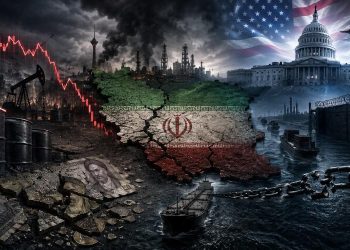
There is a certain poetic justice in watching oil tankers redirect from the Persian Gulf toward American ports. Since late February, Iran has effectively sealed the Strait of Hormuz — the narrow waterway through which roughly twenty percent of the world’s seaborne oil once flowed without interruption — turning decades of Middle Eastern energy dependency into an overnight crisis. The markets have reacted accordingly. Brent crude surged past $100 a barrel, gasoline prices climbed forty percent at the pump in weeks, and leaders in capitals from Tokyo to New Delhi scrambled to find crude wherever they could get it. Many of them started pointing their tankers in one direction: the Gulf of America.
The moment has the feel of a long-overdue reckoning. The United States is the world’s largest oil producer, pumping roughly 13.7 million barrels per day. It leads the world in LNG exports. The Panama Canal — which the media spent considerable energy mocking Trump for caring about — turns out to matter quite a lot when the alternative route is mined and blockaded. And American shale technology, the product of private ingenuity rather than government planning, is the reason this country has any options at all right now.
The question is not whether America has oil. It plainly does. The harder question is whether years of deliberate policy choices have left us capable of delivering it to a world that suddenly, desperately needs it.
The sobering answer is: not yet, and not without serious work.
- Iran has effectively closed the Strait of Hormuz since late February 2026, triggering the largest disruption to global oil supply in history — roughly 20 million barrels per day have been choked off from world markets.
- The United States produces approximately 13.7 million barrels of oil per day, making it the world’s largest single producer, but American output alone cannot cover the full Hormuz gap, which analysts estimate at 14 to 16 million barrels per day even accounting for Middle Eastern pipeline workarounds.
- Asian economies — China, India, Japan, and South Korea — bear the heaviest burden, as they collectively received nearly 89 percent of crude oil that previously transited the strait.
- American refineries face a structural mismatch: most existing facilities were engineered decades ago for heavier foreign crude, not the lighter shale oil that U.S. producers pump in abundance, limiting how much of our own production we can actually process and export as finished fuel.
- U.S. refinery capacity is actually shrinking in 2026, with closures in California and Texas cutting available throughput at exactly the wrong moment.
- The first new American oil refinery in nearly fifty years is under development in Brownsville, Texas, designed specifically for domestic shale crude — but it will not be operational for years.
- Interior Secretary Doug Burgum notes that the Biden administration took over seventy executive and regulatory actions that effectively sanctioned domestic energy development, constraining the infrastructure investment that would now be invaluable.
- The Trump administration has approved more than 6,000 drilling permits since taking office and moved to reopen California’s Santa Ynez pipeline, signaling urgency — but regulatory and infrastructure bottlenecks mean results will take time.
- Congress has the authority to accelerate refinery permitting, reform the Jones Act for coastal shipping flexibility, and expand LNG export contract frameworks — all steps that would materially improve America’s ability to supply global markets.
The Scale of the Problem Is Not Small
Before this crisis, approximately twenty million barrels of oil per day passed through the Strait of Hormuz, representing about twenty-seven percent of all seaborne oil trade globally. The IEA calculates that even with Saudi Arabia and the UAE running their bypass pipelines at maximum capacity, the available workaround covers only about 3.5 to 5.5 million barrels per day — leaving a net daily shortfall of fourteen to sixteen million barrels. Middle Eastern producers like Iraq, Kuwait, and Saudi Arabia have had no choice but to shut in wells as their storage tanks fill with crude that has nowhere to go. Global oil supply plunged by an estimated eight million barrels per day in March alone.
That is not a gap American production can close by itself, and anyone who claims otherwise is not doing the math. Analysts at CNN, the Dallas Federal Reserve, and the IEA agree on this much: drilling more wells in the Permian Basin next quarter will not replace twenty million daily barrels that moved through a now-mined strait. The U.S. industry added roughly 315,000 barrels per day in all of 2025 — a strong year by recent standards. To fill the Hormuz void would require something like fifty times that growth, instantly, which belongs in the category of physical impossibility.
But that framing, while accurate in the short term, misses the larger point. The crisis was never going to be solved by drilling alone. It was always going to be solved by military action, diplomacy, and strategic reserves buying time while long-term infrastructure fills the gap. What this moment actually exposes is not that American oil is insufficient in the abstract — it is that we have spent decades under-building the infrastructure needed to translate our enormous underground wealth into deliverable global supply.
The Mismatch Nobody Wanted to Talk About
Here is the structural problem that energy analysts have discussed quietly for years and that this crisis has made impossible to ignore. American shale production yields primarily light, sweet crude. It is excellent oil — clean, high-quality, and abundant. But most of the refinery capacity built along the Gulf Coast and in California was engineered in the 1980s and 1990s to process heavy foreign crude from Venezuela, Saudi Arabia, and Mexico. The equipment is not interchangeable. Many of those facilities cannot efficiently handle what American wells are actually producing.
The result has been an energy absurdity playing out for years without consequence — until now. The United States exports millions of barrels of light shale crude because domestic refineries cannot fully process it, while simultaneously importing heavy crude from abroad to feed refinery equipment designed for exactly that. When the foreign supply gets disrupted, as it has, the mismatch becomes acute. Gasoline prices on the West Coast reached $5.40 per gallon in April not primarily because of a shortage of crude oil in the world, but because California’s refineries are neither connected to domestic supply pipelines nor equipped to efficiently run on American shale. Geography and infrastructure, not geology, are the binding constraints.
Refinery closures have made this worse. The LyondellBasell facility in Houston — 263,000 barrels per day of capacity — was shuttered permanently. Valero’s Benicia refinery in California closed months ahead of schedule. Phillips 66 has followed suit in Los Angeles. The EIA projected before this crisis that refined fuel inventories would reach their lowest levels since 2000. That projection was made before a war closed twenty percent of global oil supply. The actual situation has been significantly more strained.
What Decades of Bad Energy Policy Cost Us
None of this happened in a vacuum. The infrastructure gap that now limits American capacity to serve as the world’s energy anchor is the direct and foreseeable consequence of policy choices made over the past two decades. Keystone XL was killed. Offshore leasing was systematically restricted. Permitting timelines for new pipelines stretched into years of litigation. The Biden administration, by Interior Secretary Burgum’s count, took more than seventy regulatory and executive actions that effectively treated American energy development as a problem to be managed rather than an asset to be deployed.
When Energy Secretary Chris Wright stood before oil executives at CERAWeek in Houston in March and told the world’s producers to pump more and do it now, the irony was not subtle. The same regulatory apparatus that had spent years strangling domestic energy investment was now urgently demanding its fruits. You cannot harvest what you have not planted, and for years the prevailing ideology insisted that oil was a sunset industry. That ideology did not lower the price of gasoline. It delayed the pipelines, blocked the refineries, and deferred the investment that would now allow America to meet this moment fully.
As the prophet Isaiah wrote, “For brass I will bring gold, and for iron I will bring silver, and for wood brass, and for stones iron: I will also make thy officers peace, and thine exactors righteousness.” The promise of abundance is real, but its fulfillment requires wise stewardship — including the unglamorous work of pipelines, permits, and refinery capacity that no one celebrates until the day it is desperately needed.
What America Can Actually Do — and What It Will Take
The picture is sobering, but it is not hopeless. The United States has genuine advantages that no other country can match. We are the world’s largest LNG exporter, and that capacity is expanding. New terminals at Plaquemines LNG and Golden Pass LNG are coming online, with total export capacity projected to reach 16.3 billion cubic feet per day by the end of 2026. Countries in Asia that cannot get LNG through the Strait are actively seeking American contracts. The market signal could not be clearer.
On the crude side, the Trump administration has approved more than 6,000 drilling permits since taking office — the most in fifteen fiscal years — and has moved aggressively to unlock Alaskan reserves, restart offshore leasing in the Gulf of America, and override California’s regulatory obstruction of domestic pipeline infrastructure. Venezuelan oil, secured through a separate geopolitical maneuver, is flowing toward Gulf Coast refineries. These are real steps, and they matter.
But the action most needed is legislative, and Congress has been slow to provide it. Three specific reforms would materially improve America’s position as a global energy supplier. First, an accelerated permitting framework for new refinery construction and expansion — particularly facilities engineered for domestic light crude. The America First Refining project in Brownsville represents the first new refinery built from scratch in nearly half a century, and it deserves every regulatory fast-track the federal government can provide.
Second, a targeted Jones Act waiver or reform that allows American crude to move more freely between domestic ports, reducing regional supply disparities of the kind punishing West Coast consumers right now.
Third, long-term LNG supply agreements with allied nations in Asia and Europe that give producers the contractual certainty to justify the capital investment in expanded export infrastructure.
Oil is not going away. The green energy lobby has spent years insisting that fossil fuels are in their final chapter, that investment in new production is stranded capital, and that the world is months away from a renewable transition that renders pipelines obsolete.
This crisis has answered that argument more decisively than any conservative commentator could. Bangladesh cut its university schedule to conserve natural gas. India rationed gas to households. The Philippines moved to a four-day work week. These are not the actions of nations on the cusp of a post-carbon future. They are the actions of nations that discovered, all at once, how fragile their energy supply had become.
America has been handed a moment of genuine strategic opportunity. The world’s tankers are not pointing toward Riyadh or Moscow right now. They are pointing toward the Gulf of America. The infrastructure, the permits, the refinery investment, and the legislative framework to fully answer that call are not yet in place. Congress should act as if they understand what is at stake — because the countries waiting on our supply certainly do.