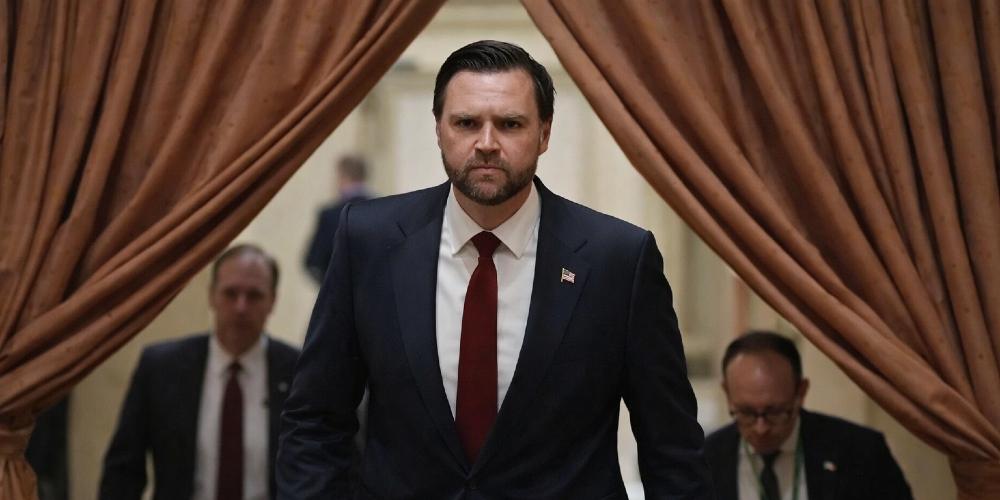
Twenty-one hours of face-to-face negotiations. Three rounds of trilateral talks. One table in a locked-down Islamabad hotel, with Pakistani mediators shuttling between two delegations that hadn’t spoken directly since the Islamic Revolution ended that possibility in 1979. And at the end of it all — nothing. Vice President JD Vance walked out of the Serena Hotel early Sunday morning and delivered a terse verdict on what may be the most consequential diplomatic failure of the Trump era so far.
“The bad news is that we have not reached an agreement,” Vance told reporters. “And I think that’s bad news for Iran much more than it’s bad news for the United States of America.”
That assessment deserves to be taken seriously — not as spin, but as strategic reality. Iran arrived in Pakistan carrying theatrical grief, a 70-person delegation dressed in black to mourn Ayatollah Ali Khamenei and others killed when the United States and Israel launched “major combat operations” on February 28. They carried shoes and bags from students they claimed were killed in a U.S. strike on a school near a military compound — a strike the Pentagon says remains under investigation. Tehran came to perform victimhood while simultaneously demanding sovereignty over one of the world’s most critical waterways. That posture, more than anything else, explains why talks collapsed.
Key Points
- After 21 hours of talks in Islamabad, Pakistan, Vice President JD Vance announced the U.S. and Iran failed to reach a peace agreement, with Iran refusing to accept American terms.
- The primary sticking point was control of the Strait of Hormuz — Iran insists on full sovereignty over the waterway through which roughly one-fifth of the world’s oil supply flows.
- Iran’s four “non-negotiable” demands included full sovereignty over the Strait, complete war reparations, unconditional release of frozen assets, and a region-wide ceasefire including Lebanon.
- Vance said the U.S. required a firm Iranian commitment to abandon pursuit of a nuclear weapon — a commitment Tehran refused to make.
- The talks represented the highest-level direct U.S.-Iran negotiations since the 1979 Islamic Revolution, with Vance, Steve Witkoff, and Jared Kushner leading the American delegation.
- U.S. Navy destroyers began mine-clearing operations in the Strait of Hormuz even as talks were underway, signaling Washington’s intent to reopen the waterway regardless of negotiation outcomes.
- Israel’s continued strikes on Iranian-backed Hezbollah in Lebanon — killing more than 2,000 people — complicated the ceasefire framework, with Iran insisting Lebanon be included and the U.S. and Israel maintaining it was not.
- Trump declared the U.S. wins regardless of outcome, noting American forces have “totally defeated” Iran’s military, while warning China against arming the regime.
- Talks are expected to continue, but the ceasefire itself remains fragile, with Iran still blocking most commercial shipping through the Strait despite the truce announced April 8.
The Hormuz Question That Everything Else Rests Upon
Understand the Strait of Hormuz and you understand why these talks were always going to be extraordinarily difficult. Roughly one-fifth of the world’s oil supply passes through that narrow channel between Iran and Oman. When Iran closed it following the February 28 strikes that killed Khamenei and decimated the country’s military and nuclear infrastructure, it didn’t just inconvenience oil traders — it triggered what analysts have called the largest disruption to global energy supplies in recorded history. Fuel protests broke out in Ireland. Gulf nations tallied catastrophic damage to their energy infrastructure. Allies who rely on the strait, from Japan to South Korea to France, watched in growing alarm.
Iran knows what it holds, or thinks it holds. Tehran arrived in Pakistan presenting four conditions it described as non-negotiable — full sovereignty over the Strait of Hormuz, complete war reparations from the United States, unconditional release of frozen Iranian assets abroad, and a region-wide ceasefire encompassing Lebanon. These were not opening bids. They were demands dressed up as conditions, framed so as to make meaningful American concession virtually impossible. Vance had warned before departing Washington: “If they’re going to try to play us, then they’re going to find the negotiating team is not that receptive.”
Iran tried to play them. And it didn’t work.
The Nuclear Red Line
When pressed on where the negotiations broke down most decisively, Vance was direct. The United States needed a firm and verifiable commitment from Iran that it would not pursue nuclear weapons.
“We haven’t seen that yet,” he said. “We hope that we will.”
That quiet phrase — “we hope” — carries enormous weight given the alternative. Trump had already declared there would be “no enrichment of Uranium,” and that the U.S. would work with Iran to remove what he called deeply buried nuclear “dust” via B-2 bomber operations if necessary. Iranian officials, meanwhile, had publicly stated that any attempt to limit the country’s enrichment capabilities would fail. These are not positions that find easy middle ground.
Israel’s Prime Minister Benjamin Netanyahu, watching from Jerusalem, was characteristically blunt. The campaign against Iran, he said Saturday evening, “is not yet over.” He listed Israeli accomplishments during the war — the killing of Iran’s top leadership, the destruction of its nuclear and missile infrastructure — and added that Iran’s stockpile of highly enriched uranium would be removed either through an agreement or, as he put it, “by other means.” Netanyahu did not appear to be speaking hypothetically.
Pakistan’s Moment — and Its Limits
It would be easy to dismiss Pakistan’s role as largely ceremonial, but that would be unfair. Islamabad executed something genuinely rare in modern diplomacy — it earned the trust of two adversaries simultaneously, enough to get them seated, if not at the same table, at least in the same hotel. The shuttle diplomacy conducted by Pakistani officials, and the personal engagement of Prime Minister Shehbaz Sharif and Army Chief Field Marshal Asim Munir, created the architecture that made these talks possible at all.
As Pakistan’s former U.N. ambassador Zamir Akram observed, “Pakistan has succeeded in getting them together. We got them to sit at a table. Now it is for the parties to decide whether they are willing to make the sacrifices necessary to reach an eventual solution.”
Islamabad was locked down for the occasion — thousands of army troops and paramilitary personnel in the streets, the Red Zone sealed, key entry points closed. The Pakistani Air Force had even mobilized escorts to fly the Iranian delegation safely to Pakistani airspace. It was an extraordinary display of diplomatic ambition from a country not historically known for mediating great-power conflicts. But no amount of Pakistani goodwill could paper over the fundamental disagreement at the heart of these talks.
The Ceasefire That Wasn’t Quite a Ceasefire
The two-week ceasefire that preceded the Islamabad talks was itself a study in competing interpretations. Trump announced it on April 8, declaring Iran would immediately open the Strait of Hormuz. Iran’s Foreign Minister Abbas Araghchi said passage would be “possible” — but only in coordination with its armed forces and with “due consideration of technical limitations.” By April 9, ships were once again being turned away from the Strait. Iranian state television carried messages from Khamenei’s son promising revenge. The IRGC’s navy declared it retained “full authority” over the waterway.
Meanwhile, Israel’s interpretation of the ceasefire excluded Lebanon, where it continued striking Hezbollah targets. On the very day the truce took effect, Israel launched what Lebanon’s Health Ministry described as the deadliest single day of strikes since September 2024, killing more than 300 people in Beirut and southern Lebanon. Iran had made inclusion of Lebanon a precondition for talks. The U.S. and Israel said Lebanon was never part of the deal. Vance called it a “legitimate misunderstanding.” Tehran called it a violation. One Pakistani source told Reuters that the temperature in the negotiating room went “up and down” considerably throughout the day.
What Happens Now
The ceasefire remains technically in place, though strained. U.S. Navy destroyers USS Frank E. Petersen and USS Michael Murphy have already begun mine-clearing operations in the Strait of Hormuz — a signal that Washington intends to reopen the waterway with or without Tehran’s cooperation. Trump has said the U.S. ships are being reloaded with the best weapons available, should diplomacy fail entirely.
“We’re loading up the ships with the best ammunition,” he told the New York Post on Friday. “And if we don’t have a deal, we will be using them, and we will be using them very effectively.”
Proverbs 11:14 reads, “Where no counsel is, the people fall: but in the multitude of counsellors there is safety.” What is missing from this conflict — and what has been missing since February 28 — is not military resolve but a coherent end state that all parties can accept. Iran demands sovereignty it cannot reasonably expect to retain after the destruction of its military. The United States wants denuclearization without offering Iran a credible reason to comply. Israel continues operations that undercut the ceasefire framework its own prime minister nominally endorsed. This is not a recipe for durable peace; it is a recipe for a fragile pause followed by resumed catastrophe.
Talks are expected to continue. But Iran’s insistence on “non-negotiable” conditions — particularly its claim to permanent control over an international waterway — leaves little room for the kind of genuine compromise that lasting agreements require. A regime that came to the table dressed in mourning, carrying the shoes of dead students as props for the cameras, is not a regime in search of peace. It is a regime buying time. The question is whether the Trump administration has the patience to wait it out — or the will to make the alternative too costly to contemplate.
Trump, for his part, was characteristically unbothered. “Regardless we win,” he told reporters Saturday. “We totally defeated that country.” Whether that confidence translates into strategic outcome remains the most important open question in global affairs today. The Strait of Hormuz is still not fully open. The nuclear program is still not verifiably dismantled. And twenty-one hours of historic diplomacy in a locked-down Pakistani capital produced not a treaty, but a plane ride home.