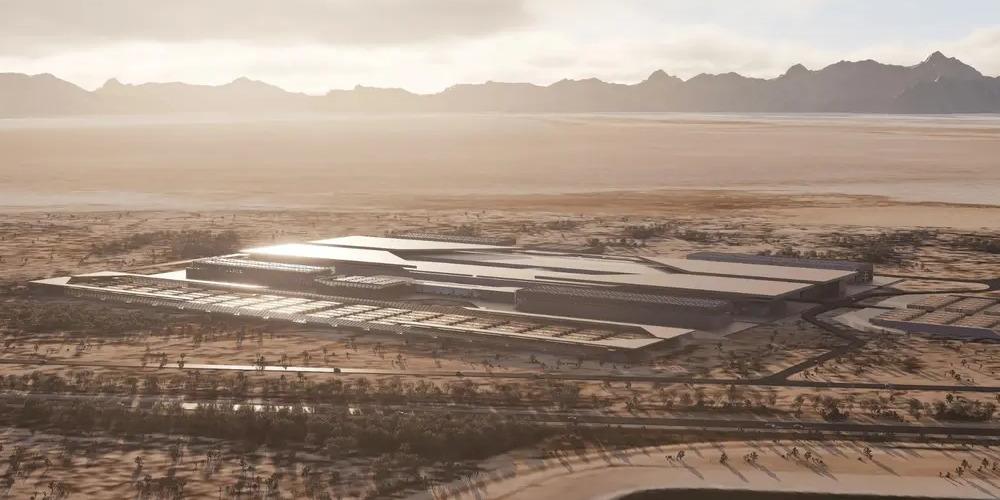
Elon Musk’s SpaceX is proposing one of the largest computing projects in American history right in the middle of the Arizona desert, and the company is doing it without sucking the local aquifer dry. A roughly $50 billion supercomputing campus in Cochise County would train the company’s superintelligence models while supporting medical research, emergency response, manufacturing, and national security work. The entire complex is designed around dry cooling so it never uses industrial groundwater.
The numbers are staggering. Nine single-story computing buildings, each about 493,000 square feet, would eventually draw up to 6 gigawatts of power. That is more than twice the electricity consumed by every data center already operating in Maricopa County.
SpaceX plans to build it in four phases of roughly 1.5 gigawatts each and back the load with a 24 gigawatt-hour battery storage system, the largest of its kind in the country. Construction is targeted for 2027 if the county signs off. Peak construction would put about 5,500 people to work. Once running, the campus would support roughly 1,000 permanent jobs.
Water is the issue that usually kills these projects in the West. Conventional data centers rely on evaporative cooling towers that can consume millions of gallons a day. SpaceX is using sealed, closed liquid loops that carry heat to fan-cooled dry coolers. The system is filled once, with an estimated 3 to 5 million gallons, and that water can be reused for up to ten years.
There are no cooling towers and no evaporative spray. Day-to-day water use at full build-out is projected at no more than 10 acre-feet a year, roughly what 20 to 30 Arizona homes consume. Construction and dust-control water would come from non-potable sources, including treated wastewater already available at the nearby Apache Generating Station. No new high-volume wells are proposed.
The campus will use dry cooling to limit water consumption and does not plan to use industrial groundwater.
Productive use of the land and careful stewardship of its resources have never been enemies. SpaceX is treating the desert as something to be worked and preserved at the same time, not as a political prop.
Power will come through the Sulphur Springs Valley Electric Cooperative and Arizona Electric Power Cooperative. SpaceX has committed $3.6 billion for grid upgrades that will be turned over to the cooperatives at no cost to their members. The company says the project could cut electricity bills for cooperative members by up to 20 percent for the life of the facility and generate substantial new tax revenue for the county, including a one-time sales-tax benefit estimated as high as $250 million. Property-tax revenue is projected between $34 million and $103 million annually once fully built.
Not everyone is cheering. A petition with roughly 2,400 signatures asks Cochise County officials to reject the project. A public hearing is scheduled for December. Some residents worry about noise, night-sky lighting, and the sheer scale of the load. SpaceX counters that there will be no on-site power plant or fuel yard, that standby natural-gas generators are limited and used only during outages or testing, and that lighting will meet dark-sky rules.
The company also filed initially under the name Tombstone Resources LLC, which a representative later explained was done because putting the SpaceX name on the application “draws attention” from outside the county.
This Arizona site is one half of a larger commitment. SpaceX is putting more than $74 billion into supercomputing campuses across Arizona and Texas. The Texas project at Starbase will generate its own power, including a proposed natural-gas plant, and comes with up to $220 million in water and wastewater investments for Brownsville and Cameron County. Together the two campuses mark a serious private push into the compute needed for frontier artificial intelligence while the public grid and water systems are already strained.
Critics will call it another data-center invasion. The practical reality is that American companies are racing to build the physical infrastructure that keeps the country competitive in artificial intelligence, national security applications, and advanced research. SpaceX is doing it with private capital, paying for the transmission upgrades, and designing the facility so it does not treat groundwater as an unlimited resource. That is the opposite of the water-intensive model that has drawn justified complaints elsewhere.
Whether Cochise County approves the campus remains to be seen. What is already clear is that the proposal treats the desert’s limits as an engineering problem to solve rather than an excuse to stop building. For more on the company’s plans, see the SpaceX Cochise County page, the Interesting Engineering report, and Breitbart’s coverage of the dual-state investment.