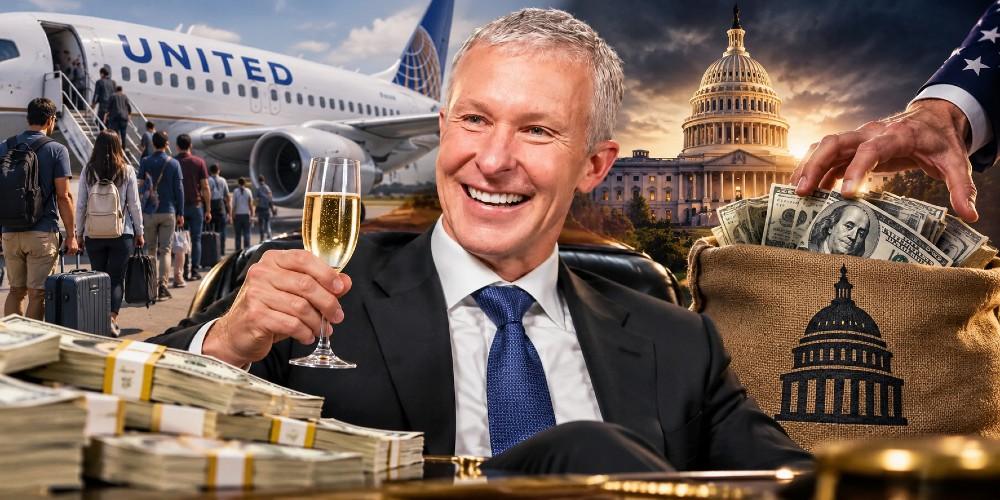
Scott Kirby pulled in $32.3 million last year running United Airlines. That is roughly 334 times what the median employee at his own company earns. Then he sat down with the New York Times and declared that wealth inequality has become a danger to our society.
He wants a national wealth tax. He wants inheritance taxes that get close to 100 percent at some level. And he says he would pay them.
This is the same man who, in the same interview, defended charging passengers extra to avoid a middle seat. “There are some customers who want to sit in a window seat or a better seat, and that costs money to deliver,” he explained.
Apparently the free market is fine when it pads United’s bottom line. When the conversation turns to his own compensation package, the free market suddenly needs a federal confiscation scheme to save the Republic.
Fox Business reported the original remarks. A follow-up the next day noted that when the outlet asked United whether Kirby planned to reduce his own pay or share any of it with employees, the company went silent. No response. No voluntary haircut. No redistribution of the $32 million to the people who actually fly the planes, load the bags, and clean the cabins.
Louisiana Governor Jeff Landry put the obvious question on X. “How audacious from a guy that didn’t even build @united and makes $32 million a year. If he feels that strongly he could simply cut a check.” Landry even linked the Treasury site where private citizens can donate to reduce the national debt.
The silence from Chicago has been instructive.
Kirby’s proposal is not a modest tweak to the existing estate tax. The federal estate tax already sits at a top rate of 40 percent with a $15 million exemption per person in 2026. Only a tiny fraction of estates pay it. What Kirby is floating is something closer to a death tax that effectively erases large inheritances, plus an annual levy on net worth that would require national enforcement so the wealthy cannot simply move.
He did not name the thresholds. He did not name the rates. He simply asserted that inequality is dangerous and that the government should take more.
Scripture does not treat wealth as the original sin. Abraham was wealthy. Job was wealthy. Joseph of Arimathea was wealthy. The problem is the heart. “Take heed, and beware of covetousness: for a man’s life consisteth not in the abundance of the things which he possesseth.”
That warning in Luke 12:15 applies to the man who resents his neighbor’s success as much as it applies to the man who clutches his own. Covetousness is not cured by writing a statute that lets the state seize what it did not earn.
A national wealth tax faces the same practical problem Kirby himself identified with state taxes: people move. Capital moves faster. Successful people and the businesses they build tend to relocate when the rules change against them. California is already testing a version of this idea on the ballot. Early analysis suggests the actual revenue will fall well short of the sales pitch once the billionaires start voting with their feet. Kirby’s answer is simply to make the tax national so there is nowhere left to go.
That is not economic analysis. That is a demand that the exit door be locked.
Meanwhile, the same executive who frets about inequality continues to run an airline that segments customers by willingness to pay. Window seat, aisle seat, basic economy, elite status—all priced differently because that is how markets allocate scarce resources.
The logic is sound. It is also the logic that justifies paying the person responsible for the entire enterprise more than the person who empties the bins. Boards set CEO pay. Shareholders can vote with their feet. Employees can leave for other carriers. None of that requires a new federal agency to measure net worth every December 31 and send a bill.
Kirby told the Times he believes the country’s economic future is “incredibly bright.” He is almost certainly right. The American economy has lifted more people out of poverty than any system in history precisely because it has allowed large fortunes to be built, invested, and passed on.
Confiscatory inheritance taxes do not primarily punish the living billionaire. They punish the next generation’s ability to take risks with capital that was already taxed when it was earned. They reward consumption over long-term investment. They turn family businesses into forced sales.
If Kirby genuinely believes his own compensation is a societal danger, he has a simple remedy that does not require Congress, the IRS, or a constitutional amendment. He can write the check. He can ask the board to cut his package. He can fund scholarships, employee profit-sharing, or the Treasury directly. Until he does, the lecture lands exactly where most such lectures land: as performative concern from a man who is doing very well under the system he now wants to dismantle for everyone else.
The rest of us can keep flying United or not. We can also keep the simple recognition that envy dressed up as public policy is still envy. And that a $32 million paycheck does not confer the moral authority to decide how much of someone else’s estate the government should seize.