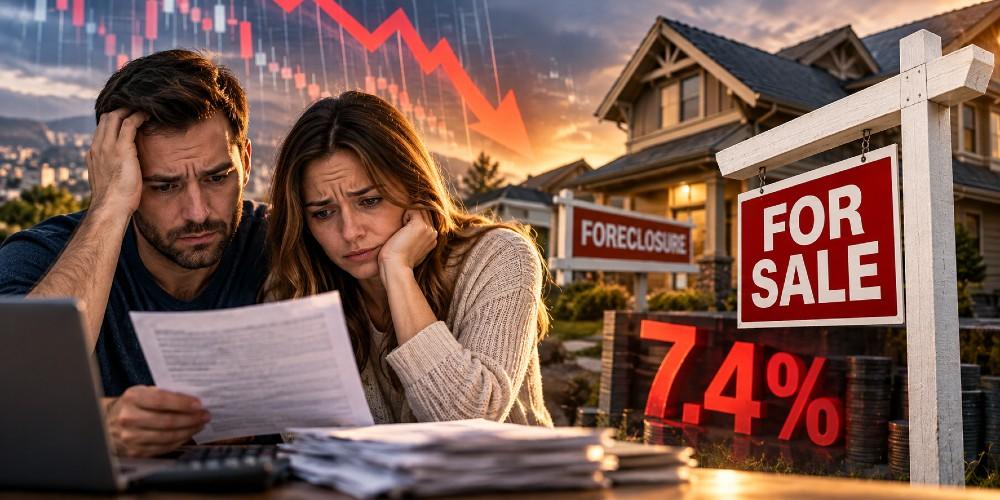
The American dream of owning a home is being priced out of reach for millions, and the numbers just keep getting worse. Pending sales cratered in September while bank repossessions jumped and mortgage rates locked in above 7 percent.
This is not some abstract market adjustment. Families who locked in low rates during the pandemic are staying put, first-time buyers are hitting 40 before they get the keys, and Washington’s spending binge is helping push Treasury yields higher through inflation fears tied to the war with Iran, the national debt, and endless deficits.
According to Daily Caller reporting on Redfin data, pending home sales fell 4 percent month-over-month in September—the steepest drop in more than three years. That pushed the total to its lowest level since 2014, excluding the early COVID freeze.
Contract signings declined year-over-year in every single one of the 50 major metros Redfin tracks. Seattle got hammered, with pending sales plunging 24.4 percent and the median sale price falling 4.4 percent. The West Coast led the declines, but no major market escaped the retreat.
“The mood in the real estate industry has significantly shifted,” Redfin Chief Economist Daryl Fairweather told Bloomberg. “When interest rates go up like this, fewer people can afford to buy homes, which means sales have to fall.”
The average 30-year fixed mortgage rate hit 7.40 percent, its highest since November 2023 and a full point above where it stood a year earlier. Freddie Mac’s weekly average at the end of September was already 7.28 percent.
That is not a rounding error. It is the difference between a family qualifying and being told to keep renting. Inventory has climbed to its highest level since March 2020, nearly one in five sellers cut their asking price in September, and 14.5 percent of purchase agreements fell through—the highest cancellation rate in Redfin’s records. Buyers who remain have more leverage. Most of them simply cannot afford to use it.
Foreclosures Climb Even as the 2008 Ghost Stays in the Background
ATTOM’s August report showed 40,277 properties with foreclosure filings, up 13 percent from a year earlier. Foreclosure starts rose 7 percent. Completed bank repossessions jumped 42 percent to 5,794 homes. South Carolina, Nevada, Florida, Texas, and Maryland posted the highest rates.
Texas led the nation in actual repossessions. These numbers remain well below the chaos of 2008, and high homeowner equity plus mostly fixed-rate loans are still providing a buffer. That does not make the trend comforting. More families are losing the properties they already own while new buyers stay frozen on the sidelines.
“August’s data shows that foreclosure activity continues to trend above year-ago levels, particularly in completed foreclosures, which saw a notable annual increase,” ATTOM CEO Rob Barber said.
Some homeowners are reaching for riskier options. Adjustable-rate mortgages made up 9.8 percent of applications in the week ending September 18. Outstanding home equity lines of credit hit $459 billion in the second quarter, up $142 billion from the 2022 low. Variable-rate debt looks cheaper at the start. It gets expensive when short-term rates stay elevated.
First-Time Buyers Are Aging Out of the Dream
The affordability squeeze hits younger Americans hardest. The New York Post reported that the median age of first-time homebuyers reached a record 40 in 2025, up from 38 the year before and 33 as recently as 2020. Their share of all purchases fell to a historic low of 21 percent.
In 1981 that median age was 29. Decades of underbuilding, pandemic-era demand, and now rates that make monthly payments punishing have pushed ownership later and later. Starting a family and building equity used to happen in the late twenties or early thirties for a large share of Americans. Now it is a mid-life event for those who manage it at all.
For which of you, intending to build a tower, sitteth not down first, and counteth the cost, whether he have sufficient to finish it?
That is exactly what millions of would-be buyers are doing right now. They are counting the cost of a 7.4 percent mortgage against stagnant wages, rising insurance, and property taxes, and deciding the tower is not worth starting. Sellers who bought at rock-bottom rates during the pandemic are not listing. Builders are watching demand evaporate.
The result is a market that looks soft on paper yet remains brutally expensive for anyone trying to get in.
None of this is mysterious. Years of massive federal spending, mounting debt that now nears $40 trillion, and inflation pressures amplified by the Iran war have kept Treasury yields elevated. Mortgage rates follow. Policymakers can talk about supply and zoning all they want.
When the monthly payment on a median home consumes an ever-larger slice of a working family’s income, the math simply does not work. The housing market is not collapsing like 2008. It is slowly freezing in place, and the people who will pay the highest price are the ones who never got the chance to buy.