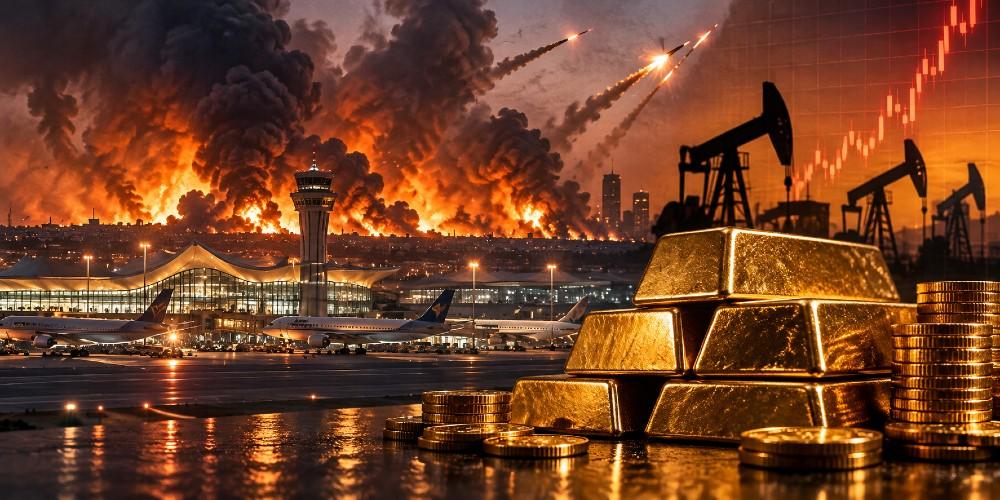
Gold is supposed to shine when the world burns. Missiles hitting a major airport, oil jumping, and a conflict that has already dragged on for months should send investors scrambling for the metal that has served as the classic refuge for centuries.
Instead, bullion is holding a drop, trading near $4,160 an ounce after finishing the prior session 0.5 percent lower, according to Bloomberg. The market is not ignoring the chaos in the Middle East. It is pricing something worse for gold than war itself: the inflation that war keeps feeding and the higher interest rates that follow.
The immediate spark is fresh fighting involving Iran-backed Houthi forces and Saudi Arabia. Attacks on King Khalid International Airport in Riyadh have killed at least a dozen people and wounded hundreds in recent days, with the airport shut and airlines warned off. Brent crude sits near $106 a barrel as traders weigh the risk of further energy supply hits.
That is not abstract. Higher oil means higher costs that do not stay in the Gulf. They show up in inflation numbers everywhere, and inflation numbers give central banks cover to keep rates elevated or push them higher.
This is not a new pattern. Gold has fallen roughly a fifth since the U.S.-Iran war erupted in late February. The conflict has repeatedly pushed energy prices up, which has kept inflation sticky and given the Federal Reserve reason to tighten rather than ease.
A metal that pays no yield loses its appeal when investors can earn more in bonds or other assets. Swap markets currently show only a low chance of a rate hike at this month’s Fed meeting but still price in one additional increase before the year ends. Wednesday’s U.S. inflation data will be watched closely for any sign that the pressure is easing or intensifying.
There is a cold logic here that frustrates the old safe-haven script. In past crises, a sudden shock often drove money into gold and Treasuries together while yields fell. This time the shock is inflationary first. Oil and shipping risks raise price pressures, yields stay high or climb, and gold gets treated more like a rates instrument than a bunker.
Reports from market desks note that the metal has struggled throughout the broader conflict for exactly this reason. Escalations lift crude, crude lifts inflation expectations, and inflation expectations keep the Fed on a tighter path. The haven trade breaks when the war itself becomes the reason rates stay high.
That leaves ordinary people holding the bag in more than one way. Energy costs feed into everything from fuel to food to shipping. Higher rates make mortgages, car loans, and business credit more expensive while the government keeps borrowing against a debt already near historic levels.
Markets can debate the next Fed move, but households feel the cumulative weight. The same forces that keep gold from rallying also keep the cost of living elevated and the path of borrowing costs uncertain.
Scripture has long warned against placing ultimate security in what can be taken or inflated away. “Lay not up for yourselves treasures upon earth, where moth and rust doth corrupt, and where thieves break through and steal: But lay up for yourselves treasures in heaven, where neither moth nor rust doth corrupt, and where thieves do not break through nor steal” (Matthew 6:19-20).
Earthly stores, including gold bars and paper claims on them, remain subject to the very disruptions and policy responses the markets are watching. The metal can still serve as a hedge in certain conditions, and central banks continue to hold it for strategic reasons, but it is not immune to the arithmetic of yields and inflation.
Traders will keep one eye on the next inflation print and the other on whether the fighting spreads further or finds any pause. For now the message from the price action is straightforward. The Middle East conflict is real, the casualties are real, and the oil risk is real. Those realities are feeding inflation fears that raise the odds of tighter policy.
Gold is holding its losses because the market sees the rate implications more clearly than the traditional flight-to-safety story. In a world where war stokes the very pressures that punish non-yielding assets, the old refuge is not behaving like one.