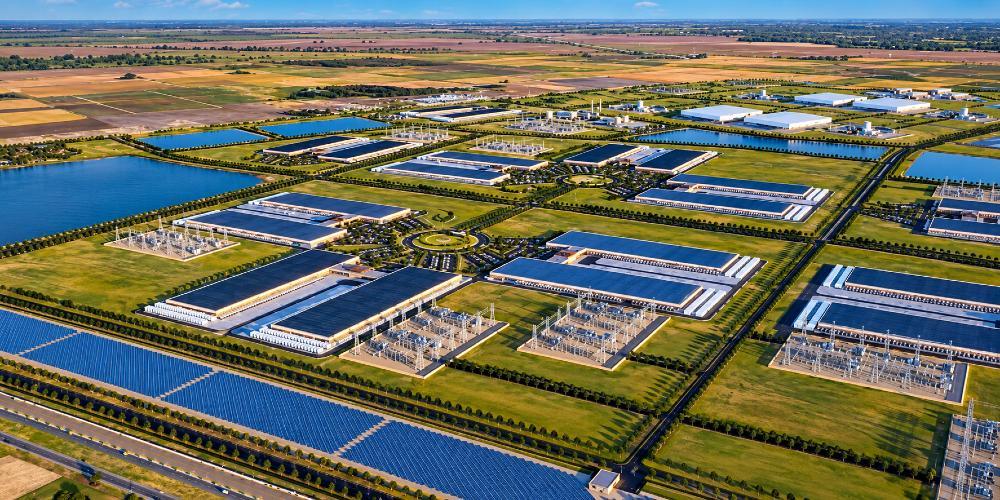
Forget the server room in the back of the office. The machine that answers your questions now wants a piece of Texas the size of a small county. Amazon is clearing a campus of about 3,000 acres outside Boling, roughly ten miles southeast of Wharton and an hour south of Houston, and regulators have already handed the company the first water permits to get dirt moving.
Three thousand acres is not a warehouse with a fancy name. It is about 187 Michigan Stadiums, the Big House and all its facilities stacked end to end across rice and cattle country.
That is the scale people still have not absorbed. A section of farmland is 640 acres. This one project is closer to five sections. Central Park in Manhattan is 843 acres. Amazon’s Wharton County site is more than three of those. And Wharton is not even the biggest drawing on the board.
Just The News reported that the campus will hold somewhere between 10 and 13 data-center buildings, each about the footprint of a Walmart Supercenter, on a project local coverage has put near $10 billion. Amazon says it will support at least 300 full-time jobs, with 150 of them showing up by mid-2027, and that construction will throw off thousands more paychecks while the concrete is poured. Do the permanent math. Three hundred jobs on 3,000 acres is one hired hand for every ten acres. The machines stay. The payroll does not.
A farm county, a well permit, and a governor who hit the brakes
Wharton County residents have been loud about water, and they are not imagining the ditch. The Coastal Bend Groundwater Conservation District issued permits in May and again in September letting Amazon pull groundwater from three wells for restrooms, construction crews, and fire protection. The ceiling is 78.2 million gallons over two and a half years, about 31.2 million gallons a year if it is spread evenly, enough for roughly 285 average American households. A second set of permits allows up to 16.9 million more gallons from two other wells by February 2029. Amazon says it does not expect to take the full amount.
The company is also careful about what those permits are not. Amazon says the 13 buildings planned on the campus will not use water for cooling, and that no groundwater will be used to cool the data halls. Potable use, it says, is limited to about 16,000 gallons a day, roughly 54 households, for bathrooms, cleaning, and fire suppression. Cooling, if it needs water at all, is supposed to come from nonpotable sources worked out with regional authorities.
Amazon says its systems already run on outside air about 90 percent of the time, that surface water is only tapped in the hottest hours, and that water use per IT load has been cut in half since 2021. It has also promised a Wharton County Community Fund and a replenishment project that would help farmers switch to alternate wetting and drying, a rice-irrigation method Amazon says can cut demand 25 percent or more without cutting yields, and return more than 225 million gallons a year for ten years in the lower Colorado River watershed.
Read that again, then read the fine print the neighbors are reading. The groundwater permits do not cover the surface water a complex this size could still need. An administrative judge ruled in July that local residents had not shown the wells would harm the Chicot Aquifer. Negligible, on paper, is a comforting word until the next drought and the next campus.
Texas water rights and water laws are like the old west.
That is Bee County Judge George Morrill, and neighboring county judges have been saying the same thing in plainer clothes. Residents and county governments often do not hold the water rights under the land being sold out from under them.
Counties in Texas also lack real zoning power, so a judge can slow a driveway and he cannot stop a 3,000-acre lease. Private property is a real good. It is also how a global cloud company buys a horizon that a rice farmer cannot outbid.
Governor Greg Abbott has noticed the politics, if not always in time to get ahead of the permits. On September 21 he told the Texas Commission on Environmental Quality to halt data-center permits until state audits are finished. That was the fourth directive in four months. In June he ordered regulators to make sure these projects pay for their own electric infrastructure instead of shifting the bill onto families and small businesses, reuse their own water, do not wreck neighborhoods, and quit living on taxpayer-funded incentives.
In September he went after water reporting, saying data centers appeared to have skipped surveys required by the Texas Water Code, and told the Texas Water Development Board to penalize the misses. Amazon was among the companies that said they would comply. The groundwater district still issued the Wharton permits.
Wharton is the postcard, not the map
Under Abbott, Texas passed Virginia for the most data-center construction in the country. Then the same governor started writing cease-and-desist letters to his own boom. That is the tell. The buildings got ahead of the grid, the aquifers, and the people who have to live next to both.
Isaiah saw the pattern a long time before anybody invented a graphics chip. “Woe unto them that join house to house, that lay field to field, till there be no place, that they may be placed alone in the midst of the earth.” Field laid to field is no longer a metaphor when the buyer is a cloud company and the crop is electricity.
Set Wharton next to what else is permitted or pouring concrete. Meta’s Hyperion campus in Richland Parish, Louisiana, started on about 2,250 acres and picked up another 1,400 next door, roughly 3,650 acres in cotton country, with the company now talking about 5 gigawatts and more than $50 billion. A gigawatt is the output of a large nuclear reactor. Five of them is a new power system wearing a data-center name.
Up in the Texas Panhandle, Fermi America’s Project Matador, co-founded by former Governor Rick Perry, holds a 99-year lease on about 5,769 acres of Texas Tech land near the Pantex plant outside Amarillo. The pitch started at 11 gigawatts of private power and has been floated as high as 17, with 18 million square feet of halls and a mix of gas, solar, wind, and nuclear.
OpenAI’s Stargate work in Texas and New Mexico is measured in campuses of 1,200 to 1,400 acres and well over a gigawatt apiece. Amazon’s own New Carlisle, Indiana, site, built to train Anthropic’s models, sits on about 1,200 acres and is already drawing on the order of 900 megawatts.
Epoch AI’s October 2026 tally put the largest operating AI hall it tracks, xAI’s Colossus 2 in the Memphis area, at about 946 megawatts of IT power. San Diego’s average electric load is about 800 megawatts. One compound, one city. The 93 large AI sites in that dataset already add up to 13.7 gigawatts of computing load, and the buildings around the computers push real facility demand higher still. Lawrence Berkeley National Laboratory’s 2025 update estimated U.S. data centers used 176 terawatt-hours in 2023 and, in the reference case, 649 terawatt-hours by 2030, about 11.8 percent of all American electricity, with the range running from 9.5 to 15.3 percent.
The Energy Information Administration has already said data centers are a main reason electricity sales are setting records, and that the West South Central region, Texas included, is leading the growth even after Austin’s pause.
The water you do not see on the tour
Direct water use is the number companies like to publish, because it is the one they can shrink with air cooling and closed loops. Lawrence Berkeley researchers put direct U.S. data-center consumption at about 17.4 billion gallons by 2023, triple the decade before, and projected 38 to 73 billion gallons by 2028.
The larger drink is upstream. Generating the electricity those halls burned in 2023 took on the order of 211 billion gallons, historically around a dozen times the water used on site. A low water-use number on a press release can sit on top of a gas plant that evaporates a river.
That is the honest size of the thing. Not a building. A land bank, a power plant, and a water claim, often in a county that did not ask for any of the three. The halls themselves can be the size of big-box stores. The reservation around them is the size of a college football Saturday repeated 187 times. The power request is the size of a city. The job count, once the cranes leave, is the size of a shift at a rural hospital.
None of this requires a tantrum against chips. Computation is not a sin, and a nation that refuses to build will rent its future from someone who will. The question is older than the cloud. Who eats the cost. Who keeps the field. Who is left holding the well when the audit finally arrives. Wharton County is where that argument stopped being abstract. Three thousand acres is big enough to see from the road, and it is still only the front gate.