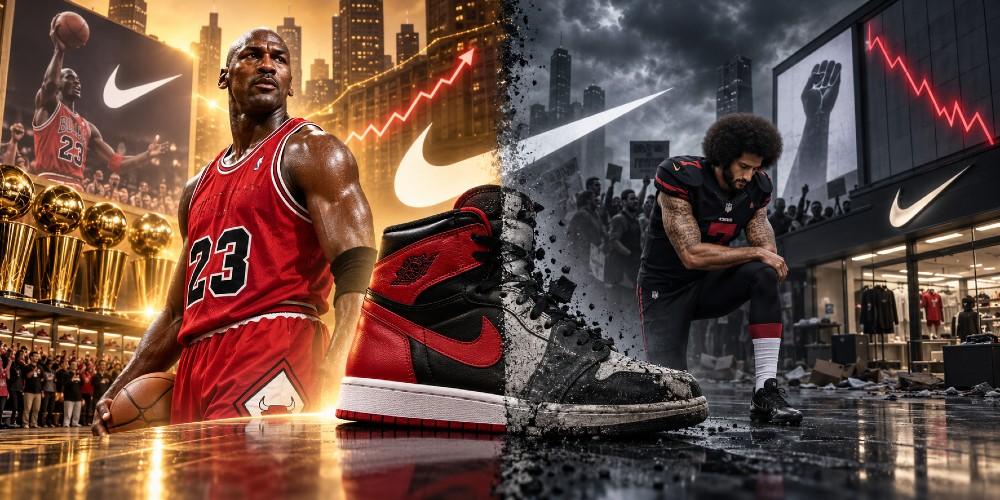
Michael Jordan said it on a team bus like a joke. Nike treated it like a suggestion it could ignore.
“Republicans buy sneakers, too.” Four words. The greatest basketball player who ever lived, the man who turned a shoe company into an empire, reminding everyone that customers come in more than one political flavor. OutKick’s Dan Zaksheske put that line back in the window this week because the Swoosh just got kicked out of the S&P 100.
S&P Dow Jones Indices announced the change September 4. Nike leaves before the open on September 21, ending a run that started at the end of 2008. Nearly eighteen years as a blue-chip name. Then the stock fell far enough that the index no longer wanted it in the top hundred.
That is not a branding problem. That is a verdict.
Two Hundred Billion Dollars Walked Away
Near its November 2021 peak, Nike was worth about $281 billion. Shares touched $179.10. This week they closed around $38.10. Market value sits near $56.5 billion. Call it a 79 percent collapse. Call it more than $220 billion gone.
The company is not bankrupt. It will still slap logos on athletes and move product by the warehouse. It remains in the broader S&P 500, a point Nike’s own investor-relations shop felt compelled to memo to executives after the headlines landed. Fine. Membership in the five hundred is not the same as belonging with the hundred. One is a wide net. The other is a club for companies that still look like winners.
Leaving with Nike are Honeywell Aerospace, Simon Property Group, and Colgate-Palmolive. Walking in are Dell Technologies, Palo Alto Networks, Arista Networks, and Sandisk. The index is swapping sneakers and toothpaste for servers and silicon. Markets do that when a consumer giant stops acting like one.
Elliott Hill took over as CEO in October 2024. The stock is down more than 50 percent on his watch. He has said the results are not there yet. Shareholders already knew.
America Bad. China Essential.
In 2018 Nike put Colin Kaepernick at the center of its 30th-anniversary “Just Do It” campaign after he refused to stand for the national anthem. The message was that America oppresses. Billboards said so. Favorability took a hit. Plenty of people kept buying. Plenty of people stopped.
Then came the Fourth of July Air Max with the Betsy Ross flag. Nike pulled it in 2019 because the design might “unintentionally offend.” Offend whom, exactly? Sen. Ted Cruz said the quiet part out loud when the stock later hit a twelve-year low. Kaepernick angered him. Canceling the founding flag told him the marketing plan was America-hate. He bought different shoes. He was not alone.
In 2020 the company rolled out “For Once, Don’t Do It” and wrapped itself in Black Lives Matter. In 2023 it paid Dylan Mulvaney to sell women’s leggings and sports bras. OutKick later reported Nike’s name attached to a proposed study of transgender youth athletes. After the exposure, a Nike executive said the study “was never initialized” and was “not moving forward.” Researcher Joanna Harper said the company pulled out once critics noticed.
That is the domestic sermon. Now look east.
When Chinese consumers bristled at Nike over reports of forced labor in Xinjiang, then-CEO John Donahoe did not lecture Beijing. On an earnings call he said, “We’re a brand of China and for China.” Forty years of investment. Thousands of stores. Commitment intact.
Greater China brought in $8.29 billion when Donahoe said that in 2021. The number now is $5.85 billion. Almost 30 percent gone, including an 11 percent drop in the past year. The communist market Nike refused to scold still shrank. The American customer Nike scolded still has feet.
Be not deceived. God is not mocked. For whatsoever a man soweth, that shall he also reap. A company that lectures one country about oppression and genuflects to another should not act shocked when the harvest comes in light.
The Hangover Has a Price Tag
Breitbart called the exit what it looks like after a decade of kneeling, flag-scrubbing, and culture-war product. Politics did not vaporize $200 billion by itself. Weak product cycles, a botched direct-to-consumer bet, frayed wholesale relationships, and Hoka and On eating lunch all belong in the autopsy. China belongs in it too.
But Nike volunteered for the extra wound. It dared half the country to take the Swoosh personally, then pretended the boycott was a rounding error.
Guy Benson put it in language any shareholder can understand. Given the plunging stock, the S&P 100 dump, and stores closing across the country, he wanted to know how much board time went to plus-size mannequins versus the things that actually built the company. He called the moment a very intense woke hangover.
From Kaepernick to Mulvaney, the decade of activism did not make Nike morally serious. It made Nike smaller.
Jordan understood the customer. He also understood the other half of the sentence Nike never wanted to hear. Republicans buy sneakers. They do not have to buy yours.