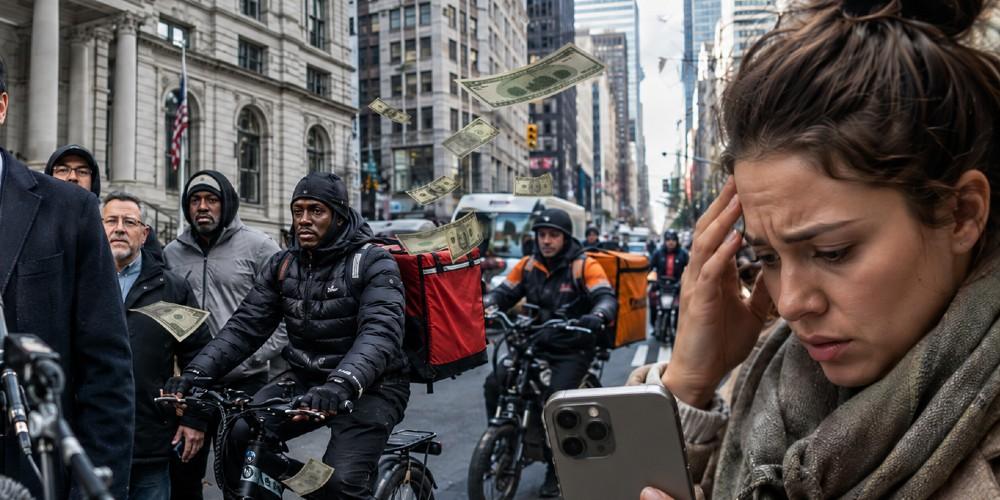
New York City’s socialist mayor just claimed another “victory.” Zohran Mamdani stood before cameras and posted online that his administration had put $104 million back into the pockets of delivery workers. “This is only the beginning,” he declared.
The applause line landed. The details did not.
The changes that forced Uber Eats and DoorDash to make tipping prompts more prominent on their apps came from a city law approved by the New York City Council before Mamdani ever took the oath. Former Mayor Eric Adams neither signed nor vetoed the measure. It became law after the waiting period.
The rules simply took effect in January under the new administration, which then enforced them. Mamdani’s office now insists implementation equals authorship. A law is only as good as its enforcement, a spokesperson told Fox News.
Convenient.
Before the rules kicked in, the city’s own Department of Consumer and Worker Protection reported that the apps had buried tip buttons and set low defaults, driving tips down sharply. Once the mandate required a clear tip option before or at checkout—with a suggested minimum of 10 percent—tips rose.
City officials now estimate an extra $104 million has flowed to workers since late January. Average tips per delivery roughly doubled in the early weeks. Officials project about $2,287 more per year for each of the city’s roughly 70,000 delivery workers.
That money did not come from corporate vaults. It came from customers. New Yorkers already paying elevated delivery fees, service charges, and a minimum pay rate for workers that now sits above $22 an hour are being nudged—hard—to tip more at the exact moment they hit “place order.”
The apps did not magically become generous. The city forced a design change that extracts more from the people ordering the food.
Critics noticed immediately. Actor Michael Rapaport called it out plainly: the City Council passed the bill last year, Adams let it become law, and Mamdani simply took the credit once it was already in effect. Others pointed to the obvious downstream effect.
Higher default expectations and more prominent prompts mean higher total costs for delivery in a city where the cost of living already crushes families. One finance observer noted the double hit: customers now subsidize both the elevated base pay and the boosted tips. Market distortion by another name.
This is the pattern. Mamdani campaigned as a Democratic socialist promising to hold “mega corporations” accountable. In office he has sued delivery platforms, expanded enforcement budgets, and celebrated every regulatory win as proof that City Hall now puts workers first.
Fair enough—delivery work is hard, and many of the people doing it are immigrants grinding through traffic and weather. But government does not create value by rewriting app screens. It transfers costs. The same New Yorkers who already face high rents, high taxes, and high grocery prices now face more expensive takeout and grocery delivery because the mayor prefers the optics of “putting money back” to the harder work of reducing the regulatory burden that drives prices up in the first place.
Scripture has something to say about the impulse to claim credit that does not belong to you. “Let nothing be done through strife or vainglory; but in lowliness of mind let each esteem other better than themselves” (Philippians 2:3).
Taking a pre-existing statute, enforcing it, and then presenting the resulting tip dollars as a personal triumph is the opposite of lowliness. It is the familiar political move of expanding government power while shifting the bill to citizens who have no real choice if they want dinner delivered.
“This is only the beginning,” Mamdani promised. That should not comfort anyone who still believes free people and free markets, guided by honest labor and voluntary exchange, produce better outcomes than mandates written in City Hall.
Delivery workers deserve fair pay. New Yorkers deserve a city that does not treat every transaction as another opportunity for politicians to pose as saviors while the bill lands on ordinary households. The tip button may be more visible now. The real cost of socialist governance remains harder to hide.