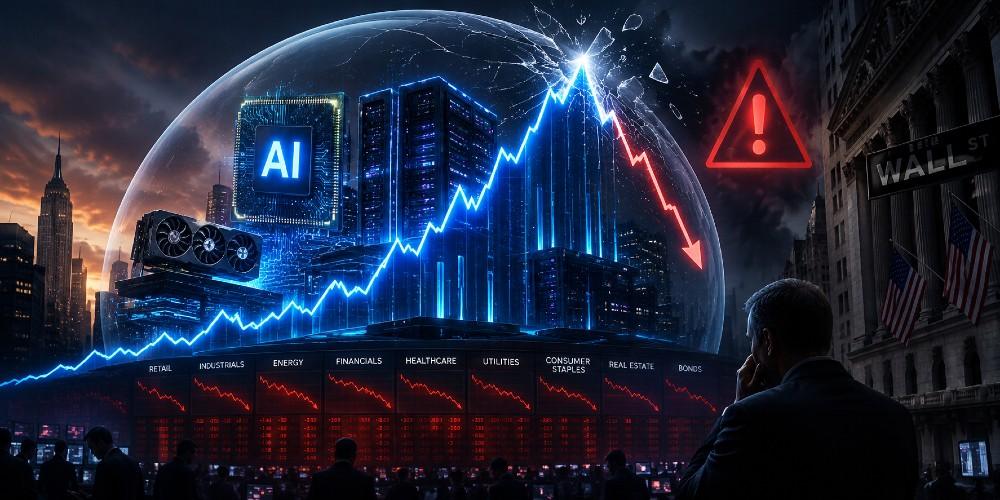
The S&P 500 notched another record close at the end of May, yet beneath the surface, something troubling unfolded. Only 20 stocks in the index reached new highs — a striking parallel to the final days of the dot-com bubble in March 2000, when precisely the same number of names carried the market to its unsustainable summit.
This is not broad-based prosperity rooted in sound economic fundamentals. It is concentrated speculation, fueled by artificial intelligence hype and enabled by years of loose monetary policy. While the technology delivering these gains may prove transformative, the market behavior surrounding it carries the familiar scent of excess that has preceded every major correction in modern financial history.
Bank of America strategist Michael Hartnett highlighted the parallel, noting that the speculative price action likely has further to run before central bank tightening and rising rates deliver the inevitable reckoning. Semiconductors and AI-related plays — Micron, AMD, and their peers — posted staggering monthly gains, propelling the Nasdaq to its strongest two-month stretch in decades.
Yet the broader market internals tell a different story: lagging advance-decline lines, a shrinking percentage of stocks above their 200-day moving averages, and concentrated leadership that leaves most companies behind.
History’s Lessons on Concentrated Manias
The dot-com era promised a new economy where traditional metrics no longer applied. Companies with no earnings and questionable business models commanded trillion-dollar imaginations. When reality reasserted itself, the Nasdaq shed nearly 80 percent of its value. Millions of Americans saw retirement savings evaporate, and the broader economy felt the aftershocks.
Today’s situation differs in important respects — many leading AI firms generate substantial revenue and possess genuine technological moats. Yet the valuation extremes and market concentration exceed even 2000 levels in several measures. The Buffett Indicator, which compares total stock market capitalization to GDP, now sits well above its dot-com peak. Shiller CAPE ratios and other metrics paint a picture of historic overvaluation.
What makes this particularly concerning is the role of policy. For years, the Federal Reserve’s suppression of interest rates and expansion of the money supply distorted capital allocation. Resources flowed not to the most productive uses but to the most narrative-driven ones. Government spending, regulatory favoritism toward Big Tech, and a cultural obsession with disruption over durability have amplified the distortion.
This narrow rally benefits those already closest to the financial spigot while leaving Main Street exposed. Small businesses and everyday workers do not own concentrated portfolios of AI megacaps. When the inevitable broadening or reversal comes, the pain will not remain confined to Silicon Valley trading desks.
The Perils of Forgetting Prudence
Conservatives have long warned that markets work best when grounded in reality rather than narrative. The Constitution grants Congress power over money and commerce with the expectation of stable, honest systems — not engineered booms that transfer wealth upward before collapsing. The left’s embrace of endless stimulus and “Build Back Better” experiments has only encouraged the very speculation they later decry when consequences arrive.
Questions abound: How much of the AI infrastructure buildout depends on subsidized energy policies and regulatory capture? What happens when the marginal returns on massive data center investments diminish? Will Washington respond with more intervention, further entangling the state with private markets?
The pattern repeats because human nature does. Greed, fear, and the desire for effortless wealth drive manias across generations. Whether tulips in 17th-century Holland, railroads, or internet stocks, the story ends the same way: those who built on solid rock endure, while those chasing wind suffer loss.
“And the rain descended, and the floods came, and the winds blew, and beat upon that house; and it fell not: for it was founded upon a rock.” Matthew 7:25
Scripture reminds us that true security comes not from market momentum but from foundations laid in wisdom and righteousness. In financial matters, this means rejecting the idolatry of endless growth without regard for risk or stewardship.
Preparing with Eyes Wide Open
Investors and families would do well to recall the post-dot-com roadmap Hartnett referenced: defensive positioning, long bonds, and sectors that underperformed during the final speculative frenzy. Diversification beyond the Magnificent Few, attention to cash flow and balance sheets, and a healthy skepticism of Wall Street consensus remain timeless principles.
The AI revolution may reshape society in profound ways, much as the internet ultimately did despite the bust. But revolutions in technology do not suspend economic laws or absolve us from the duty of prudence. As the market whispers familiar warnings, wise stewards will listen — not in panic, but in preparation for whatever season lies ahead.