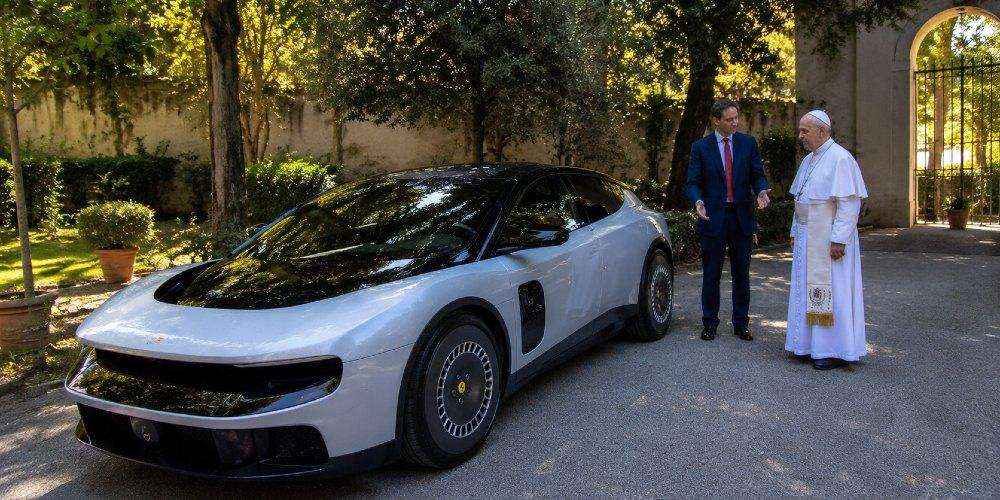
When the pope asks whether your new flagship is a four-door sedan, you may have a branding problem on your hands. That was the scene at Castel Gandolfo this week, where Ferrari president John Elkann presented the company’s first fully electric car to Pope Leo XIV, only for the pontiff to wonder aloud whether he was looking at the first four-door Ferrari ever built.
The question was innocent enough. The reaction from investors, critics, and even Ferrari’s own former chairman was anything but.
Ferrari unveiled the all-electric Luce, Italian for “light,” in Rome to maximum pageantry and minimum enthusiasm. The Italian automaker rolled out its inaugural EV at the same moment that rival luxury brands are quietly retreating from their own electrification commitments, and the market noticed.
Ferrari stock dropped 8.4 percent in Milan trading, while U.S.-listed shares fell 5.3 percent. One auto analyst at Oddo BHF called it the sharpest reaction to a car design he had ever witnessed, summing it up bluntly: the market has spoken.
A Disgrace to the Prancing Horse
The harshest verdict did not come from Wall Street. It came from Luca di Montezemolo, who ran Ferrari for decades until 2014 and watched the brand become a symbol of Italian engineering pride. Speaking to Italian media, the former chairman called the Luce a disgrace to the company’s storied history.
“I hope that they take off the prancing horse from that car,” he told reporters on the sidelines of a business conference in Rome. Ferrari declined to respond.
Montezemolo, it should be noted, joined the board of rival McLaren last year, a company that builds competing sports cars and has wisely focused on hybrid engines rather than betting the brand on a battery. So perhaps his criticism carries a competitive edge. But he was hardly alone.
Italian Deputy Prime Minister and Transport Minister Matteo Salvini piled on as well, panning the car as electric, outrageously expensive at 550,000 euros, and aesthetically self-evident in the worst way. When a sitting cabinet minister and a former chairman both line up to mock your halo product, the design language has failed before a single unit ships.
The Luxury EV Bet Nobody Else Wants to Make
What makes the Luce so revealing is its timing. Ferrari is charging into the electric market precisely as everyone else is charging out of it. The company once promised that 40 percent of its lineup would be fully electric by 2030. It has since cut that target in half, to 20 percent, after pouring billions of euros into a technology its core customers never asked for.
The pullback is industry-wide. Lamborghini CEO Stephan Winkelmann, watching the Luce backlash unfold, told CNBC that his own decision to kill Lamborghini’s all-electric plans in favor of plug-in hybrids was the right way to go. He observed that the acceptance curve for EVs among his type of customer simply was not increasing, so the company moved away from full-electric entirely.
Lamborghini, owned by Volkswagen, joins a long list of global automakers that have quietly abandoned ambitious electrification timelines after losing enormous sums on a product mainstream buyers continue to resist.
The numbers tell the story regulators do not want told. Electric cars hit 20 million in global sales last year, roughly one in four new vehicles, according to the International Energy Agency. That sounds impressive until you remember that much of that adoption was manufactured by government mandate rather than consumer demand.
The European Union now requires a 90 percent reduction in tailpipe emissions by 2035, a target that forces automakers to build cars their customers are not clamoring to buy. Ferrari may be launching the Luce less because the world wants it and more because Brussels insists on it.
Here is the deeper irony. The genius of the free market is that it reveals truth through millions of individual choices that no central planner can override. Strip away the subsidies and the emissions quotas, and the verdict on luxury EVs becomes plain.
Ferrari built its entire mystique on the visceral roar of a combustion engine and a half-century of classic design. Strategists at Morningstar noted that fans believe the EV concept dilutes the supercar brand. When even your most devoted enthusiasts feel betrayed, the problem is not marketing. The problem is that you have severed the thing that made you what you are.
What the Light Cannot Hide
Ferrari executives insist the Luce will give drivers the same sensation as a traditional model, arguing that every engine has its own sound and that what matters is the emotion delivered to the driver. It is a clever bit of spin, but emotion is not engineered in a boardroom. It is earned over generations, and it can be squandered in a single unveiling.
There is something fitting about a car named “light” being met with such darkness from the very people who built the brand. Ferrari was enticed by the promise of regulatory approval and a green halo, drawn away from the very identity that gave it value. The fruit of that enticement is now plain for the world to see.
The Pope sat in the driver’s seat, a Ferrari test driver kneeling beside him to explain the controls. It made for a memorable photograph. But the consumer, less photogenic and far less forgiving, has not yet rendered judgment.
If the early reaction is any guide, Ferrari may discover that no amount of papal blessing can substitute for the one approval that actually matters. The market has spoken once already. It tends to repeat itself.