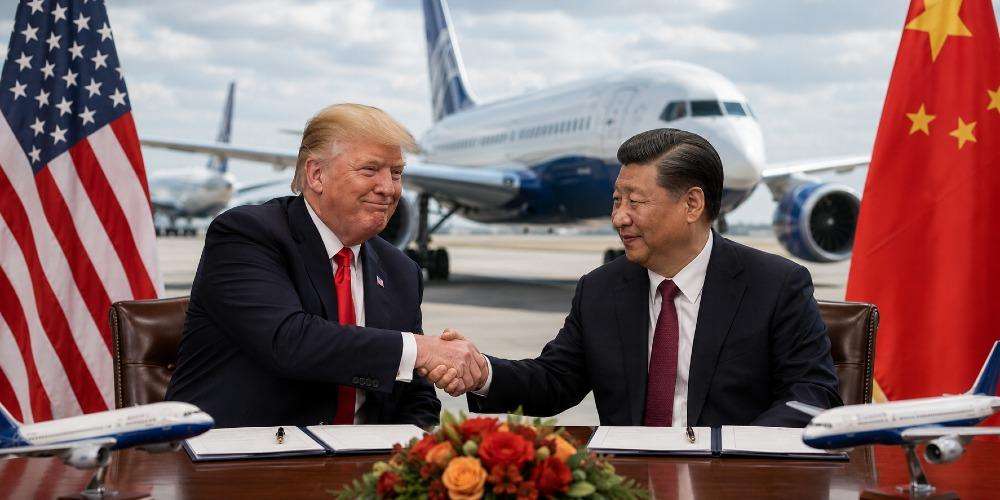
President Donald Trump announced Thursday that China has committed to purchasing 200 Boeing jets, marking the first significant order from the communist nation in nearly ten years. The multibillion-dollar agreement emerged from high-level talks in Beijing, where Trump pressed for fairer economic terms amid ongoing tensions.
This development comes after years of strained relations, including tariffs and retaliatory measures that once saw Beijing instruct its airlines to halt Boeing deliveries. Yet here we are, with Xi Jinping’s government signaling a willingness to buy American—more planes than Boeing itself anticipated. It raises pointed questions about the effectiveness of leverage in international commerce and whether persistent pressure, rather than endless concessions, truly compels adversaries to the table.
Trump, speaking directly after the engagements, made clear the scale of the achievement. “One thing he agreed to today is he’s going to order 200 jets,” the president told Sean Hannity. “That’s a big thing — Boeing. 200 big ones. That’s a lot of jobs. Boeing wanted 150, he got 200.” The tone was one of pragmatic victory, not naive celebration. American workers stand to gain as production lines hum with renewed purpose.
For too long, U.S. policy toward China tolerated massive trade imbalances while American aerospace giants watched Airbus claim larger shares of the Chinese market. This order flips the script. It demonstrates that resolute leadership, backed by economic tools like tariffs, can extract tangible concessions.
China needs reliable commercial aircraft. Boeing delivers quality. The transaction benefits both sides, but only because Washington finally insisted on reciprocity.
Critics on the left may downplay the announcement, noting it fell short of speculative highs floated by analysts. Yet such carping misses the larger picture. A decade without major orders gave way to concrete progress under Trump’s watch. This is not mere symbolism; it translates into thousands of American jobs, strengthened supply chains, and a reminder that economic nationalism need not mean isolation—it means smart engagement rooted in strength.
History offers perspective here. From the days of mercantile competition to modern global supply lines, nations thrive when they defend their industrial base. The Founders understood commerce as a tool of national power, not a surrender of sovereignty. Today’s deal echoes that wisdom, prioritizing domestic manufacturing over utopian free-trade fantasies that enriched Beijing at our expense.
Of course, vigilance remains essential. China’s track record includes intellectual property concerns, forced technology transfers, and strategic ambitions that extend far beyond passenger jets. This purchase does not erase those realities. It merely illustrates that when America leads with clarity and resolve, even hardened competitors recalibrate.
In the realm of providence and human affairs, diligent stewardship of our national blessings—innovation, workforce, enterprise—yields fruit. This Boeing breakthrough reflects such stewardship in action.
The path forward demands continued focus. Tariffs, alliances with like-minded nations, and unapologetic advocacy for American excellence can sustain momentum. Trump’s team, including executives from Boeing, Tesla, and Nvidia at the table, modeled a whole-of-economy approach that puts U.S. interests first without apology.
In an era of complex interdependence, deals like this one affirm a core conservative truth: peace through strength extends to the economic arena. American workers, engineers, and families deserve the dignity of production, not perpetual dependence on foreign goodwill. With this order secured, Boeing and the nation it serves take another step toward renewed industrial leadership.