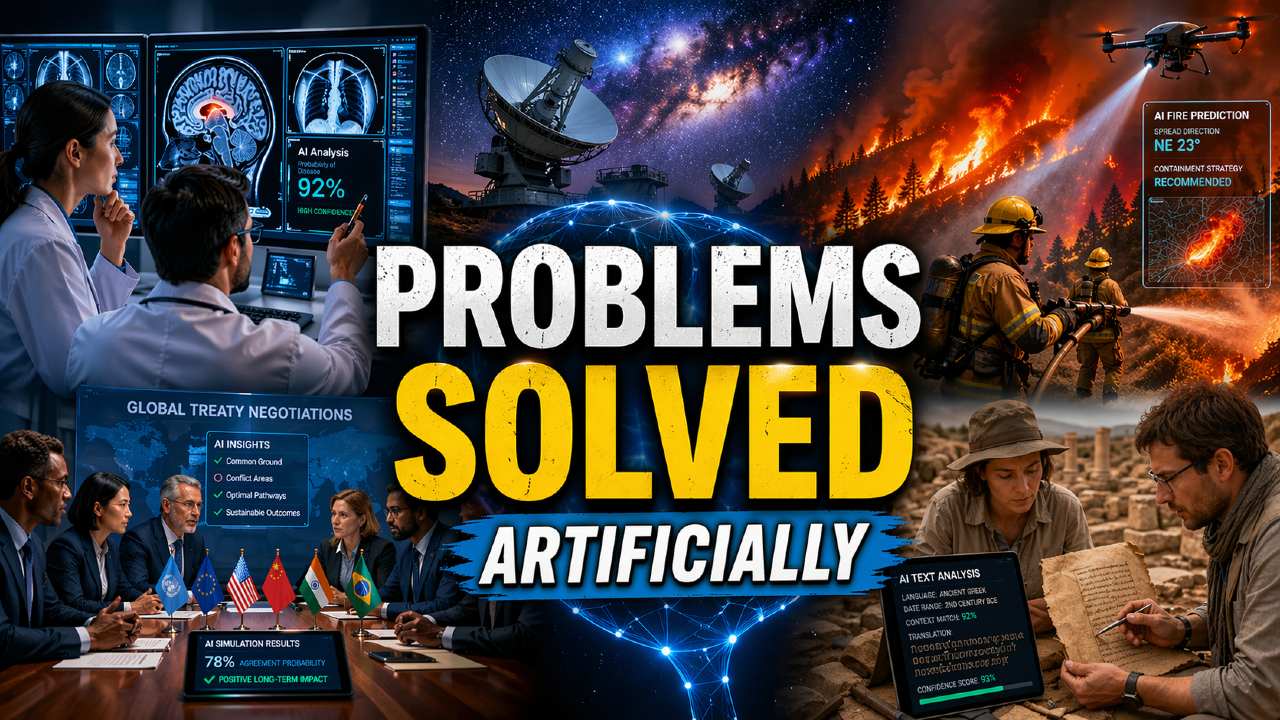
There is something deeply revealing about the way the left has chosen to use artificial intelligence. It has embraced the technology with great enthusiasm for surveilling political dissidents, flagging “misinformation” that contradicts official narratives, scoring social compliance, and automating ideological enforcement across digital platforms. What it has treated with considerably more skepticism — and often outright bureaucratic resistance — are the applications of AI that could actually save lives, end suffering, feed the hungry, and unlock the kind of human flourishing that no government program has ever managed to produce.
This is not a coincidence. A philosophy that requires dependency cannot afford solutions that are too effective. And AI, deployed rightly, is nothing less than an extension of human capacity on a scale that would embarrass every federal agency and international body that has spent decades pretending to solve the same problems with more money and more meetings.
That said, optimism here must be cautious and clearly bounded. AI is a tool — powerful, accelerating, and morally indifferent. It cannot love. It cannot repent. It cannot discern. What it can do, when guided by people who understand both its power and its limits, is accomplish things that human institutions — hobbled by politics, bias, bureaucracy, and sheer cognitive limitation — simply cannot.
The ten problems below are evidence of that. They are not hypothetical. They are either already underway or technically within reach. And every one of them has been chronically underfunded, under-prioritized, or politically obstructed by the very institutions that claim to care most about solving them.
1. Diagnosing the Undiagnosable
There are more than 7,000 known rare diseases. They collectively affect an estimated 300 million people worldwide. And for most of those patients, the diagnostic odyssey often takes five years or more, marked by repeated specialist consultations, misdiagnoses, and unnecessary treatments. The mathematics of rare disease diagnosis are cruel: even the best physician cannot hold 7,000 disease profiles in working memory while simultaneously cross-referencing a patient’s genetic variants, symptom clusters, and published case literature.
AI can. A system called DeepRare — detailed in a landmark paper published in Nature in early 2026 — uses key symptoms to find similar cases and medical papers, analyzes genetic variants, and creates a short list of possible rare diseases. In clinical testing, it outperformed human specialists. The diagnostic delay for many of these diseases is roughly ten to fifteen years, because physicians don’t see them very often. While waiting for diagnosis, the disease can progress and cause irreversible damage. That is a decade and a half of suffering that could, in many cases, be compressed into minutes.
One AI model developed at UCLA’s zebraMD project demonstrated it could identify patients for testing with 89 to 93 percent accuracy, and recognized 71 percent of patients earlier than their actual diagnosis — saving an average of 1.2 years per patient.
This is not a small efficiency gain. For the mother of a five-year-old bouncing between specialists with no answers, a year and a half is everything.
2. Auditing the Unauditable
The federal government is arguably the most fraud-saturated institution in human history. Not because the people running it are uniquely dishonest, but because the sheer scale of spending has long since outpaced any conceivable human auditing capacity. According to the Government Accountability Office, the federal government loses between $233 billion and $521 billion annually to fraud, based on data from 2018 to 2022. That is not a rounding error and it’s likely . That is a catastrophe that has been allowed to persist because no army of auditors could ever manually review the billions of transactions flowing through Medicare, Medicaid, defense procurement, and entitlement programs every year.
AI changes the equation fundamentally. AI tools flag anomalies and identify suspicious billing patterns at greater speed and accuracy, while also enhancing service delivery by processing legitimate claims faster than ever and reducing backlogs. In a recent federal operation aptly named “Gold Rush,” AI tools prevented $4.45 billion in Medicare payments by identifying anomalies in durable medical equipment billing. One case within that same operation involved fraudsters submitting $10.6 billion in false claims using more than one million stolen identities.
The left has been remarkably incurious about applying this level of scrutiny to government spending. The reason is not a mystery. Fraud detection on this scale would expose not just criminal actors but the structural dysfunction of programs progressives treat as sacred. AI does not care about the politics of who is caught.
3. Seeing Fire Before Anyone Else Does
Every major wildfire catastrophe of the past decade has shared a common thread: the fire was small once. The difference between a brush fire and a catastrophe is almost always time — specifically, the minutes and hours between ignition and first response. Human spotters, ground crews, and conventional satellite imagery have never been able to close that gap reliably. The resolution was too low, the revisit times too infrequent, and the coverage too fragmented.
Now consider Google’s FireSat. FireSat is a constellation of satellites dedicated entirely to detecting and tracking wildfires. When the full constellation is operational, it will provide global high-resolution imagery updated every 20 minutes, enabling the detection of wildfires roughly the size of a classroom. FireSat uses AI to compare the current image with the prior thousand images of the same spot, takes local weather and other factors into account, and then reliably determines if a fire is present in the image.
The real-world results are already measurable. During a recent Oklahoma wildfire outbreak, state officials said GOES satellites provided initial detection on 19 separate fires. Of those, preliminary analysis of fire spread modeling found that rapid firefighter response likely saved more than $850 million worth of structures and property — 250 times greater than the cost of developing the detection system. This is what genuine problem-solving looks like: a return on investment so stark it renders the old approach indefensible. Every wildfire death after this technology reaches full deployment is, in a real sense, a policy failure.
4. Recovering What Time Has Buried
It is estimated that humanity has lost more than 75 percent of all languages ever spoken. Entire civilizations — their prayers, their commerce, their arguments with God — have vanished behind scripts no living person can read. Ancient scrolls scorched by the eruption of Vesuvius. Clay tablets from Mesopotamia stacked in museum basements. Biblical manuscripts fragmentary enough to frustrate the most devoted scholar. For generations, the bottleneck was identical: not enough experts, not enough time, not enough computational power to process the patterns buried in thousands of years of deteriorating text.
AI is tearing through that bottleneck. South Korean authorities employed a small team of translators to decipher hundreds of thousands of articles written in Hanja, a historical written system based on Chinese characters. The translation was expected to take decades, but AI translations completed in a matter of months uncovered an unprecedented array of historical documents — from state visits to music concerts. In the volcanic ashes of Pompeii, CT scans combined with AI decipherment are recovering text from burned scrolls that were thought permanently destroyed. The Dead Sea Scrolls, already among the most studied documents in history, are yielding new secrets.
For Christian scholars and archaeologists, the implications are profound. These are not merely antiquarian curiosities. They are windows into the world of the early church, the ancient Near East, and the textual transmission of Scripture itself. Once a writing system is finally deciphered, a new world opens. Before that, we knew a civilization that used a script we weren’t able to read only through its material culture. After we’re able to read their writings, a whole new treasure trove of information becomes readily available — we discover ancient peoples through their own words, by reading the documents they left behind. AI is giving historians the closest thing to a time machine the modern world has ever produced.
5. Feeding the World Without a Summit
Every decade produces a new international conference on global hunger. Every decade, the conference ends with pledges, photographs, and carefully worded communiqués. And every decade, hundreds of millions of people remain malnourished not because the Earth cannot produce enough food, but because human agricultural systems are staggeringly inefficient — the wrong crops in the wrong soil at the wrong time of year, managed by farmers who could take advantage of real-time access to soil analysis, weather modeling, pest detection, and yield optimization data.
AI-driven precision agriculture is attacking every one of those failures simultaneously. Modern systems use satellite imagery, soil sensors, drone surveillance, and machine learning algorithms to tell farmers exactly what to plant, when to plant it, how much water to use, and where disease or pest pressure is developing before it damages a crop. Multiple AI agents can be assigned specific tasks — monitoring soil moisture, detecting pests, analyzing weather patterns, managing irrigation — operating independently but sharing information in real time, allowing for quick and informed decisions. When a pest detection agent identifies an early infestation, it can alert nutrient and irrigation agents, preventing crop stress and reducing chemical utilization.
The productivity projections are not modest. By 2050, there will be an estimated 9.6 billion people on the planet, and climate change is making food production even more stressful globally. Conventional political approaches to that reality involve wealth redistribution and centralized food policy. AI-driven agriculture offers a different path: produce dramatically more food with fewer resources, in more places, regardless of what any government decides to do about it. The first solution requires power. The second simply requires letting the technology work.
6. Negotiating Without Ego
The history of failed international negotiations is also, in large part, a history of human vanity. Diplomats who cannot afford to be seen conceding. Leaders for whom compromise means political weakness at home. Cultural assumptions so deeply embedded they prevent both sides from recognizing a mutually beneficial outcome when it is sitting directly in front of them. The Cuban Missile Crisis was resolved in part because two men — Kennedy and Khrushchev — had enough private back-channel communication to step back from catastrophe. But most diplomatic crises do not have that luxury. And most treaties are laden with language that satisfies lawyers and offends everyone else.
AI brings something to the negotiating table that no human diplomat can: it has no career to protect. During a 2025 gathering at the UNFCCC campus, climate negotiators from nine African nations used AI platforms to sift through more than 100,000 pages of documents, pinpointing shared interests and aligning their talking points — a task that would have been overwhelming without that kind of computational backup.
At the Center for Strategic and International Studies, researchers built a program called “Strategic Headwinds” designed to help shape negotiations for the Ukraine conflict. Researchers trained an AI model on hundreds of peace treaties and open-source news articles detailing each side’s negotiating stance. The model then uses that information to find areas of agreement that could show a path toward a ceasefire.
None of this removes the human element from diplomacy — nor should it. But a tool that can map a hundred thousand pages of treaty history, model the downstream consequences of every proposed clause, and identify win-win language that both parties’ pride would prevent them from proposing themselves is not a luxury. In a world with active wars on multiple continents, it is a moral obligation to at least try it.
7. Watching the Sky
In December 2024, an asteroid designated 2024 YR4 was detected by the NASA-funded Asteroid Terrestrial-impact Last Alert System in Chile. Within weeks, it had been flagged as carrying the highest recorded impact probability ever assigned to an object of its size — briefly exceeding three percent for a potential Earth strike in 2032. For context: three percent sounds small until you consider that the object in question was estimated to be between 174 and 220 feet across, large enough to collapse residential structures across a city if it detonated over a populated area.
As the planetary defense community collected more observations, the range of possibilities for the asteroid’s future position on December 22, 2032 clustered over Earth, raising the apparent chances of collision. However, with the addition of even more data points, the cluster of possibilities eventually moved off Earth. The entire process — detection, analysis, risk assessment, and resolution — unfolded over a matter of weeks, driven by AI-augmented tracking systems processing enormous volumes of observational data in near real time. No human team, working manually, could have processed that volume of data with the necessary precision and speed.
NASA’s next-generation NEO Surveyor telescope is being designed specifically to accelerate the search for potentially hazardous asteroids and comets. By continuously monitoring the night sky and cross-referencing new observations with historical data, AI can alert astronomers to potentially hazardous objects well in advance. This is one area where the existential stakes — quite literally, planetary survival — make the argument for AI-assisted monitoring self-evident. It is also one of the few problems on this list where the window for failure is measured not in policy cycles but in extinction events.
8. Mapping the Mind
The human brain contains roughly 86 billion neurons, connected by an estimated 100 trillion synaptic links. Mapping those connections — understanding which neural circuits govern memory, emotion, behavior, and disease — is the scientific challenge that may ultimately unlock cures for Alzheimer’s disease, PTSD, schizophrenia, addiction, and depression simultaneously. For decades, that mapping project, known as the human connectome, has proceeded at the pace of extraordinary human effort applied to incomprehensible complexity.
AI is changing the pace. Researchers used connectome data and machine learning algorithms to classify combat-related PTSD cases from trauma-exposed controls based on their brain connectivity patterns, highlighting the neural mechanisms underlying the disorder and paving the way for potential diagnostic applications. Four separate research groups within the Human Connectome Project are focused specifically on Alzheimer’s disease and dementia. AI analysis of connectome data is already demonstrating the ability to differentiate between the preclinical and clinical stages of Alzheimer’s disease — meaning the disease could potentially be identified and addressed before it becomes the catastrophe most families experience.
Psalm 139:14 declares, “I will praise thee; for I am fearfully and wonderfully made: marvellous are thy works; and that my soul knoweth right well.” The architecture of the human brain is perhaps the most arresting evidence for that declaration in all of creation. Every advance in understanding it is, in a real sense, an act of reverence toward its Maker — and a mercy extended to the millions who suffer when it breaks.
9. Cracking the Energy Equation
Humanity has been attempting to replicate the power of the sun since the 1950s. Fusion energy — the process of fusing hydrogen atoms to release enormous quantities of clean, virtually limitless power — has been perpetually described as thirty years away. The joke has become a cliché. The reason for the repeated failure is not lack of effort or investment. It is the raw physics of the problem: sustaining a plasma hotter than the core of the sun inside a magnetic containment vessel requires making millions of micro-adjustments per second across dozens of interdependent variables. No human team can do that. No conventional computer program can do it fast enough.
AI can. Google DeepMind has shown that deep reinforcement learning can control the magnets of a tokamak to stabilize complex plasma shapes. Princeton’s Plasma Physics Laboratory recently awarded its highest research prize to a team whose AI system optimized 3D magnetic fields in tokamaks to control edge instabilities while minimizing disruptions and improving confinement. Their lab director stated plainly that the next step — a fully automated 3D field optimization system — is too complicated for conventional approaches, so a form of AI known as machine learning will be the key method to make a breakthrough.
If fusion energy reaches commercial viability in the 2030s — as Commonwealth Fusion Systems now projects — it does so in large part because AI solved the stabilization problem that eluded human engineers for seven decades. The geopolitical implications alone are staggering: a world no longer dependent on Middle Eastern oil, Russian natural gas, or conflict-zone rare earth minerals is a fundamentally different world than the one we inhabit now.
10. Lost in Translation No More
In American hospitals, a patient who cannot speak English is statistically more likely to be misdiagnosed, more likely to be readmitted, and more likely to suffer an adverse outcome than an English-speaking patient with the same condition. In courtrooms, language barriers have contributed to wrongful convictions and unjust sentences. The human cost of this failure is not abstract. It is a misunderstood consent form signed under pressure. It is a symptom misreported because the interpreter — often a family member, often a child — did not know the medical terminology. It is a plea agreement signed without genuine comprehension of its terms.
A 2025 study in JAMA Pediatrics evaluated the ability of GPT-4o to translate pediatric patient instructions into Spanish. The results were striking: the AI translations were not merely comparable to those of professional human translators but were often preferred by expert evaluators for their fluency and clarity, containing significantly fewer mistranslation errors than the human reference standard. The American Medical Association’s 2024 Physician AI Sentiment Report found that translation services now rank as the most familiar AI use case among physicians, with 57 percent of respondents already using or planning to adopt these tools.
The implications extend well beyond Spanish. The world contains roughly 7,000 living languages. Professional medical interpreters exist for perhaps a few dozen of them at meaningful scale. AI translation, as it matures, collapses that gap — not perfectly, not immediately, but at a speed and coverage that no credentialing program or workforce investment could ever match. This is not a replacement for human compassion in medicine. It is the removal of a wall that has stood between the vulnerable and the care they deserve.
The Stewardship Warning
Everything above is genuinely exciting. It is also the setup for the most important argument in this piece.
There is a version of the AI future that looks like salvation — and functions like a trap. It is the version in which these tools work so well, so consistently, and so effortlessly that civilization gradually offloads not just its difficult problems but its problem-solving capacity itself. The version in which doctors stop learning diagnostic reasoning because an AI can do it faster. In which diplomats stop developing cultural intuition because an algorithm has modeled the outcomes. In which farmers stop reading the land because a satellite will tell them what it says.
A civilization that cannot function without its machines is not an advanced civilization. It is a fragile one. And fragile civilizations fall — not always with warning, not always slowly, and not always with enough intact human capacity to rebuild.
Genesis 2:15 assigns the first human task with striking precision: “And the LORD God took the man, and put him into the garden of Eden to dress it and to keep it.” The words “dress” and “keep” in the Hebrew original carry the weight of active cultivation and vigilant guardianship. Stewardship, in the biblical sense, is never passive. It is not the act of delegating creation to a system and walking away. It requires engagement, judgment, accountability, and the kind of wisdom that only grows through practice — including the practice of solving hard problems by hand.
The Tower of Babel is worth revisiting here — not as a fable about ambition, but as a serious theological warning about what happens when human systems, sufficiently advanced, begin to function as a substitute for dependence on God. The problem at Babel was not that the people were building something impressive. It was that their technology had become the basis of their unity, their identity, and their confidence. When that structure collapsed, they had nothing left to hold them together. The lesson is not “build nothing.” It is “know what you are building on.”
AI, deployed rightly, is one of the most powerful expressions of the dominion mandate in human history — an extension of the mind God gave us, applied to problems that would otherwise overwhelm us. But the moment it becomes the solution to every problem, the answer to every question, and the replacement for every form of human engagement with difficulty, something essential will have been quietly traded away. The name for a people who have outsourced their judgment is not “advanced.” It is “dependent.” And dependent peoples are, historically, not free ones.
A Tool, Not a God
None of the ten applications above require us to worship the machine. They require us to use it — wisely, deliberately, and with the full awareness that the moral agency governing its use belongs to human beings made in the image of a God who commanded them to think, to choose, and to bear responsibility for the consequences of both.
The left’s selective deployment of AI — enthusiastic where it controls, suspicious where it liberates — is a preview of what happens when a technology this powerful is governed by ideology rather than wisdom. The answer is not to cede that ground. It is to seize the conversation, make the affirmative case for AI’s most redemptive applications, and insist simultaneously that the humans operating these tools remain capable, morally accountable, and irreplaceable.
The same God who placed 86 billion neurons inside the human skull also placed within us the curiosity to map them, the ingenuity to build the tools that could, and the moral gravity to understand why those tools must never be mistaken for their Maker. That is not a contradiction. That is stewardship — cautious, grateful, and wide awake.