There is a particular kind of blindness that afflicts prosperous societies — the conviction that the machinery of modern life will simply continue to run regardless of what happens to the fuel that powers it. Americans are exhibiting that blindness right now, in real time, as one of the gravest supply crises in modern history quietly takes shape on the other side of the world. The Strait of Hormuz — a narrow sliver of water between Iran and Oman, roughly as wide as Florida is long — has effectively closed to commercial shipping. And the consequences are already cascading outward in ways that most of the public has yet to reckon with.
In South Korea, residents are panic-buying trash bags. Not gasoline, not food — trash bags. The reason is simple, and deeply instructive: virtually everything we consume, package, or dispose of in the modern world is downstream of petroleum. When oil and its derivatives stop flowing, it is not merely fuel gauges that drop. It is the plastic on the shelf at the grocery store, the packaging around your medication, the vacuum seal on your rice, the tubing in a dialysis machine. CNN — not exactly a publication given to catastrophism on behalf of conservative economic concerns — is warning of a “shortage of nearly everything.”
That is not fearmongering. It is supply chain arithmetic. President Trump and (hopefully) our allies must do whatever is necessary to open up the Strait of Hormuz as quickly as possible. Every day of uncertainty that passes is a step further from recovery.
The Strait That Runs the World
To understand what is unfolding, one must first appreciate just how much of the global economy flows through twenty-one miles of Persian Gulf water. The International Energy Agency — albeit an alarmist organization — has described the effective closure of the Strait of Hormuz as the “largest supply disruption in the history of the global oil market.”
Roughly twenty percent of the world’s daily oil supply, along with significant volumes of liquefied natural gas, normally passes through that corridor. China receives approximately a third of its oil through it. Europe draws twelve to fourteen percent of its LNG from Qatar via the strait. The Gulf region accounts for somewhere between thirty and thirty-five percent of global urea exports — the nitrogen fertilizer that grows the food the world eats.
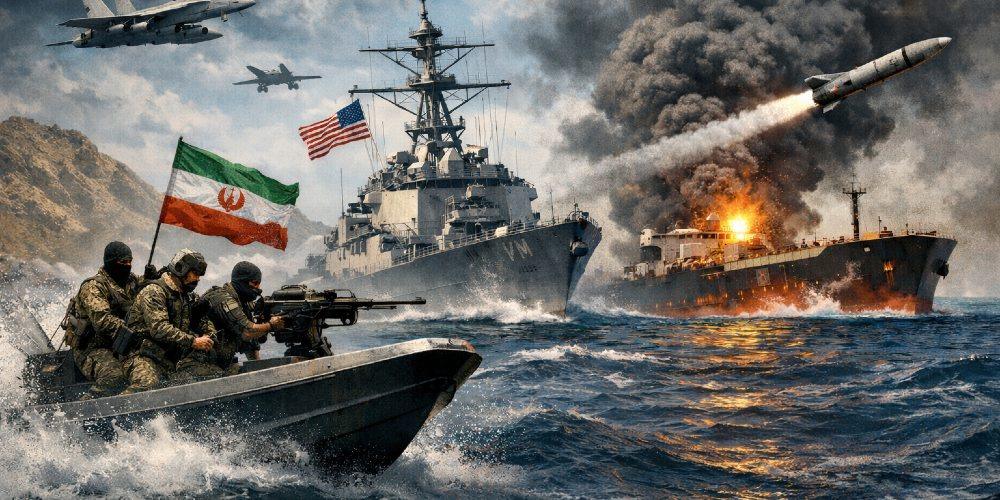
Since the United States and Israel launched coordinated strikes on Iran on February 28, 2026, tanker traffic through the strait has collapsed to near zero. The Islamic Revolutionary Guard Corps has declared the waterway closed to vessels traveling to and from the United States, Israel, and their allies — and has gone further still, announcing that traffic through the strait “will never return to its former state, especially for America and Israel.”
The IRGC, which controls Iran’s military posture in this conflict, has made demands the United States and Israel cannot possibly accept — including effective Iranian sovereignty over Persian Gulf shipping. There is no near-term diplomatic exit from this impasse unless miraculously Iran agrees to America’s ceasefire terms. The war will continue. And the shortages will deepen.
What $5.61 Diesel Actually Means
Americans accustomed to thinking about gas prices in terms of personal budgeting are about to receive an education in second and third-order consequences. The national average for diesel fuel has risen to $5.61 per gallon — nearly fifty percent above where it stood when the war began. In California, diesel has reached $7.67 per gallon, more than doubling in the space of a month. These are not numbers that merely sting at the truck stop. They are multipliers that run through the entire economy.
Diesel powers the trucks that move goods from ports to distribution centers. It powers the farm machinery that plants and harvests the crops Americans eat. It powers the ships that deliver everything from electronics to clothing to the raw materials that American manufacturers depend upon. A Kansas farmer named Curt Hoobler put it plainly to CNN: “Now’s when we need it the most.”
He was speaking of planting season — the spring weeks when fuel and fertilizer costs determine what gets planted and, months later, what ends up on the table. Commodity prices for corn, wheat, and soybeans have already begun to climb.
Moody’s Analytics chief economist Mark Zandi — the same analyst who correctly predicted the 2008 financial crisis — has stated bluntly that pre-war energy prices may never return. “Certainly won’t be this year, won’t even be next year,” he said. “Might not be ever.”
Too much energy infrastructure has been disrupted. Too many supply chains have been rerouted or broken. The globe cannot simply snap back to February 2026.
The Cascade Beyond Oil
The instinct is to think of this as an energy crisis — rising prices at the pump, canceled flights, rationing in Asia. But oil is not merely fuel. It is feedstock. It is the raw material from which modern civilization manufactures nearly everything it touches.
Consider what petroleum derivatives actually make possible: the plastic caps on beverage bottles, the adhesives in shoes and furniture, the solvents in paint and cleaning products, the industrial lubricants that keep factory machinery moving, the synthetic rubber in medical gloves, the film that vacuum-seals food. As one supply chain analyst summarized the situation: “This spills into everything very, very quickly: beer, noodles, chips, toys, cosmetics.”
Taiwan has established a government hotline for manufacturers who have run out of plastic. Japanese hospitals are warning that patients dependent on hemodialysis may face shortages of the plastic medical tubing their lives require. Malaysian glove manufacturers report that petroleum byproducts needed for latex production are disappearing from the market.
The fertilizer dimension alone threatens food security well into 2027. The Gulf region produces nearly half of the world’s urea and thirty percent of global ammonia. Both are critical to nitrogen fertilization of crops. Urea prices have already risen fifty percent since the conflict began. The disruption of spring planting season in the United States — the period when fertilizer demand peaks — could reduce corn yields, which in turn affect beef, poultry, and dairy production. Brazil, which supplies sixty percent of global soybean exports, imports nearly half its fertilizer through the Strait of Hormuz. The cascades run long and deep.
The Blindness of Comfortable Expectations
What is most striking about this moment is not the crisis itself — geopolitical shocks of this magnitude have occurred before, most comparably in 1973. What is striking is the degree of public inattention. Oil and gas industry executives meeting at CERAWeek in Houston were blunt about the gap between the market’s apparent confidence and the physical reality on the ground.
“There are very real, physical manifestations of the closure of the Strait of Hormuz that are working their way around the world,” Chevron CEO Mike Wirth told the conference, “that I don’t think are fully priced into the futures curves on oil.”
The ConocoPhillips CEO put it even more starkly: “You just can’t take eight to ten million barrels a day of oil and twenty or so percent of the LNG market off the world stage without having some significant repercussions.”
And yet the comfortable assumption persists — particularly in Washington and in the media ecosystem that shapes public understanding — that this will resolve itself, that the administration will find a diplomatic lever, that markets will self-correct, that the lights will stay on because they always have. This is the kind of assumption that precedes the moments in history when things stop working the way they always have.
Vice President JD Vance has reassured Americans that the price spike is “temporary.” Energy Secretary Chris Wright promises that ideas are in the works to bring additional diesel to the marketplace. The Strategic Petroleum Reserve release of 172 million barrels has been authorized. These are not nothing. But ConocoPhillips CEO Ryan Lance assessed the Biden-era playbook honestly: at the scale of this disruption, the strategic reserves are a bridge, not a solution. “The playbook is pretty bare at this point,” said the American Petroleum Institute’s CEO Mike Sommers.
A Nation That Forgot What Fragility Feels Like
There is a deeper reckoning embedded in this crisis that transcends the immediate politics of the Iran conflict. For decades, American policymakers of both parties — but particularly the progressive wing that has treated energy production as a moral offense — pursued policies that left the United States and its allies strategically dependent on the goodwill of hostile regimes for energy security. The shale revolution of the 2010s provided a partial corrective. American oil production reached historic highs. But the global market integration that liberals celebrated as evidence of cosmopolitan economic wisdom turns out to cut both ways: when a chokepoint closes halfway around the world, prices at the American pump rise regardless of how much domestic oil flows.
The critics of energy independence — those who spent a decade arguing that pipelines were ecological atrocities and that fossil fuel production should be wound down as rapidly as possible — have no answer for what happens to dialysis patients in Japan when the plastic tubing supply collapses. They have no answer for the Kansas farmer who cannot afford to plant this spring. They have no answer for the family in Bangladesh who cannot afford cooking gas, or the South Korean who is panic-buying trash bags because the petrochemical supply chain is unraveling. The green energy transition that was supposed to liberate us from these vulnerabilities is measured in decades; the crisis is measured in weeks.
A civilization that cannot acknowledge its own dependencies cannot protect itself from disruptions to those dependencies.
What Comes Next
Europe’s airports have begun restricting jet fuel access. Lufthansa is preparing to ground up to forty aircraft. Scandinavian Airlines has already cut a thousand flights. Ryanair’s CEO has warned of summer cancellations across Europe if the Strait remains closed. The International Energy Agency projects that the oil lost in April will be twice what was lost in March — a worsening curve, not a stabilizing one.
For Americans, the months ahead will bring grocery price increases that arrive with a lag — the fuel and fertilizer costs incurred in March do not appear at the supermarket until April and May. An economist at RSM estimated that every ten percent rise in diesel adds roughly a tenth of a percent to the consumer price index. Diesel has risen nearly fifty percent. The arithmetic is straightforward, and it is not encouraging.
None of this means the worst-case scenario is inevitable. Military resolution of the strait standoff remains possible. Alternative pipeline routes through Saudi Arabia and the UAE offer partial relief. American energy production is already running near capacity. But the corollary of all those partial remedies is that none of them is sufficient to fully offset what has been lost, and that even optimistic outcomes leave the world at higher prices for a long time to come.
The appropriate response to that reality is not panic, and it is not the political despair that crisis merchants traffic in. It is the honest, clear-eyed assessment that America’s strategic and economic vulnerabilities are real, that the politicians and pundits who denied those vulnerabilities for years have been proven wrong in the most consequential possible way, and that the rebuilding of energy security — domestic production, strategic reserves, supply chain diversification — is not a culture war talking point but a matter of national survival.
South Koreans buying trash bags is not a quirky foreign news story. It is a window into what happens when the invisible infrastructure of modern life is interrupted. Americans would do well to look through it.