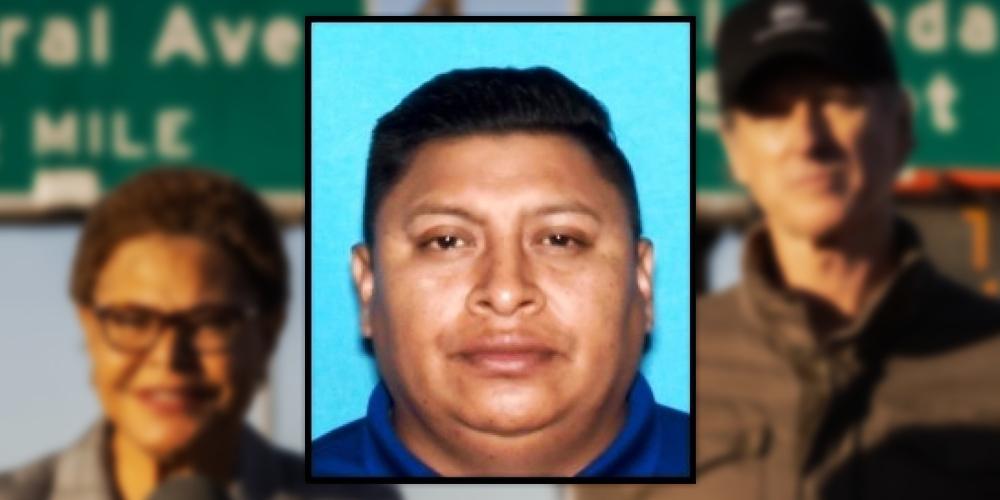
A 52-year-old Guatemalan national living illegally in the Westlake district of Los Angeles pleaded guilty in federal court Friday to running one of the largest human smuggling operations ever prosecuted in the United States — an enterprise that moved approximately 20,000 people across the southern border over more than a decade, left seven people dead on an Oklahoma highway including a 4-year-old child, and kept human beings locked in stash houses until their families paid up or faced death threats.
His name is Eduardo Domingo Renoj-Matul. His alias was “Turko.” And for years, he operated in the open, just blocks from downtown Los Angeles.
Renoj-Matul entered his guilty plea on two federal counts: conspiracy to bring aliens into the United States for financial gain, and hostage-taking. Sentencing is scheduled for October 2, 2026, at which point he faces a statutory maximum of life in federal prison. The plea came roughly thirteen months after his February 2025 arrest, which itself followed years during which his transnational criminal organization moved thousands of Guatemalans through Mexico, across the Arizona border, and into a network of stash houses stretching from Phoenix to Los Angeles.
The scale of the operation is difficult to absorb. According to the U.S. Attorney’s Office for the Central District of California, the Renoj-Matul organization functioned for at least twelve years. Associates in Guatemala recruited migrants and charged between $15,000 and $18,000 per person for transportation to the United States. The immigrants were first handed off to Mexican smuggling networks who moved them through Sonora and into Arizona, where Renoj-Matul’s people collected them and held them in stash houses — at least one of which sat on James M. Wood Boulevard in Westlake — until fees were paid in full. Prosecutors say migrants who could not pay were not simply turned away. They were held hostage.
In April 2024, according to the federal indictment, a payment for one woman already inside the United States was not made on time. Renoj-Matul personally called her mother and told her the woman “would come home in a box” if the smuggling fees were not settled.
Prosecutors also detailed a separate episode in 2024 in which Renoj-Matul and his right-hand man, Cristobal Mejia-Chaj, held two Guatemalan nationals hostage for months in the Westlake neighborhood, threatening to kill them unless third parties paid for their release. These are the acts to which Renoj-Matul has now admitted in open court.
The deadliest chapter of this operation came in November 2023, when a vehicle operated by one of Renoj-Matul’s drivers crashed near Elk City, Oklahoma. The driver, José Paxtor-Oxlaj, was transporting migrants between New York and Los Angeles when the accident occurred. Seven people were killed. Three of them were minors. One was a 4-year-old child.
Paxtor-Oxlaj — a Guatemalan national who had already been deported once, in 2010, before illegally re-entering the country — was subsequently convicted in Oklahoma state court on six counts of first-degree manslaughter and sentenced to four years in state prison. He also faces a separate two-year federal sentence for illegal reentry. A trial on the federal human smuggling charges is scheduled for April 21, 2026 in Los Angeles.
The geographic reach of the operation was staggering. According to the indictment, Renoj-Matul’s organization distributed illegal aliens to at least 20 states and Washington, D.C. The pipeline ran from remote villages in Guatemala to the streets of the American interior, fueled by fees that totaled hundreds of millions of dollars if the 20,000-person figure holds. This was not a side operation run out of desperation. It was a corporation — with a CEO, a chain of command, regional lieutenants, drivers, recruiters, and enforcers. It operated for over a decade in a major American city without being dismantled, even as it killed people and issued death threats against federal law enforcement.
That last point deserves attention. When federal agents executed a search warrant at the residence of one of Renoj-Matul’s lieutenants, Helmer Obispo-Hernandez — known as “Xavi” — Obispo-Hernandez allegedly threatened to cut off the head of a Homeland Security Investigations Task Force officer and members of his family. Federal authorities subsequently filed a criminal complaint against Obispo-Hernandez, but he has since gone underground and is currently considered a fugitive, believed to be back in Guatemala. His trial is pending. The threat against a federal officer was not treated as bluster. It was treated as exactly what it was: a declaration that the organization considered itself above the reach of American law.
Renoj-Matul’s guilty plea arrives against the backdrop of a renewed federal offensive against human smuggling networks. The Trump administration has made the dismantling of transnational criminal organizations a central pillar of its border security agenda, and prosecutions like this one are the tangible result of that shift in enforcement priorities. Acting U.S. Attorney Joseph McNally stated plainly at the time of the original arrests that “these smuggling organizations have no regard for human life and their conduct kills,” adding that the case had “dismantled one of the country’s largest and most dangerous smuggling organizations.”
Los Angeles, meanwhile, has emerged as a documented hub for human trafficking operations of multiple kinds. In February 2026, a massive multi-agency sting called “Operation Reclaim and Rebuild” resulted in 547 arrests across California, including rescues of multiple minors — the youngest of whom was 13 years old.
Los Angeles County District Attorney Nathan Hochman publicly acknowledged that Los Angeles County is “one of the epicenters of human sex trafficking in the entire nation,” calling it “a multi-billion dollar industry that is nothing less than modern slavery.” The fact that Renoj-Matul ran his operation for more than a decade from a Westlake apartment — while also helping to sustain that broader ecosystem — raises real questions about how long such networks can thrive in sanctuary-city environments before federal pressure forces the issue.
The human cost framed inside the legal documents is worth sitting with for a moment. The migrants Renoj-Matul exploited were not abstractions. They were people who paid $15,000 to $18,000 — often money scraped together by entire extended families — in the hope of reaching the United States. Many arrived only to be locked in a stash house, threatened at gunpoint, and told their families would receive them in a box if payment was delayed.
Some of them were crammed into vehicles and driven across the country under conditions that got seven of them killed on a rural highway in Oklahoma. Even Democrats can agree the exploitation of these human beings was not a policy question. It was a crime. And for over a decade, the man responsible for it lived quietly in Los Angeles and went about his business under weak leftist enforcement.
Cristobal Mejia-Chaj, Renoj-Matul’s co-defendant and described right-hand man, remains in custody awaiting the April 21 trial. José Paxtor-Oxlaj, the driver implicated in the Oklahoma deaths, is set to stand trial alongside him. Helmer Obispo-Hernandez remains a fugitive. Federal investigators continue to pursue the full financial picture of the organization, including assets and any additional associates who may have facilitated operations in the 20-plus states where migrants were reportedly distributed.
On October 2, 2026, Eduardo Domingo Renoj-Matul — “Turko” — will stand before a federal judge to be sentenced for his crimes. The maximum the law allows is life in federal prison. Given what he admitted in open court, and what his organization left behind on an Oklahoma highway, it is difficult to argue he deserves anything less.